Cái nào tốt hơn cho làm việc từ xa và chơi game từ xa, Awesun hay DeskIn?

/

/

Updated

Làm việc từ xa và chơi game từ xa đang trở nên phổ biến hơn và các yêu cầu của chúng tôi về phần mềm máy tính để bàn từ xa cũng ngày càng cao hơn. Trong bài viết này, chúng tôi sẽ phân tích các yêu cầu chính đối với phần mềm máy tính để bàn từ xa trong công việc và chơi game từ xa và so sánh hiệu suất của hai phần mềm máy tính để bàn từ xa phổ biến — DeskIn và AweSun. Hãy xem cái nào phù hợp hơn với bạn.


Các nhu cầu trong các tình huống làm việc từ xa

1. Làm việc từ xa—kết nối ổn định và mượt mà

Sử dụng thiết bị di động hoặc laptop di động để truy cập vào các PC hiệu suất cao từ xa để thiết kế, chỉnh sửa công việc là kịch bản sử dụng phổ biến nhất cho phần mềm máy tính để bàn từ xa. Để trải nghiệm công việc giống như đang thực hiện tại chỗ, chúng tôi yêu cầu phần mềm từ xa cung cấp kết nối ổn định, mượt mà và độ trễ thấp.

2. Hợp tác từ xa - chia sẻ tệp, các tính năng hợp tác

Trong quá trình làm việc nhóm từ xa, thường có trường hợp chúng tôi cần hợp tác với các đồng nghiệp. Chẳng hạn, chia sẻ tệp hoặc màn hình trong các cuộc họp từ xa để giao tiếp và phản hồi ngay lập tức, và chỉnh sửa các tệp cùng nhau trong quá trình brainstorming. Do đó, chúng tôi cần phần mềm máy tính để bàn từ xa có thể cung cấp các tính năng hợp tác phong phú và chức năng quản lý màn hình cho phép chúng tôi hợp tác thuận tiện với các thành viên trong nhóm bên kia trái đất.

3. Tương thích đa hệ điều hành — Tương tác chuẩn xác và quản lý thiết bị hiệu quả

Làm việc trên các thiết bị với các hệ điều hành và thương hiệu khác nhau đồng thời không phải là điều hiếm gặp. Chẳng hạn, có một MacBook ở nhà và một PC Windows ở văn phòng. Các công cụ máy tính để bàn từ xa nên hỗ trợ nhiều hệ điều hành, và có thể ánh xạ hoàn hảo việc sử dụng bàn phím, chuột hoặc các thiết bị ngoại vi khác giữa các hệ thống khác nhau để đảm bảo sử dụng trơn tru.

4. Hỗ trợ kỹ thuật từ xa - truy cập nhiều thiết bị cùng lúc


Hỗ trợ kỹ thuật từ xa cũng là một kịch bản sử dụng phổ biến nhất cho các công cụ máy tính để bàn từ xa, đặc biệt là cho các văn phòng phân tán. Các kỹ sư CNTT cần phản hồi nhanh chóng và cung cấp hỗ trợ ngay lập tức cho việc khắc phục sự cố, cài đặt phần mềm hoặc cập nhật hệ thống. Đôi khi, họ thậm chí cần hỗ trợ nhiều người cùng một lúc. Sẽ thật tuyệt nếu phần mềm máy tính để bàn từ xa cho phép giao tiếp thời gian thực giữa 2 bên, để kỹ sư có thể nhanh chóng hiểu vấn đề và giải quyết nó.

So sánh hiệu suất của DeskIn và AweSun cho làm việc từ xa.

Dựa trên nhu cầu của người dùng trong các kịch bản làm việc từ xa: Kết nối ổn định và mượt mà, các chức năng hợp tác từ xa như truyền tệp, hỗ trợ đa nền tảng và giao tiếp nhanh chóng, v.v. Chúng tôi đã phân tích các chức năng và hiệu suất liên quan của DeskIn và AweSun cho làm việc từ xa:
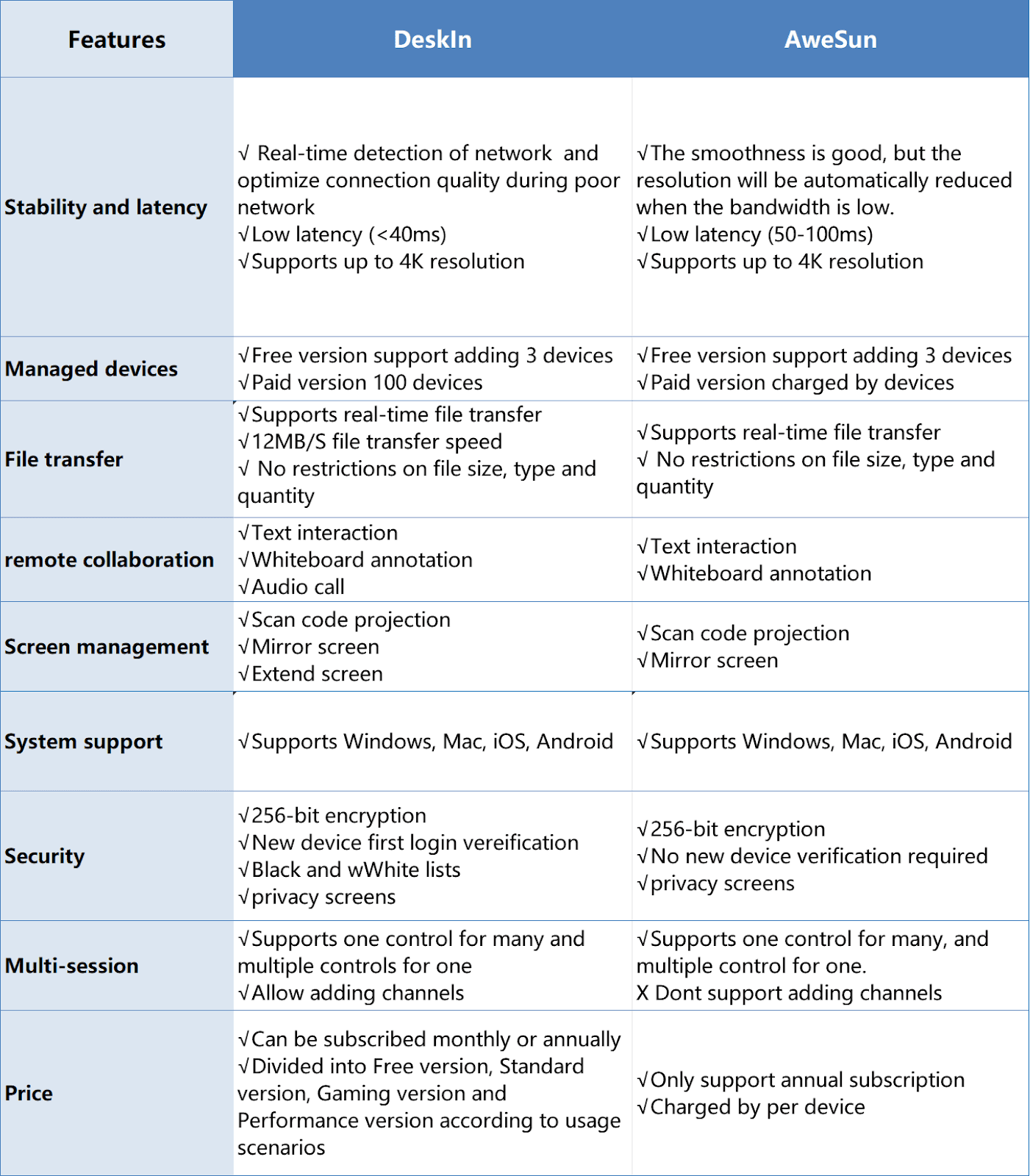
DeskIn nổi bật về độ ổn định, tốc độ truyền tệp và khả năng hợp tác nhiều người, khiến nó đặc biệt phù hợp cho công việc từ xa và teamwork mà yêu cầu hợp tác hiệu quả, trong khi AweSun chỉ phù hợp cho công việc nhẹ hàng ngày


Các nhu cầu trong các tình huống chơi game từ xa

1. Chơi game nặng từ xa — ổn định, mượt mà, không giật lag

Đối với các trò chơi FPS đòi hỏi thao tác chính xác và phản ứng nhanh, một chút độ trễ có thể khiến bạn thua hay thắng. Do đó, các game thủ từ xa mong đợi các công cụ máy tính để bàn từ xa cung cấp kết nối ổn định, tần số khung hình cao, độ trễ thấp và do đó, trải nghiệm chơi game từ xa mượt mà.

2. Chơi game từ xa giữa các hệ điều hành — tương thích hoàn hảo với bàn phím, chuột và tay cầm

Khi kết nối giữa các hệ thống khác nhau, phần mềm máy tính để bàn từ xa phải đảm bảo ánh xạ hoàn hảo giữa bàn phím và chuột cục bộ và từ xa để đảm bảo kiểm soát chính xác các trò chơi từ xa. Nếu nó cho phép sử dụng điều khiển cục bộ để kiểm soát các trò chơi từ xa, nó có thể cải thiện trải nghiệm chơi game từ xa lên một tầm cao mới.

3. Trải nghiệm chơi game sâu sắc---chơi trên màn hình lớn/màn hình đôi

Các game thủ có thể muốn chiếu trò chơi lên màn hình lớn hơn để chơi hoặc có một màn hình đôi có thể phóng to các chi tiết bản đồ góc hoặc mở chat nhóm. Điều này yêu cầu phần mềm máy tính để bàn từ xa cung cấp các chức năng quản lý màn hình tương ứng, có thể giúp người chơi có được trải nghiệm chơi game sâu sắc hơn.

4. Khóa bàn phím và chuột

Một số trò chơi—chủ yếu là các trò chơi Hàn Quốc—hạn chế việc sử dụng bàn phím và chuột của bên thứ ba, chẳng hạn như Blade & Soul, Summoners War, MU Online, v.v., dẫn đến tình trạng bạn không thể điều khiển PC từ xa bằng chuột ảo. Để giải quyết vấn đề này, các công cụ từ xa cần cung cấp bàn phím và chuột ảo, vượt qua những hạn chế này để đảm bảo rằng người chơi có thể điều khiển trò chơi từ xa.

So sánh hiệu suất của DeskIn và AweSun cho chơi game từ xa.

Hiệu suất trò chơi có ảnh hưởng ngày càng tăng đến sự lựa chọn của mọi người về phần mềm máy tính để bàn từ xa. Chất lượng hình ảnh cao, độ trễ thấp và kết nối ổn định là rất quan trọng cho trải nghiệm chơi game. Dưới đây là so sánh hiệu suất của DeskIn và AweSun cho chơi game từ xa:

DeskIn và AweSun đều có hiệu suất tốt và hỗ trợ tính năng cho chơi game từ xa, nhưng họ có các mô hình tính phí khá khác nhau. Nếu bạn có 4 thiết bị trở lên, DeskIn có thể là lựa chọn tiết kiệm chi phí hơn cho bạn.

Tại sao lại chọn DeskIn?

DeskIn kết hợp độ ổn định, hiệu suất và tính linh hoạt để cung cấp trải nghiệm điều khiển từ xa tuyệt vời cho cả nhu cầu làm việc và chơi game từ xa. Dưới đây là những lợi ích chính của DeskIn:

  1. Ổn định và mượt mà: Cung cấp kết nối ổn định và mượt mà, không có giới hạn thời gian kết nối và không bị ngắt.

  2. Độ trễ thấp và chất lượng hình ảnh cao: Độ trễ thấp <40ms, chất lượng hình ảnh lên đến 4K, phù hợp cho chơi game sâu sắc và công việc thiết kế.

  3. Truyền tệp nhanh: Hỗ trợ truyền tệp lớn giữa PC và thiết bị di động với tốc độ cao lên đến 12MB/S, không giới hạn kích thước và định dạng.

  4. Các tính năng hợp tác mạnh mẽ: Hỗ trợ kết nối nhiều phiên mở rộng màn hình, sao chép màn hình và cuộc gọi âm thanh, nâng cao hiệu quả hợp tác nhóm.

  5. Các khả năng đa nền tảng: Tương thích với Windows, macOS, iOS và Android, dễ dàng quản lý tất cả các thiết bị thông minh của bạn.

Kết luận

DeskIn và AweSun đều là phần mềm máy tính để bàn từ xa tuyệt vời, nếu bạn là game thủ, cả DeskIn và AweSun đều có thể cung cấp trải nghiệm chơi game từ xa rất tốt. Nếu bạn chủ yếu sử dụng nó cho công việc và hợp tác từ xa, không nghi ngờ gì nữa DeskIn có thể cung cấp các chức năng phong phú hơn và kết nối ổn định hơn, mang đến cho bạn trải nghiệm làm việc từ xa hiệu quả hơn. Tải xuống ngay và thử ngay hôm nay!

Làm việc từ xa và chơi game từ xa đang trở nên phổ biến hơn và các yêu cầu của chúng tôi về phần mềm máy tính để bàn từ xa cũng ngày càng cao hơn. Trong bài viết này, chúng tôi sẽ phân tích các yêu cầu chính đối với phần mềm máy tính để bàn từ xa trong công việc và chơi game từ xa và so sánh hiệu suất của hai phần mềm máy tính để bàn từ xa phổ biến — DeskIn và AweSun. Hãy xem cái nào phù hợp hơn với bạn.


Các nhu cầu trong các tình huống làm việc từ xa

1. Làm việc từ xa—kết nối ổn định và mượt mà

Sử dụng thiết bị di động hoặc laptop di động để truy cập vào các PC hiệu suất cao từ xa để thiết kế, chỉnh sửa công việc là kịch bản sử dụng phổ biến nhất cho phần mềm máy tính để bàn từ xa. Để trải nghiệm công việc giống như đang thực hiện tại chỗ, chúng tôi yêu cầu phần mềm từ xa cung cấp kết nối ổn định, mượt mà và độ trễ thấp.

2. Hợp tác từ xa - chia sẻ tệp, các tính năng hợp tác

Trong quá trình làm việc nhóm từ xa, thường có trường hợp chúng tôi cần hợp tác với các đồng nghiệp. Chẳng hạn, chia sẻ tệp hoặc màn hình trong các cuộc họp từ xa để giao tiếp và phản hồi ngay lập tức, và chỉnh sửa các tệp cùng nhau trong quá trình brainstorming. Do đó, chúng tôi cần phần mềm máy tính để bàn từ xa có thể cung cấp các tính năng hợp tác phong phú và chức năng quản lý màn hình cho phép chúng tôi hợp tác thuận tiện với các thành viên trong nhóm bên kia trái đất.

3. Tương thích đa hệ điều hành — Tương tác chuẩn xác và quản lý thiết bị hiệu quả

Làm việc trên các thiết bị với các hệ điều hành và thương hiệu khác nhau đồng thời không phải là điều hiếm gặp. Chẳng hạn, có một MacBook ở nhà và một PC Windows ở văn phòng. Các công cụ máy tính để bàn từ xa nên hỗ trợ nhiều hệ điều hành, và có thể ánh xạ hoàn hảo việc sử dụng bàn phím, chuột hoặc các thiết bị ngoại vi khác giữa các hệ thống khác nhau để đảm bảo sử dụng trơn tru.

4. Hỗ trợ kỹ thuật từ xa - truy cập nhiều thiết bị cùng lúc


Hỗ trợ kỹ thuật từ xa cũng là một kịch bản sử dụng phổ biến nhất cho các công cụ máy tính để bàn từ xa, đặc biệt là cho các văn phòng phân tán. Các kỹ sư CNTT cần phản hồi nhanh chóng và cung cấp hỗ trợ ngay lập tức cho việc khắc phục sự cố, cài đặt phần mềm hoặc cập nhật hệ thống. Đôi khi, họ thậm chí cần hỗ trợ nhiều người cùng một lúc. Sẽ thật tuyệt nếu phần mềm máy tính để bàn từ xa cho phép giao tiếp thời gian thực giữa 2 bên, để kỹ sư có thể nhanh chóng hiểu vấn đề và giải quyết nó.

So sánh hiệu suất của DeskIn và AweSun cho làm việc từ xa.

Dựa trên nhu cầu của người dùng trong các kịch bản làm việc từ xa: Kết nối ổn định và mượt mà, các chức năng hợp tác từ xa như truyền tệp, hỗ trợ đa nền tảng và giao tiếp nhanh chóng, v.v. Chúng tôi đã phân tích các chức năng và hiệu suất liên quan của DeskIn và AweSun cho làm việc từ xa:

DeskIn nổi bật về độ ổn định, tốc độ truyền tệp và khả năng hợp tác nhiều người, khiến nó đặc biệt phù hợp cho công việc từ xa và teamwork mà yêu cầu hợp tác hiệu quả, trong khi AweSun chỉ phù hợp cho công việc nhẹ hàng ngày


Các nhu cầu trong các tình huống chơi game từ xa

1. Chơi game nặng từ xa — ổn định, mượt mà, không giật lag

Đối với các trò chơi FPS đòi hỏi thao tác chính xác và phản ứng nhanh, một chút độ trễ có thể khiến bạn thua hay thắng. Do đó, các game thủ từ xa mong đợi các công cụ máy tính để bàn từ xa cung cấp kết nối ổn định, tần số khung hình cao, độ trễ thấp và do đó, trải nghiệm chơi game từ xa mượt mà.

2. Chơi game từ xa giữa các hệ điều hành — tương thích hoàn hảo với bàn phím, chuột và tay cầm

Khi kết nối giữa các hệ thống khác nhau, phần mềm máy tính để bàn từ xa phải đảm bảo ánh xạ hoàn hảo giữa bàn phím và chuột cục bộ và từ xa để đảm bảo kiểm soát chính xác các trò chơi từ xa. Nếu nó cho phép sử dụng điều khiển cục bộ để kiểm soát các trò chơi từ xa, nó có thể cải thiện trải nghiệm chơi game từ xa lên một tầm cao mới.

3. Trải nghiệm chơi game sâu sắc---chơi trên màn hình lớn/màn hình đôi

Các game thủ có thể muốn chiếu trò chơi lên màn hình lớn hơn để chơi hoặc có một màn hình đôi có thể phóng to các chi tiết bản đồ góc hoặc mở chat nhóm. Điều này yêu cầu phần mềm máy tính để bàn từ xa cung cấp các chức năng quản lý màn hình tương ứng, có thể giúp người chơi có được trải nghiệm chơi game sâu sắc hơn.

4. Khóa bàn phím và chuột

Một số trò chơi—chủ yếu là các trò chơi Hàn Quốc—hạn chế việc sử dụng bàn phím và chuột của bên thứ ba, chẳng hạn như Blade & Soul, Summoners War, MU Online, v.v., dẫn đến tình trạng bạn không thể điều khiển PC từ xa bằng chuột ảo. Để giải quyết vấn đề này, các công cụ từ xa cần cung cấp bàn phím và chuột ảo, vượt qua những hạn chế này để đảm bảo rằng người chơi có thể điều khiển trò chơi từ xa.

So sánh hiệu suất của DeskIn và AweSun cho chơi game từ xa.

Hiệu suất trò chơi có ảnh hưởng ngày càng tăng đến sự lựa chọn của mọi người về phần mềm máy tính để bàn từ xa. Chất lượng hình ảnh cao, độ trễ thấp và kết nối ổn định là rất quan trọng cho trải nghiệm chơi game. Dưới đây là so sánh hiệu suất của DeskIn và AweSun cho chơi game từ xa:

DeskIn và AweSun đều có hiệu suất tốt và hỗ trợ tính năng cho chơi game từ xa, nhưng họ có các mô hình tính phí khá khác nhau. Nếu bạn có 4 thiết bị trở lên, DeskIn có thể là lựa chọn tiết kiệm chi phí hơn cho bạn.

Tại sao lại chọn DeskIn?

DeskIn kết hợp độ ổn định, hiệu suất và tính linh hoạt để cung cấp trải nghiệm điều khiển từ xa tuyệt vời cho cả nhu cầu làm việc và chơi game từ xa. Dưới đây là những lợi ích chính của DeskIn:

  1. Ổn định và mượt mà: Cung cấp kết nối ổn định và mượt mà, không có giới hạn thời gian kết nối và không bị ngắt.

  2. Độ trễ thấp và chất lượng hình ảnh cao: Độ trễ thấp <40ms, chất lượng hình ảnh lên đến 4K, phù hợp cho chơi game sâu sắc và công việc thiết kế.

  3. Truyền tệp nhanh: Hỗ trợ truyền tệp lớn giữa PC và thiết bị di động với tốc độ cao lên đến 12MB/S, không giới hạn kích thước và định dạng.

  4. Các tính năng hợp tác mạnh mẽ: Hỗ trợ kết nối nhiều phiên mở rộng màn hình, sao chép màn hình và cuộc gọi âm thanh, nâng cao hiệu quả hợp tác nhóm.

  5. Các khả năng đa nền tảng: Tương thích với Windows, macOS, iOS và Android, dễ dàng quản lý tất cả các thiết bị thông minh của bạn.

Kết luận

DeskIn và AweSun đều là phần mềm máy tính để bàn từ xa tuyệt vời, nếu bạn là game thủ, cả DeskIn và AweSun đều có thể cung cấp trải nghiệm chơi game từ xa rất tốt. Nếu bạn chủ yếu sử dụng nó cho công việc và hợp tác từ xa, không nghi ngờ gì nữa DeskIn có thể cung cấp các chức năng phong phú hơn và kết nối ổn định hơn, mang đến cho bạn trải nghiệm làm việc từ xa hiệu quả hơn. Tải xuống ngay và thử ngay hôm nay!

new year promo
deskin promo
deskin promo
deskin promo
Chrome Remote Desktop and setup guide

Table of Contents

deskin promo

What’s next?

Chrome Remote Desktop and setup guide

How to Set Up & Use Chrome Remote Desktop: Complete Beginner's Guide | DeskIn Japan

How to Set Up and Use Chrome Remote Desktop in Japan: A Complete Beginner's Guide to CRD

What You'll Learn in This Article

This article walks through the basic setup and features of Chrome Remote Desktop (CRD), Google's free remote access tool — explained clearly for first-time users.

CRD is free, simple to configure, and integrates smoothly with your existing Google account and Chrome browser. It works across Windows, Mac, and smartphones, making it easy to get started with remote access from virtually any device.

For everyday personal use and one-off remote support sessions, it's an excellent option — though its features are limited to "Remote Access" and "Remote Support." For more advanced requirements — 4K display quality, low latency, or stable connections inside Japanese corporate networks — a professional-grade tool like DeskIn is worth considering.


Introduction

What Is Chrome Remote Desktop?

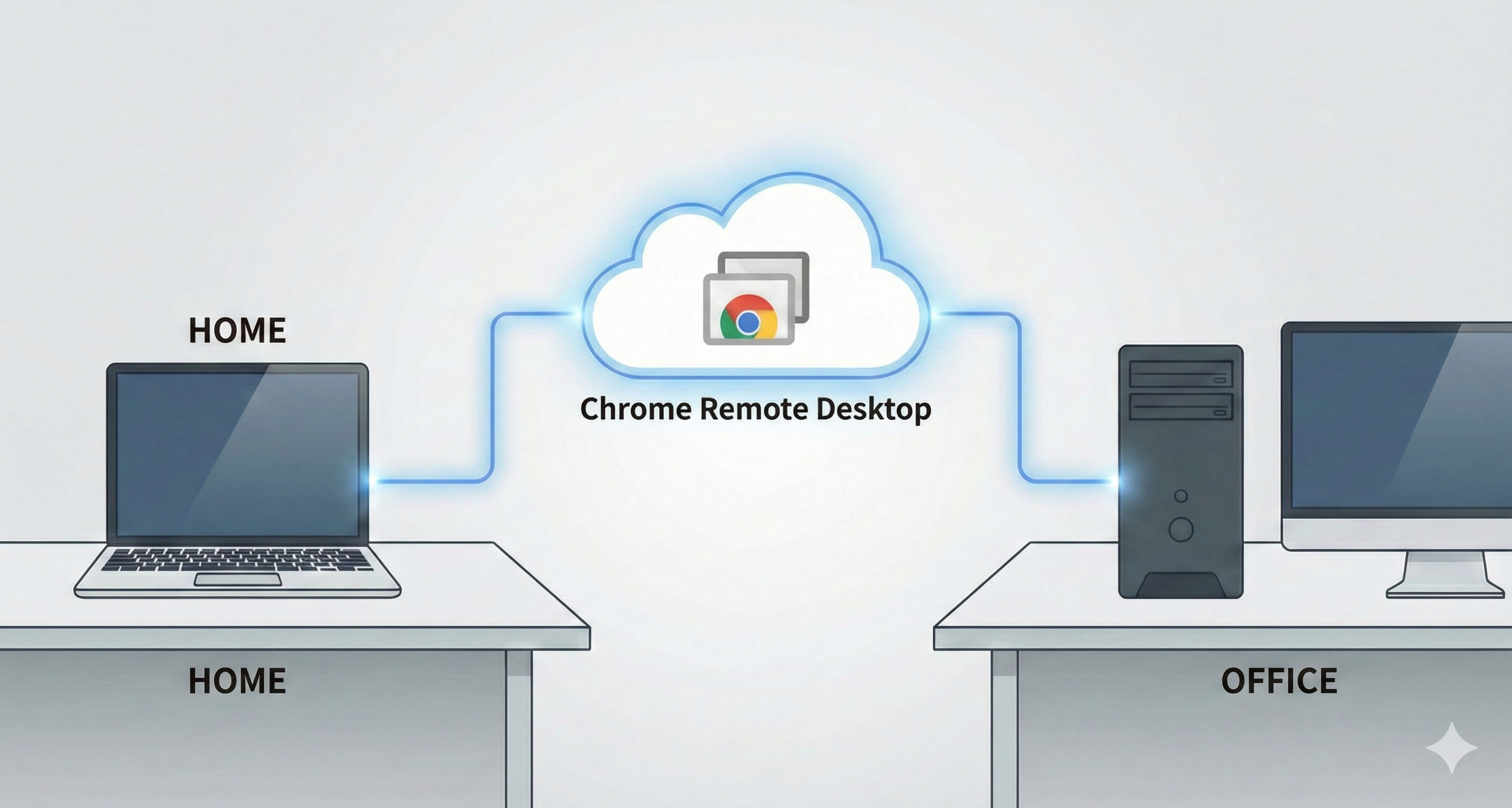
Chrome Remote Desktop (CRD) is a free remote access tool developed by Google. All you need is the Chrome browser and a Google account to remotely control another PC over the internet, from anywhere. No additional hardware is required, making it one of the most accessible ways to get started with remote desktop access.

Why Remote Desktop Is Useful in Japan

Hybrid work has become a fixture across Japan's working culture. Many companies — especially in Tokyo and other major cities — now expect employees to split their time between the office and home. Students, too, often find themselves needing access to files or software left behind on a home PC. And for those who have just joined the workforce as shinshakajin (新社会人 — literally "new members of society," the term for fresh graduates entering their first job, typically in April when Japan's fiscal and academic year begins), juggling unfamiliar tools across multiple environments can be genuinely stressful. Chrome Remote Desktop offers a practical, low-barrier solution for all of these situations.

Recommended Reads:
Which One Is Better, Chrome Remote Desktop Or Microsoft Remote Desktop?

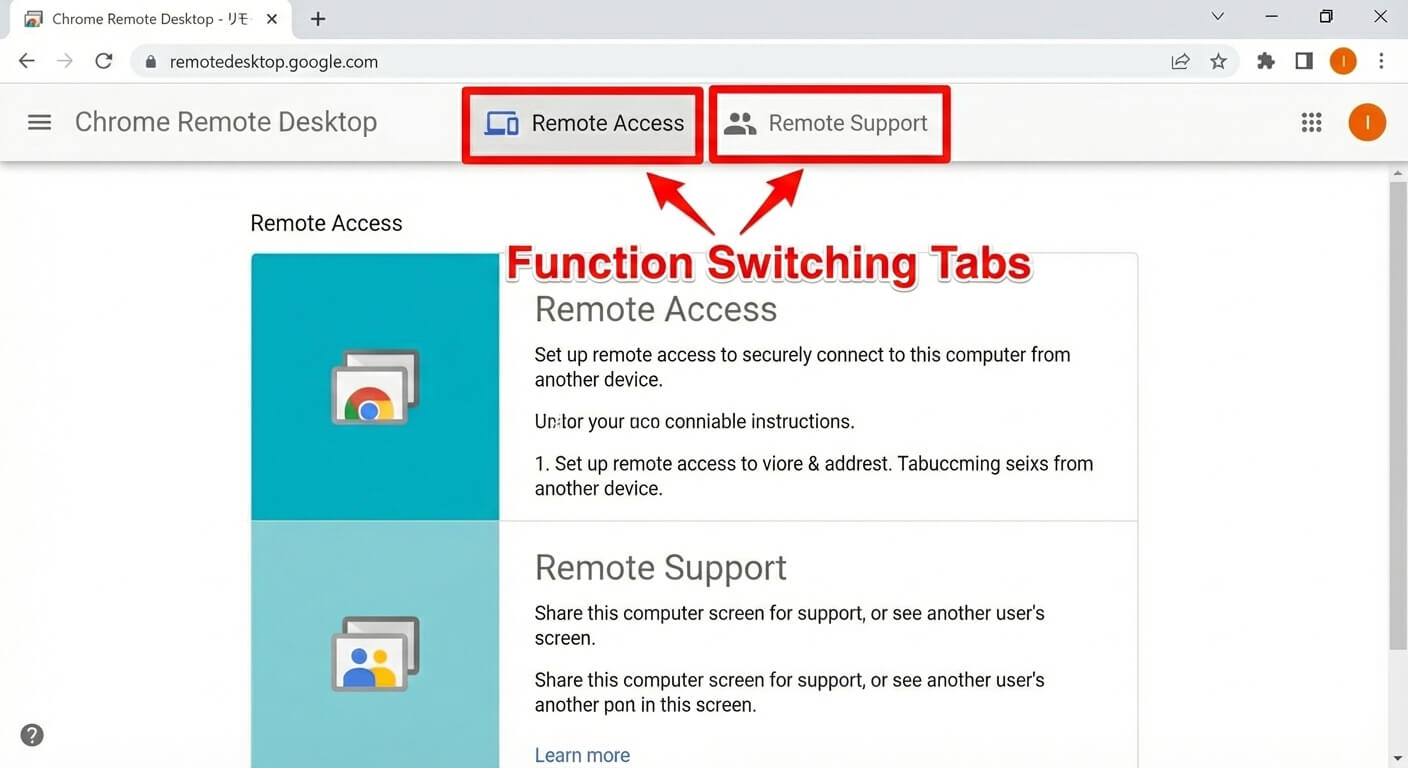
Chrome Remote Desktop's Two Core Features

  1. Remote Access — Connect to Your Own Devices, Anytime

The "Remote Access" feature lets you connect to your home or office PC from any location, at any time. Once the host machine is configured, you can control it remotely as long as it's powered on — even if no one is sitting in front of it. This is ideal for pulling up a file you left on your home PC while you're at school or the office, or for using your full desktop environment from a laptop while you're out.

  1. Remote Support — Temporary Screen Sharing for Troubleshooting

The "Remote Support" feature is built for one-off, temporary sessions. By sharing a connection code, you can let someone else view or control your screen — or do the same for them — without exchanging account credentials. It's a clean and simple way to help a classmate, colleague, or family member work through a technical issue remotely.

Chrome Remote Desktop is designed specifically around these two functions. That focused scope makes it particularly easy to pick up, even if you've never used a remote desktop tool before.

Chrome Remote Desktop feature switching

What You'll Need Before Getting Started

A Google Account

A Google account is required. If you don't already have one, register before you begin. If you're already using Gmail or Google Drive, that same account will work here.

Google Chrome Browser

CRD runs inside the Chrome browser, so Chrome needs to be installed on both the host (the PC you want to access remotely) and the client (the device you're connecting from). Chrome can be installed alongside any other browser without conflict.

A Stable Internet Connection

Remote desktop transmits live screen data over the internet, so a reliable connection on both ends matters. If your Wi-Fi is inconsistent, a wired connection will generally produce a much smoother experience.

Step-by-Step Setup Guide

Setting Up the Host PC (the Computer You Want to Control)

Start by configuring Chrome Remote Desktop on the machine you'll be accessing remotely.

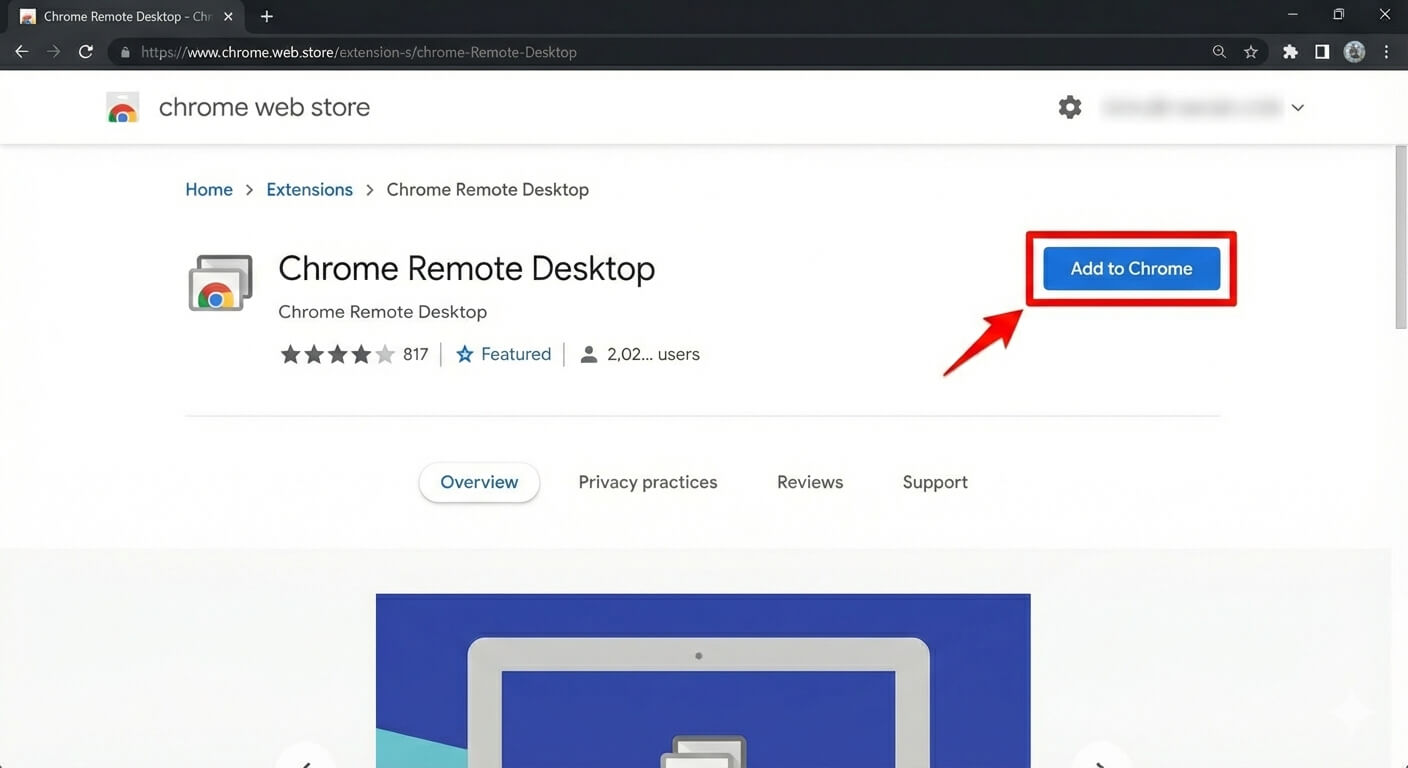
  1. Open Google Chrome and navigate to the Chrome Remote Desktop page.

  2. Follow the on-screen prompts to add the extension and complete the installation.

Chrome Remote Desktop addition and installation procedure
  1. Enable "Remote Access" and follow the steps to set a PIN code of at least six digits.

  2. Once setup is complete, this PC will appear in your list of remotely accessible devices.

Connecting from the Client Device (the Device You're Using to Connect)

Next, prepare the device you'll be connecting from.

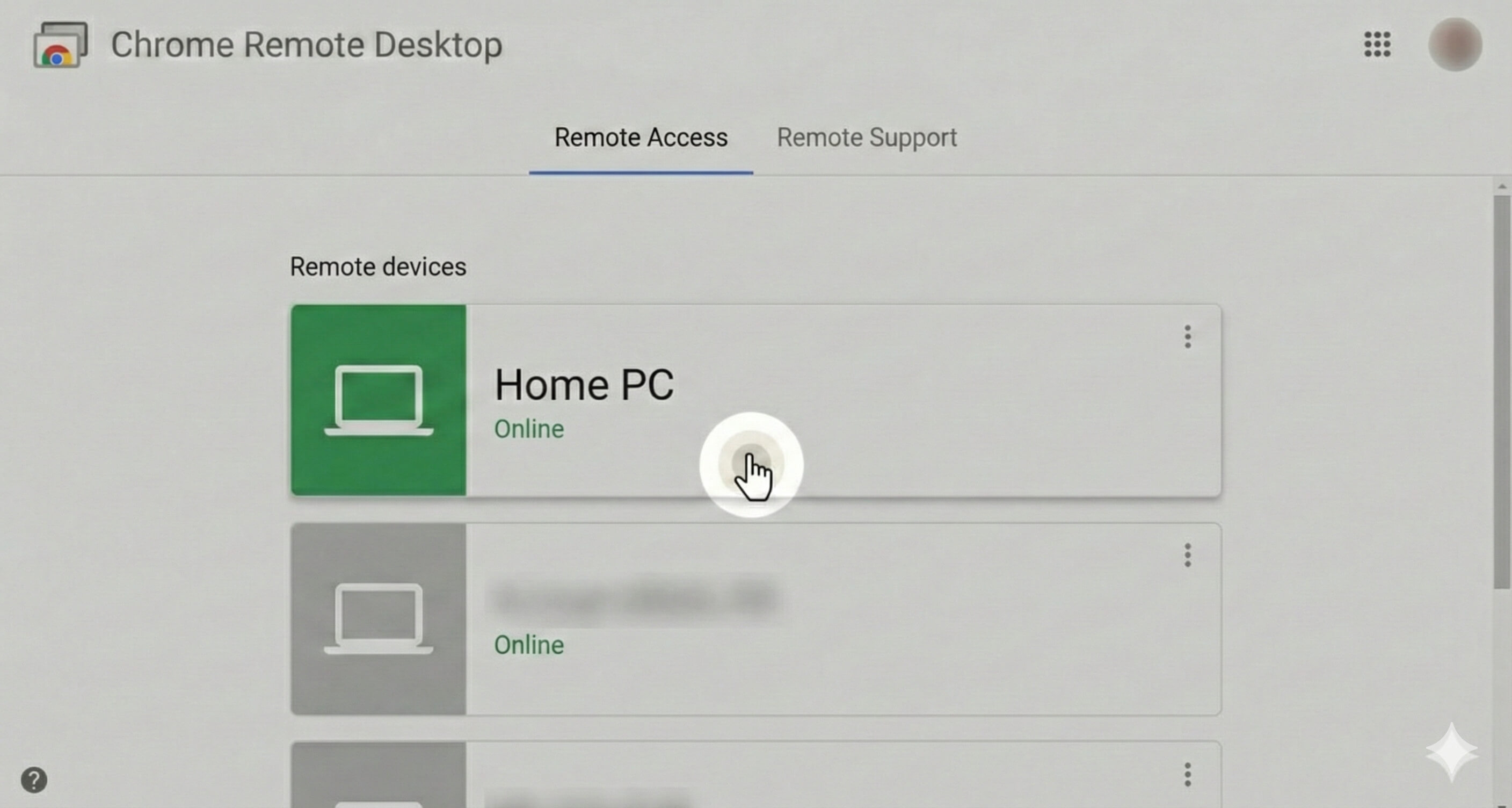
  1. Log into Chrome with the same Google account and open the Chrome Remote Desktop page.

  2. Select the host PC from your device list.

Chrome Remote Desktop device connection screen
  1. If connecting from a smartphone or tablet, download the dedicated iOS or Android app and select your target PC from within the app.

Authenticating with Your PIN Code

After selecting the host PC, you'll be prompted to enter your PIN to verify the connection.

  1. Enter the PIN you created during setup on the client device.

  2. Once authenticated, the host PC's screen will appear on your device and you'll be able to control it with your mouse and keyboard.

  3. The connection is encrypted and can be ended at any time.

Tips for Getting More Out of CRD

Make the Most of Keyboard Shortcuts

Using keyboard shortcuts deliberately can make a real difference to your efficiency in a remote session. This is especially worth thinking about if you're switching between Windows and Mac, where key behaviour differs — particularly around:

  • The difference between the Ctrl and Cmd keys

  • Full-screen toggling and window switching

Familiarising yourself with these basics in advance will help things feel more natural. If shortcuts are being captured by your local device instead of reaching the remote machine, check the settings for an option like "Send all keyboard input to remote" — this is usually the fix.

Using CRD on Mobile: What to Expect

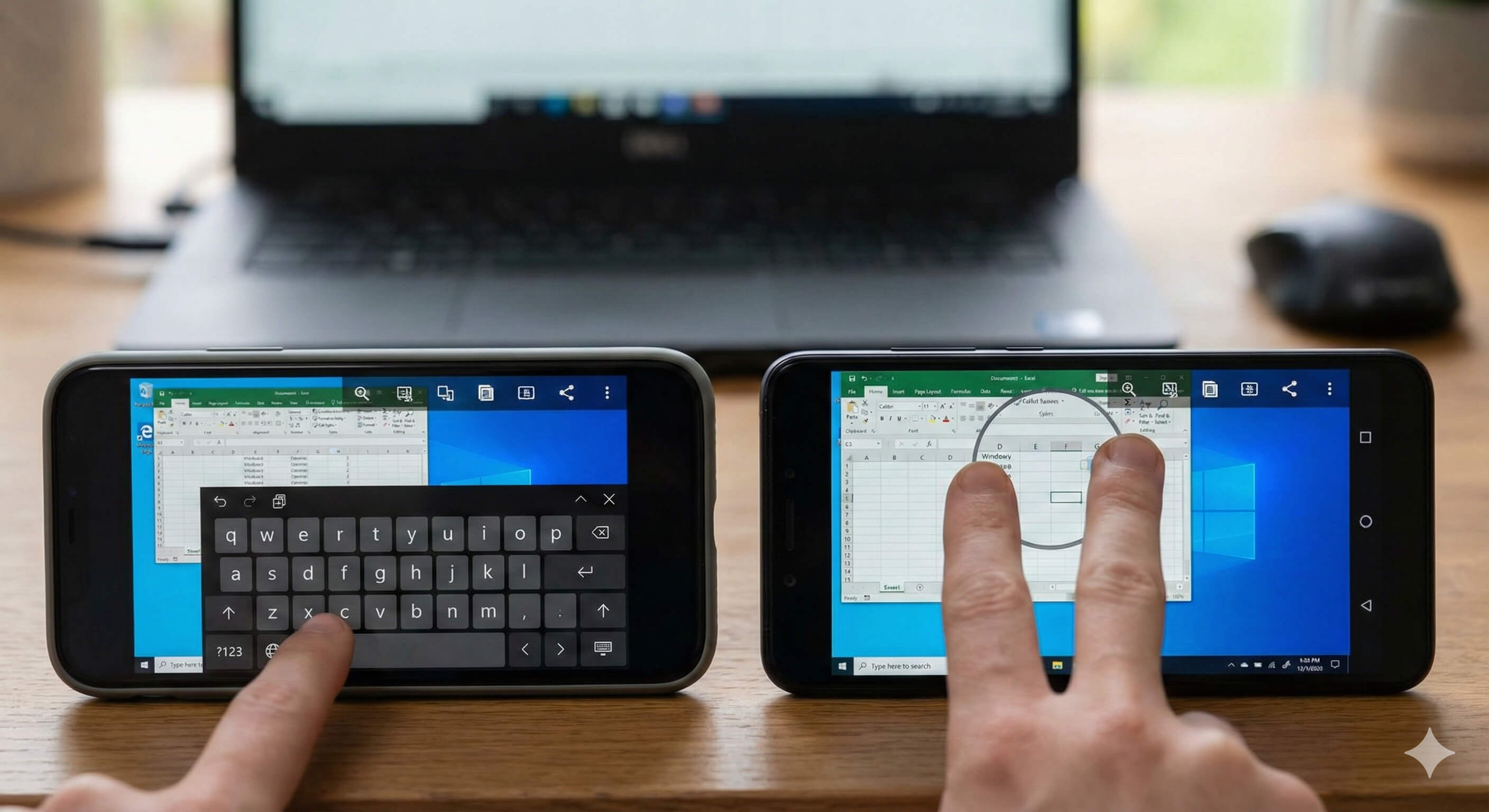
The mobile experience differs quite a bit from working on a desktop. Chrome Remote Desktop's mobile app is built around touch controls:

  • Swipe to move the mouse cursor

  • Pinch to zoom in or out

  • Toolbar at the bottom of the screen to access the keyboard and menu

Precise input — longer text entry, drag-and-drop, clicking small targets — is slower and more effortful on mobile than on a PC. In practice, mobile access works best for quick checks and light tasks. For anything more involved, a laptop or desktop will serve you much better.

Chrome Remote Desktop smartphone operation image

The Limitations of Chrome Remote Desktop

Simplicity Has Its Ceiling

Chrome Remote Desktop is, at its core, a tool built for "Remote Access" and "Remote Support" — nothing more. That focus is part of what makes it easy to use, but it also means that more specialised requirements hit a wall fast. If you need to transfer large files quickly, manage multiple users or devices, or keep detailed logs of remote sessions, you'll find CRD doesn't have the tools for the job.

Instability Inside Japanese Corporate Networks

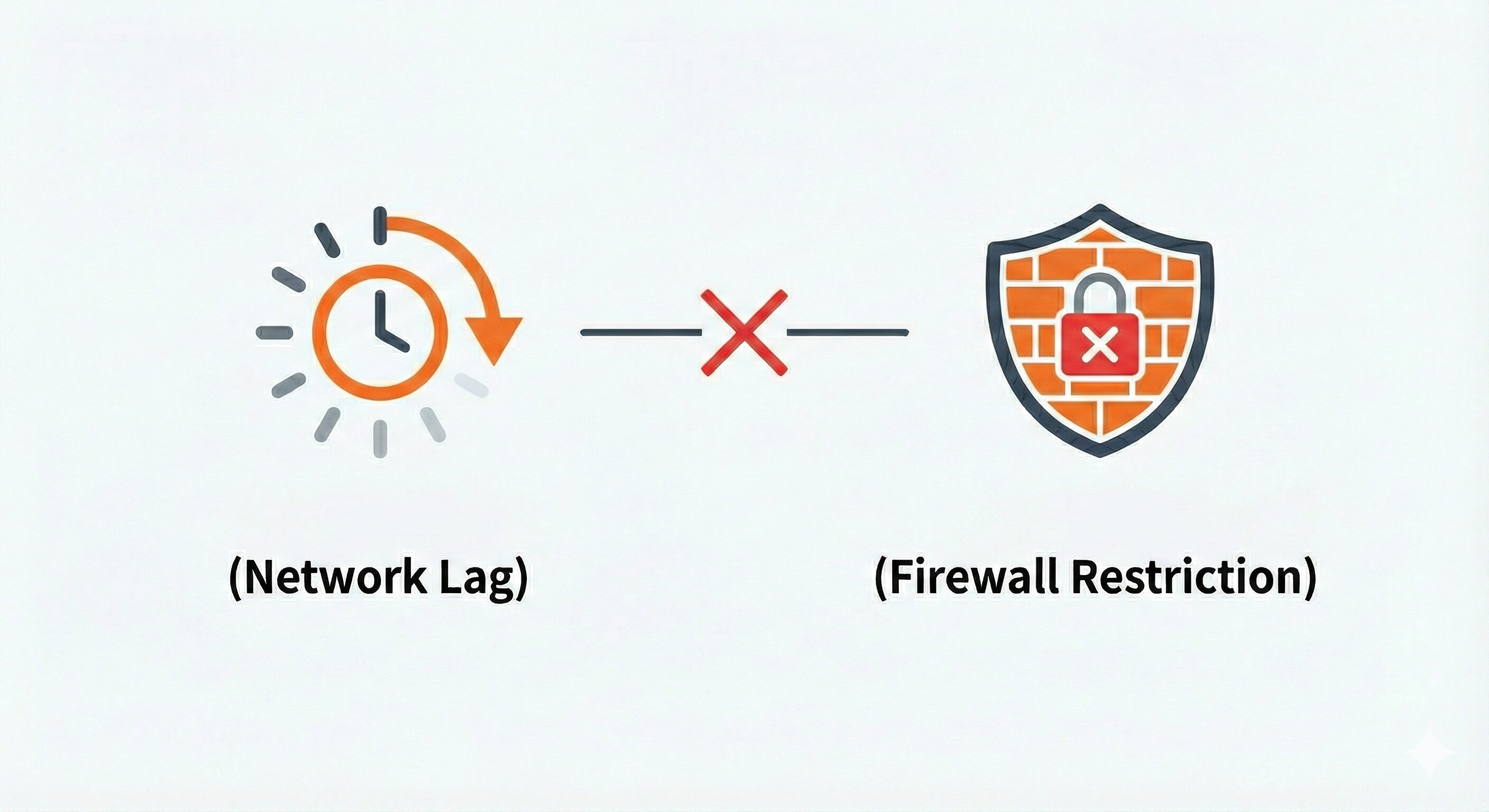
Many Japanese companies — particularly larger organisations — maintain strict internal network environments managed by their IT departments (joho shisutemu-bu, 情報システム部). Firewalls, proxy settings, and restrictions on Google services are common, particularly in finance, manufacturing, and government-adjacent industries. In these environments, Chrome Remote Desktop connections can become unreliable, suffer significant lag, or fail entirely.

If you've started a new job in Japan and found that CRD simply won't connect from the office network, this is almost certainly why.

Network latency and firewall restrictions image

Dependency on Your Google Account

Because CRD is tied to a Google account, any disruption to that account — a forgotten password, an account lock, or a multi-factor authentication hiccup — directly affects your ability to access remote machines. For personal use this is manageable, but for anything business-critical, it's a meaningful single point of failure.

Ready for More? Meet DeskIn — A Professional Remote Desktop Solution

The Natural Next Step Up from CRD

Chrome Remote Desktop is a solid starting point, but as remote work needs become more regular and more demanding, many users find themselves running up against its limits. For those who need a more robust, feature-rich tool suited to daily professional use, DeskIn is the obvious step up.

Built to Handle Japan's Corporate Network Environments

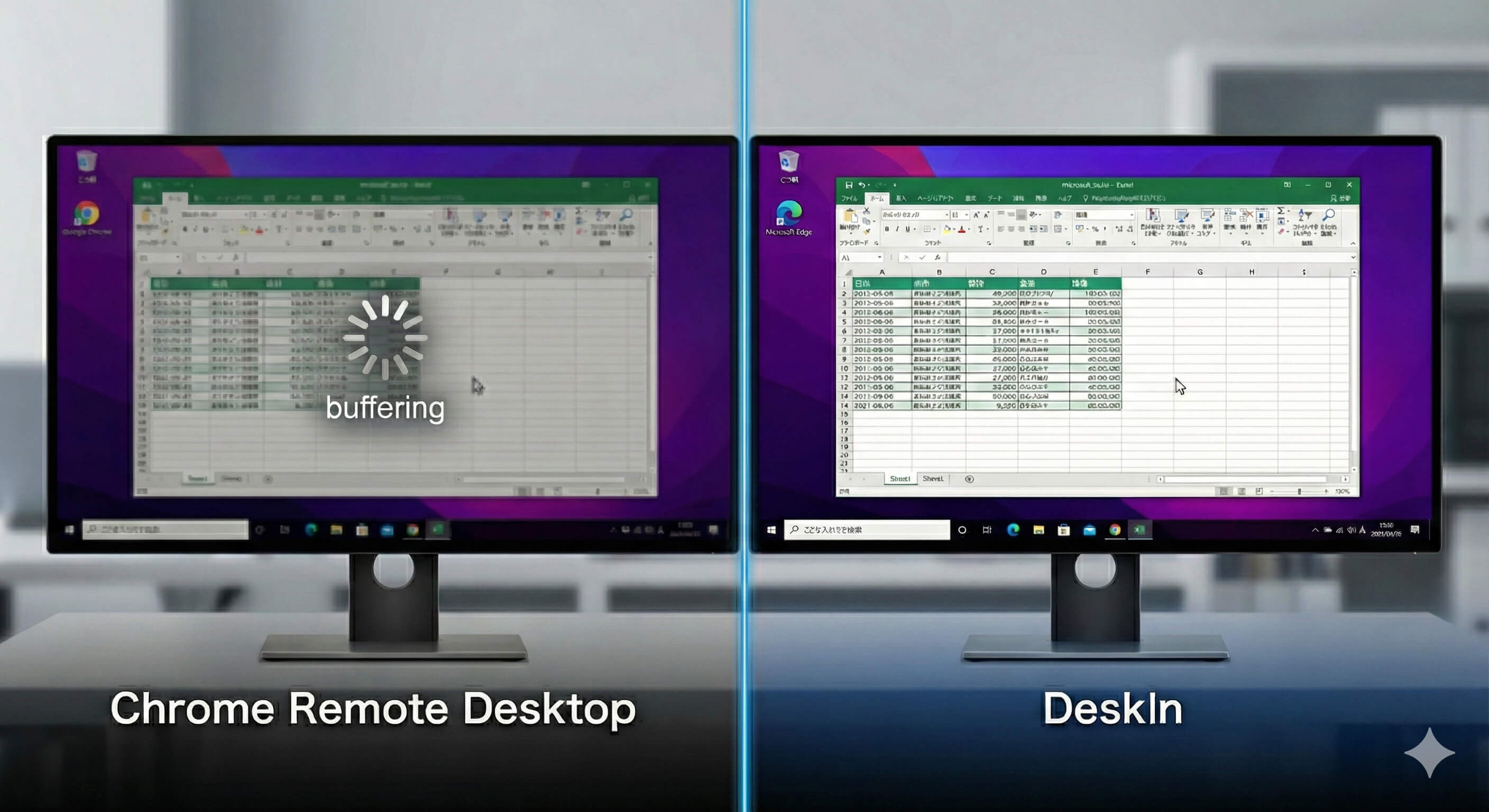
DeskIn is engineered for stability in complex network setups — including the kind of strict firewalls and proxy configurations common in Japanese corporate IT infrastructure. Where CRD struggles in these environments, DeskIn is designed to maintain consistent, low-latency connections even under restrictive conditions.

Image comparison of image quality between Chrome Remote Desktop and Deskin

Professional Performance and an Intuitive Workflow

DeskIn supports 4K display quality and ultra-low-latency response, with a dedicated desktop client that isn't dependent on a browser. For creative work, detailed tasks, or simply getting through a full working day remotely without friction, this level of performance makes a tangible difference. 

→ Try DeskIn for free and explore what's possible

Summary

Chrome Remote Desktop is a free, easy-to-use tool that works well for personal use, occasional remote access, and basic screen sharing. If you're new to remote desktop tools — or if you just need a quick, no-cost way to access your own PC remotely — CRD is a perfectly reasonable place to start.

For day-to-day professional use in Japan, however, particularly within corporate network environments or when you need reliable performance and high display quality, CRD will likely fall short. In those cases, transitioning to or pairing CRD with a tool like DeskIn will give you a remote setup that's genuinely fit for purpose.

Recommended Reads:
9 Benefits of Remote Access & Best Practices for Modern Life

daughter helping her father troubleshooting windows home remote access

Windows Home không hỗ trợ Remote Desktop. Cách truy cập từ xa miễn phí mà không cần nâng cấp lên Pro.

If you have ever tried to remotely access a second laptop from your Windows Home PC, only to be told that your Home edition does not support Remote Desktop, you already know the frustration. Three pain points hit hardest. First, Windows Home editions can't serve as Remote Desktop hosts, so your desktop/laptop can never be the host. Second, the only official fix is upgrading to Windows Pro, which costs an extra US$99 per licence. Third, Microsoft’s own Remote Desktop client apps are being discontinued through 2025 and 2026, leaving Home users with even fewer built-in options than before. The good news is that affordable (and in some cases free) alternatives exist. Here is what changed, how it affects everyday users, and which tools can get you back in control.

Before: What Windows Home Users Expected

When most people buy a Windows laptop, they assume they are getting the full Windows experience. Remote Desktop Protocol (RDP) is a native app that has been part of the Windows OS for over two decades. But Microsoft reserves the RDP host function, the ability to accept incoming remote connections, for Windows Pro, Enterprise, and Education editions only. Windows Home can only act as a client, meaning you can connect out to a Pro machine, but nobody can connect in to yours.

For designers who need to reach a powerful desktop from a lightweight travel laptop, for students who left a file on their home PC, or for anyone helping a family member troubleshoot remotely, this is a real gap. The assumption was always “I’ll just remote in.” The reality is that Windows Home quietly says no.

The Real Cost of “Just Upgrade to Pro”

Microsoft’s official answer is to purchase a Windows 11 Pro licence. A fresh Pro licence retails at US$199, while the in-place upgrade from Home to Pro costs US$99. If you own more than one machine—say a home desktop and a personal laptop—those costs add up quickly. For freelancers, students, and privacy-conscious home users, that is a steep bill just to unlock one feature. And even after upgrading, configuring RDP for use outside your local network still requires VPN setup or port forwarding, tasks that are far from beginner-friendly.

After: The Phasing Out of Microsoft’s Remote Apps Adds Urgency

To make matters worse, Microsoft retired the Remote Desktop Store app in May 2025 and will end support for the standalone MSI Remote Desktop client on 27 March 2026. Both are being replaced by the new “Windows App,” which focuses on cloud services such as Azure Virtual Desktop and Windows 365. The classic built-in tool (mstsc.exe) remains supported, but it still cannot turn a Home machine into a host. For everyday users who relied on Microsoft’s own apps to bridge devices, the transition adds confusion and reinforces that third-party software is now the practical path forward.

Solution: Third-Party Remote Desktop Tools

The simplest fix is to skip RDP entirely and use a remote access application that works regardless of your Windows edition. Three products are worth comparing and use AES-256 encryption as standard (even for financial institutions).

AnyDesk still technically offers a free tier for personal use, but recent restrictions have made it hard to rely on. Users report that sessions now disconnect in as little as five minutes, down from the 30 to 40 minutes previously allowed. File transfer has been removed from the free version entirely. The free tier is also capped at three devices, with only one session at a time. On top of that, AnyDesk’s commercial-use detection regularly flags and disconnects personal users who have done nothing wrong. Paid plans start at US$14.90 per month.

TeamViewer is one of the most recognised names in remote access. Its free tier covers personal use and includes encryption, file transfer, and multi-platform support. TeamViewer’s large user base means guides and troubleshooting resources are easy to find. However, it suffers from the same commercial-use detection problem as AnyDesk: personal users frequently get flagged and must appeal to regain access. Its paid tiers are also priced for business budgets rather than individual users, approximately around US$58.90 a month

DeskIn takes a different approach. Its free plan gives you full remote control of up to three devices at 1080p 30 FPS, with no session time limits and no commercial-use flags that cut you off mid-task. For the Windows Home user who just needs to reach a file on another PC, help an elderly relative troubleshoot, or check in on a home PC while travelling, the free plan covers it. It connects devices through its own cloud relay, so there is no need for VPN or port forwarding. File transfers run up to 12 MB/s with no size cap but limits to computer-to-phone transfer. The cross-platform capability allows you to control your home PC from a phone, or extend your laptop display to a tablet, all without a Windows Pro licence. 

For users who need more, paid plans start from US$9.90 per month with higher resolution streaming, faster file transfers, and support for up to 100 devices

DeskIn: Full Remote Access for Free

All three tools restore the remote control ability that Windows Home withholds. AnyDesk and TeamViewer are familiar names, but their free tiers have become increasingly limited: short session caps, removed features, and unpredictable commercial-use flags make them hard to count on for regular use. If you need colour accuracy for design work, transfer large project files every day, or simply want a reliable remote access experience without networking headaches, DeskIn offers the most complete set of features at a reasonable price, and its personal tier is free to start.

Upgrading to Windows Pro is still a valid option if you need RDP and other Pro features. But if remote desktop access is the main reason you are considering the US$99 upgrade, DeskIn offers a free alternative with low-latency connections that works on any Windows edition. Download DeskIn for remote work or explore its productivity features if this is the right tool for you before spending on a licence upgrade.

Tại sao DeskIn Remote Desktop lại tốt hơn Splashtop?

Nếu bạn đang tìm kiếm một giải pháp thay thế tốt hơn cho Splashtop, bài viết này sẽ so sánh Splashtop và DeskIn về việc hỗ trợ thiết bị di động, chức năng và giá cả, và cho bạn biết lý do tại sao DeskIn remote desktop lại tốt hơn Splashtop.

DeskIn vs Splashtop: Hỗ trợ thiết bị di động

  • DeskIn: Phiên bản miễn phí đã hỗ trợ sử dụng trên Android, iOS, Windows và Mac. Cũng cho phép sử dụng thương mại.

  • Splashtop: Phiên bản miễn phí không hỗ trợ sử dụng thương mại. Bạn cần nâng cấp lên phiên bản trả phí để sử dụng trên thiết bị di động. Nó cũng thiếu tính năng tìm kiếm thiết bị.

DeskIn vs Splashtop: Đa dạng chức năng

  • DeskIn: Cung cấp nhiều tính năng miễn phí phong phú, bao gồm Mở rộng màn hình, Cuộc gọi âm thanh, Chú thích, Clipboard chia sẻ, v.v. Tất cả đều được thiết kế để nâng cao hiệu quả hợp tác từ xa và quản lý màn hình của người dùng. Cũng có tính năng Bàn phím chơi game, Gamepad dành riêng cho trò chơi từ xa.

  • Splashtop: Mặc dù cũng cung cấp chức năng tương đối phong phú, một số chức năng trả phí không phù hợp với người dùng cá nhân. Phiên bản miễn phí không hỗ trợ chuyển file và in từ xa, bạn cần một kế hoạch trả phí để sử dụng chúng.

DeskIn vs Splashtop: Khả năng quản lý thiết bị

  • DeskIn:Hỗ trợ lên đến 100 thiết bị liên kết với một tài khoản. Phù hợp với người dùng cá nhân và các nhóm nhỏ. Với tính năng truy cập không giám sát, bạn có thể kết nối với thiết bị của mình bất cứ lúc nào, ở đâu.

  • Splashtop: Splashtop chỉ hỗ trợ 10 thiết bị trên mỗi tài khoản. Điều này có thể hạn chế tính linh hoạt cho một số người dùng.

DeskIn vs Splashtop: Giá cả

  • DeskIn: Cung cấp 3 gói trả phí: Tiêu chuẩn, Chơi game và Hiệu suất với các tính năng và quyền lợi hợp lý. Hỗ trợ đăng ký hàng tháng.

  • Splashtop: Chỉ cho phép đăng ký hàng năm, và giá cao, không thực sự thân thiện với người dùng cá nhân.

So sánh phiên bản miễn phí và trả phí của DeskIn và Splashtop:

Khởi đầu dễ dàng với DeskIn

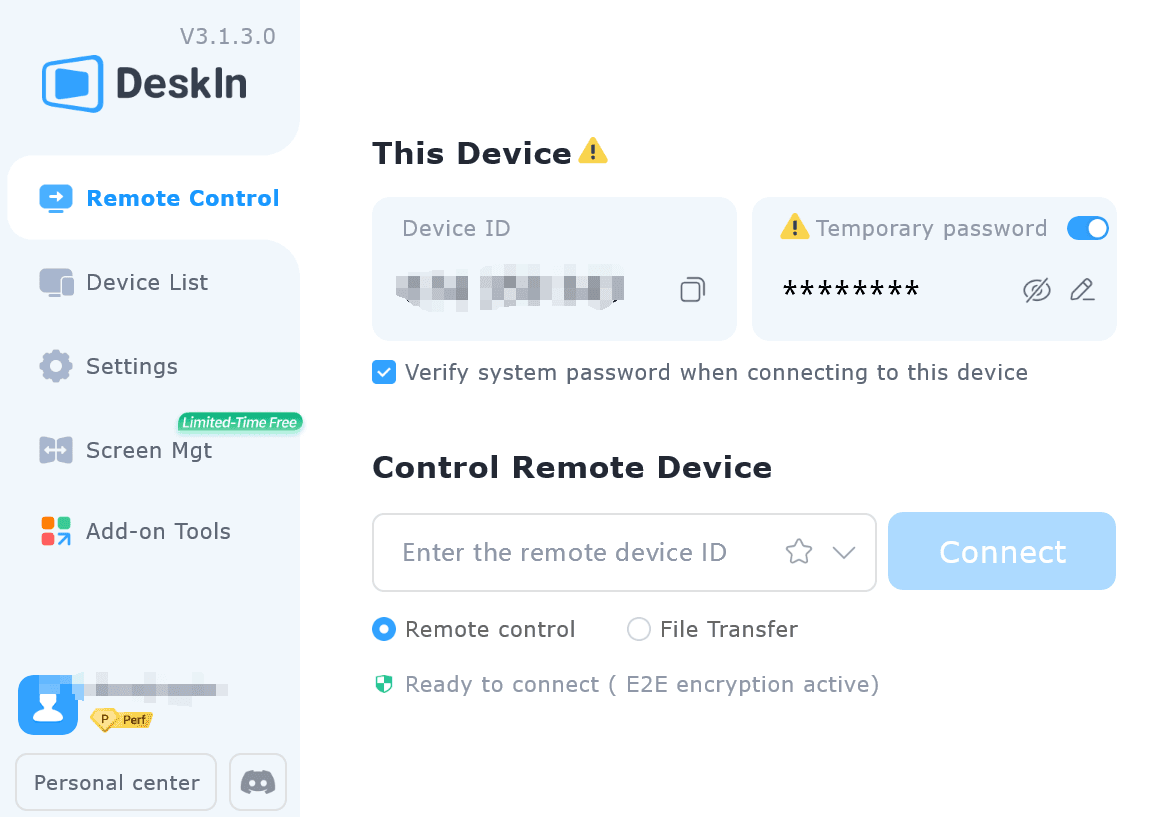
Truy cập vào trang web chính thức của DeskIn Zuler Product - DeskIn Personal | Ứng dụng Remote Desktop Miễn phí với hơn 40 triệu người dùng để tải xuống và cài đặt DeskIn. Đăng ký một tài khoản bằng địa chỉ email của bạn và đăng nhập.

Nhập ID của thiết bị được điều khiển trên thiết bị chính, nhấp vào kết nối, và sử dụng kết nối mật khẩu hoặc kết nối không mật khẩu để hoàn tất xác minh. Sau đó, bạn có thể truy cập vào thiết bị từ xa.

Kết luận

DeskIn remote desktop vượt trội hơn Splashtop về việc hỗ trợ thiết bị di động, chức năng toàn diện, tính thân thiện với trải nghiệm người dùng và hiệu quả chi phí trong môi trường WAN. Những lợi thế này khiến DeskIn remote desktop trở thành một giải pháp remote desktop xuất sắc và thực tiễn hơn, mang đến một trải nghiệm vận hành từ xa thuận tiện, hiệu quả và an toàn hơn cho cả người dùng cá nhân và người dùng doanh nghiệp.

Chrome Remote Desktop and setup guide

How to Set Up & Use Chrome Remote Desktop: Complete Beginner's Guide | DeskIn Japan

How to Set Up and Use Chrome Remote Desktop in Japan: A Complete Beginner's Guide to CRD

What You'll Learn in This Article

This article walks through the basic setup and features of Chrome Remote Desktop (CRD), Google's free remote access tool — explained clearly for first-time users.

CRD is free, simple to configure, and integrates smoothly with your existing Google account and Chrome browser. It works across Windows, Mac, and smartphones, making it easy to get started with remote access from virtually any device.

For everyday personal use and one-off remote support sessions, it's an excellent option — though its features are limited to "Remote Access" and "Remote Support." For more advanced requirements — 4K display quality, low latency, or stable connections inside Japanese corporate networks — a professional-grade tool like DeskIn is worth considering.


Introduction

What Is Chrome Remote Desktop?

Chrome Remote Desktop (CRD) is a free remote access tool developed by Google. All you need is the Chrome browser and a Google account to remotely control another PC over the internet, from anywhere. No additional hardware is required, making it one of the most accessible ways to get started with remote desktop access.

Why Remote Desktop Is Useful in Japan

Hybrid work has become a fixture across Japan's working culture. Many companies — especially in Tokyo and other major cities — now expect employees to split their time between the office and home. Students, too, often find themselves needing access to files or software left behind on a home PC. And for those who have just joined the workforce as shinshakajin (新社会人 — literally "new members of society," the term for fresh graduates entering their first job, typically in April when Japan's fiscal and academic year begins), juggling unfamiliar tools across multiple environments can be genuinely stressful. Chrome Remote Desktop offers a practical, low-barrier solution for all of these situations.

Recommended Reads:
Which One Is Better, Chrome Remote Desktop Or Microsoft Remote Desktop?

Chrome Remote Desktop's Two Core Features

  1. Remote Access — Connect to Your Own Devices, Anytime

The "Remote Access" feature lets you connect to your home or office PC from any location, at any time. Once the host machine is configured, you can control it remotely as long as it's powered on — even if no one is sitting in front of it. This is ideal for pulling up a file you left on your home PC while you're at school or the office, or for using your full desktop environment from a laptop while you're out.

  1. Remote Support — Temporary Screen Sharing for Troubleshooting

The "Remote Support" feature is built for one-off, temporary sessions. By sharing a connection code, you can let someone else view or control your screen — or do the same for them — without exchanging account credentials. It's a clean and simple way to help a classmate, colleague, or family member work through a technical issue remotely.

Chrome Remote Desktop is designed specifically around these two functions. That focused scope makes it particularly easy to pick up, even if you've never used a remote desktop tool before.

Chrome Remote Desktop feature switching

What You'll Need Before Getting Started

A Google Account

A Google account is required. If you don't already have one, register before you begin. If you're already using Gmail or Google Drive, that same account will work here.

Google Chrome Browser

CRD runs inside the Chrome browser, so Chrome needs to be installed on both the host (the PC you want to access remotely) and the client (the device you're connecting from). Chrome can be installed alongside any other browser without conflict.

A Stable Internet Connection

Remote desktop transmits live screen data over the internet, so a reliable connection on both ends matters. If your Wi-Fi is inconsistent, a wired connection will generally produce a much smoother experience.

Step-by-Step Setup Guide

Setting Up the Host PC (the Computer You Want to Control)

Start by configuring Chrome Remote Desktop on the machine you'll be accessing remotely.

  1. Open Google Chrome and navigate to the Chrome Remote Desktop page.

  2. Follow the on-screen prompts to add the extension and complete the installation.

Chrome Remote Desktop addition and installation procedure
  1. Enable "Remote Access" and follow the steps to set a PIN code of at least six digits.

  2. Once setup is complete, this PC will appear in your list of remotely accessible devices.

Connecting from the Client Device (the Device You're Using to Connect)

Next, prepare the device you'll be connecting from.

  1. Log into Chrome with the same Google account and open the Chrome Remote Desktop page.

  2. Select the host PC from your device list.

Chrome Remote Desktop device connection screen
  1. If connecting from a smartphone or tablet, download the dedicated iOS or Android app and select your target PC from within the app.

Authenticating with Your PIN Code

After selecting the host PC, you'll be prompted to enter your PIN to verify the connection.

  1. Enter the PIN you created during setup on the client device.

  2. Once authenticated, the host PC's screen will appear on your device and you'll be able to control it with your mouse and keyboard.

  3. The connection is encrypted and can be ended at any time.

Tips for Getting More Out of CRD

Make the Most of Keyboard Shortcuts

Using keyboard shortcuts deliberately can make a real difference to your efficiency in a remote session. This is especially worth thinking about if you're switching between Windows and Mac, where key behaviour differs — particularly around:

  • The difference between the Ctrl and Cmd keys

  • Full-screen toggling and window switching

Familiarising yourself with these basics in advance will help things feel more natural. If shortcuts are being captured by your local device instead of reaching the remote machine, check the settings for an option like "Send all keyboard input to remote" — this is usually the fix.

Using CRD on Mobile: What to Expect

The mobile experience differs quite a bit from working on a desktop. Chrome Remote Desktop's mobile app is built around touch controls:

  • Swipe to move the mouse cursor

  • Pinch to zoom in or out

  • Toolbar at the bottom of the screen to access the keyboard and menu

Precise input — longer text entry, drag-and-drop, clicking small targets — is slower and more effortful on mobile than on a PC. In practice, mobile access works best for quick checks and light tasks. For anything more involved, a laptop or desktop will serve you much better.

Chrome Remote Desktop smartphone operation image

The Limitations of Chrome Remote Desktop

Simplicity Has Its Ceiling

Chrome Remote Desktop is, at its core, a tool built for "Remote Access" and "Remote Support" — nothing more. That focus is part of what makes it easy to use, but it also means that more specialised requirements hit a wall fast. If you need to transfer large files quickly, manage multiple users or devices, or keep detailed logs of remote sessions, you'll find CRD doesn't have the tools for the job.

Instability Inside Japanese Corporate Networks

Many Japanese companies — particularly larger organisations — maintain strict internal network environments managed by their IT departments (joho shisutemu-bu, 情報システム部). Firewalls, proxy settings, and restrictions on Google services are common, particularly in finance, manufacturing, and government-adjacent industries. In these environments, Chrome Remote Desktop connections can become unreliable, suffer significant lag, or fail entirely.

If you've started a new job in Japan and found that CRD simply won't connect from the office network, this is almost certainly why.

Network latency and firewall restrictions image

Dependency on Your Google Account

Because CRD is tied to a Google account, any disruption to that account — a forgotten password, an account lock, or a multi-factor authentication hiccup — directly affects your ability to access remote machines. For personal use this is manageable, but for anything business-critical, it's a meaningful single point of failure.

Ready for More? Meet DeskIn — A Professional Remote Desktop Solution

The Natural Next Step Up from CRD

Chrome Remote Desktop is a solid starting point, but as remote work needs become more regular and more demanding, many users find themselves running up against its limits. For those who need a more robust, feature-rich tool suited to daily professional use, DeskIn is the obvious step up.

Built to Handle Japan's Corporate Network Environments

DeskIn is engineered for stability in complex network setups — including the kind of strict firewalls and proxy configurations common in Japanese corporate IT infrastructure. Where CRD struggles in these environments, DeskIn is designed to maintain consistent, low-latency connections even under restrictive conditions.

Image comparison of image quality between Chrome Remote Desktop and Deskin

Professional Performance and an Intuitive Workflow

DeskIn supports 4K display quality and ultra-low-latency response, with a dedicated desktop client that isn't dependent on a browser. For creative work, detailed tasks, or simply getting through a full working day remotely without friction, this level of performance makes a tangible difference. 

→ Try DeskIn for free and explore what's possible

Summary

Chrome Remote Desktop is a free, easy-to-use tool that works well for personal use, occasional remote access, and basic screen sharing. If you're new to remote desktop tools — or if you just need a quick, no-cost way to access your own PC remotely — CRD is a perfectly reasonable place to start.

For day-to-day professional use in Japan, however, particularly within corporate network environments or when you need reliable performance and high display quality, CRD will likely fall short. In those cases, transitioning to or pairing CRD with a tool like DeskIn will give you a remote setup that's genuinely fit for purpose.

Recommended Reads:
9 Benefits of Remote Access & Best Practices for Modern Life

daughter helping her father troubleshooting windows home remote access

Windows Home không hỗ trợ Remote Desktop. Cách truy cập từ xa miễn phí mà không cần nâng cấp lên Pro.

If you have ever tried to remotely access a second laptop from your Windows Home PC, only to be told that your Home edition does not support Remote Desktop, you already know the frustration. Three pain points hit hardest. First, Windows Home editions can't serve as Remote Desktop hosts, so your desktop/laptop can never be the host. Second, the only official fix is upgrading to Windows Pro, which costs an extra US$99 per licence. Third, Microsoft’s own Remote Desktop client apps are being discontinued through 2025 and 2026, leaving Home users with even fewer built-in options than before. The good news is that affordable (and in some cases free) alternatives exist. Here is what changed, how it affects everyday users, and which tools can get you back in control.

Before: What Windows Home Users Expected

When most people buy a Windows laptop, they assume they are getting the full Windows experience. Remote Desktop Protocol (RDP) is a native app that has been part of the Windows OS for over two decades. But Microsoft reserves the RDP host function, the ability to accept incoming remote connections, for Windows Pro, Enterprise, and Education editions only. Windows Home can only act as a client, meaning you can connect out to a Pro machine, but nobody can connect in to yours.

For designers who need to reach a powerful desktop from a lightweight travel laptop, for students who left a file on their home PC, or for anyone helping a family member troubleshoot remotely, this is a real gap. The assumption was always “I’ll just remote in.” The reality is that Windows Home quietly says no.

The Real Cost of “Just Upgrade to Pro”

Microsoft’s official answer is to purchase a Windows 11 Pro licence. A fresh Pro licence retails at US$199, while the in-place upgrade from Home to Pro costs US$99. If you own more than one machine—say a home desktop and a personal laptop—those costs add up quickly. For freelancers, students, and privacy-conscious home users, that is a steep bill just to unlock one feature. And even after upgrading, configuring RDP for use outside your local network still requires VPN setup or port forwarding, tasks that are far from beginner-friendly.

After: The Phasing Out of Microsoft’s Remote Apps Adds Urgency

To make matters worse, Microsoft retired the Remote Desktop Store app in May 2025 and will end support for the standalone MSI Remote Desktop client on 27 March 2026. Both are being replaced by the new “Windows App,” which focuses on cloud services such as Azure Virtual Desktop and Windows 365. The classic built-in tool (mstsc.exe) remains supported, but it still cannot turn a Home machine into a host. For everyday users who relied on Microsoft’s own apps to bridge devices, the transition adds confusion and reinforces that third-party software is now the practical path forward.

Solution: Third-Party Remote Desktop Tools

The simplest fix is to skip RDP entirely and use a remote access application that works regardless of your Windows edition. Three products are worth comparing and use AES-256 encryption as standard (even for financial institutions).

AnyDesk still technically offers a free tier for personal use, but recent restrictions have made it hard to rely on. Users report that sessions now disconnect in as little as five minutes, down from the 30 to 40 minutes previously allowed. File transfer has been removed from the free version entirely. The free tier is also capped at three devices, with only one session at a time. On top of that, AnyDesk’s commercial-use detection regularly flags and disconnects personal users who have done nothing wrong. Paid plans start at US$14.90 per month.

TeamViewer is one of the most recognised names in remote access. Its free tier covers personal use and includes encryption, file transfer, and multi-platform support. TeamViewer’s large user base means guides and troubleshooting resources are easy to find. However, it suffers from the same commercial-use detection problem as AnyDesk: personal users frequently get flagged and must appeal to regain access. Its paid tiers are also priced for business budgets rather than individual users, approximately around US$58.90 a month

DeskIn takes a different approach. Its free plan gives you full remote control of up to three devices at 1080p 30 FPS, with no session time limits and no commercial-use flags that cut you off mid-task. For the Windows Home user who just needs to reach a file on another PC, help an elderly relative troubleshoot, or check in on a home PC while travelling, the free plan covers it. It connects devices through its own cloud relay, so there is no need for VPN or port forwarding. File transfers run up to 12 MB/s with no size cap but limits to computer-to-phone transfer. The cross-platform capability allows you to control your home PC from a phone, or extend your laptop display to a tablet, all without a Windows Pro licence. 

For users who need more, paid plans start from US$9.90 per month with higher resolution streaming, faster file transfers, and support for up to 100 devices

DeskIn: Full Remote Access for Free

All three tools restore the remote control ability that Windows Home withholds. AnyDesk and TeamViewer are familiar names, but their free tiers have become increasingly limited: short session caps, removed features, and unpredictable commercial-use flags make them hard to count on for regular use. If you need colour accuracy for design work, transfer large project files every day, or simply want a reliable remote access experience without networking headaches, DeskIn offers the most complete set of features at a reasonable price, and its personal tier is free to start.

Upgrading to Windows Pro is still a valid option if you need RDP and other Pro features. But if remote desktop access is the main reason you are considering the US$99 upgrade, DeskIn offers a free alternative with low-latency connections that works on any Windows edition. Download DeskIn for remote work or explore its productivity features if this is the right tool for you before spending on a licence upgrade.

Don't miss out.

Don't miss out.

Contact Us

Email: support@deskin.io

Office: 991D Alexandra Road #02-17, Singapore 119972

Copyright © 2026 Zuler Technology PTE. LTD. All rights reserved.

Contact Us

support@deskin.io

991D Alexandra Road #02-17

Singapore 119972

Copyright © 2026 Zuler Technology PTE. LTD. All rights reserved.

Contact Us

Email: support@deskin.io

Office: 991D Alexandra Road #02-17, Singapore 119972

Copyright © 2026 Zuler Technology PTE. LTD. All rights reserved.

Up To 76%

Spring Sale Limited Offer 🎉Yearly Plan From $2.91/Month

👉 Use Promo Code: DESKINSPRING

Up To 76%

Spring Sale 🎉Yearly Plan From $2.91/Month

👉 Use Promo Code: DESKINSPRING

Up To 76%

Spring Sale 🎉Yearly Plan From $2.91/Month

👉 Code: DESKINSPRING