Robloxでのマネーの見つけ方:フィッシュ

ファリス

5分間

更新済み

2025/10/21

RobloxのFischで何時間も釣りをしていて、本当のお金を手に入れる方法を知りたがっているのはあなただけではありません。この人気のRobloxゲームは、そのリラックスしたゲームプレイ、美しい環境、そして報酬のある進行システムでプラットフォームを席巻しています。

しかし、正直に言うと、Fischのすべての釣りスポットが同じというわけではありません。あるエリアでは小さくて一般的な魚しか手に入らないかもしれませんが、他のエリアにはすぐにお金持ちになれる珍しい魚種が隠れています。

このガイドでは、Roblox Fischでお金を得る方法、経済の仕組み、どのようなツールやアップグレード、AFKメソッドが収益を最大化するのに役立つかを詳細に解説します。—たとえゲームをしていないときでも。

釣りでお金を稼ぐ方法

釣りはFischの中心です。魚を捕まえて売ることでお金を稼ぎます。—そして、それは単純に聞こえるかもしれませんが、正しい装備は大きな違いを生み出します。

お金を稼ぐことに本気な人には、以下の2つの釣り竿が際立っています。

  • フォーチュンロッドロスリット湾の鍛冶屋12,750C$で入手可能。次のキャッチで110%の運のブーストをもたらします。

  • デスティニーロッドカレイア(アーチ)190,000C$で入手可能。驚異的な250%の運の増加を持ち、高価で売れる珍しい魚を捕まえるのに最適です。

キャッチ率を向上させるには、常に餌を装備してください。特定の餌で捕まえやすい魚もいます。—たとえば、レジェンダリー魚のラビットフィッシュは、Seaweedを餌にすると、アーチの下で捕まえやすいです。

ほとんどの島で餌クレート120C$で購入できます。必須ではありませんが、運の良いロッドと組み合わせることで、珍しい釣果を早く得られます。

make money in roblox with fischer

釣りを強化するトーテムの使い方

Fischのトーテムは、天候や時間帯を制御する特別なアイテムで、特定の条件下でしか現れない魚を捕まえるのに役立ちます。

島々で見つけられる4つの主要なトーテムがあります。

  1. サンダイヤルトーテムサンストーン島の隠れた洞窟内で発見。2000C$かかり、昼夜を切り替えます。

  2. ウィンドセットトーテムテラピン島の下にある複雑な水中洞窟にあります。風の強い天候を作り出し、珍しい魚に最適です。

  3. テンペストトーテムスノーキャップ洞窟で発見。やはり2000C$で、雨を降らせます。特定のキャッチに必要です。

  4. スモークスクリーントーテムマッシュグローブ湿地に隠れており、アリゲーターマーシュの後ろか、南東の壊れた梯子ルートから入手可能。霧を作り出しタラ、サバ、ブルシャークを引き寄せます。

トーテムは一回限りの使用ですので、フィッシングストリーク時に賢く使いましょう!

魚の豊富なプール

効率的に釣りをしたいなら、魚が豊富なプールを探しましょう。これらは特定のエリアで特定の魚の捕獲確率が高まる特別なランダムイベントです。

ゲーム内で表示されるメッセージが出たらすぐに、それに乗じて光る水域にボートを進めることで効率よく釣りができ、少ない労力で効率的にお金が稼げます。

釣果を査定して追加利益を得る

釣りの後は、必ず魚を査定してください。ムースウッドの買取業者NPCのところに行き、商人の隣にいます。450C$で捕まえた魚を評価してもらい、ラッキーならその価値が上がります。

特に、大きな魚や珍しい魚(インベントリの黄色い重量のもの)を査定するのがおすすめです。一般的な魚を査定するのはお金の無駄の場合が多いです。

アングラーからのクエストを完了する

Fischのすべての島には、アングラーNPCがいて、釣りのクエストを提供します。これらのミッションは現金やその他の報酬を支払い、探索中の安定した収入源となります。

アングラーの場所一覧:

  • ムースウッド: 商人の向かい側。

  • サンストーン島: ビーチの宿屋の隣。

  • テラピン島: 船大工の向かい側。

  • ロスリット島: キャンプファイヤー近くとビーチにいます。

  • ヴァーティゴ: シンセの隣。

これらのクエストには時間がかかるかもしれませんが、安定した収入を築くために完了する価値があります。

DeskIn無料ダウンロード

収入を最大化するためのヒント

  • 珍しい魚の場所に注目することで、より高い利益をもたらします。

  • 可能であれば、常にロッドをアップグレードしましょう。

  • 餌 + 運の増加 + トーテムを組み合わせて、最高のキャッチ率を目指しましょう。

  • ロード直後の魚の豊富なプールの告知を見逃さないようにしましょう。

  • インベントリがいっぱいになる前に、販売や査定を忘れないでください

Deskinを使ってリモートでFischをプレイ

PCから離れていても釣りを続けたいですか?DeskInを試してみてください。—ゲームをインストールせずに電話やタブレットからRoblox Fischをプレイできる強力なリモートデスクトップアプリです。

Deskinを使用すると:

  • どこでもAFK釣りの進行状況を監視できます。

  • Robloxのフルデスクトップバージョンにリモートでスムーズにアクセスできます。

  • AFKでFischでお金を稼ぐことができる — グラインドや外出先での釣果確認に最適です。

AFKでありながら、コントロールを維持し、Deskinが釣りの冒険を24/7続けさせましょう。

DeskIn無料ダウンロード

RobloxのFischで何時間も釣りをしていて、本当のお金を手に入れる方法を知りたがっているのはあなただけではありません。この人気のRobloxゲームは、そのリラックスしたゲームプレイ、美しい環境、そして報酬のある進行システムでプラットフォームを席巻しています。

しかし、正直に言うと、Fischのすべての釣りスポットが同じというわけではありません。あるエリアでは小さくて一般的な魚しか手に入らないかもしれませんが、他のエリアにはすぐにお金持ちになれる珍しい魚種が隠れています。

このガイドでは、Roblox Fischでお金を得る方法、経済の仕組み、どのようなツールやアップグレード、AFKメソッドが収益を最大化するのに役立つかを詳細に解説します。—たとえゲームをしていないときでも。

釣りでお金を稼ぐ方法

釣りはFischの中心です。魚を捕まえて売ることでお金を稼ぎます。—そして、それは単純に聞こえるかもしれませんが、正しい装備は大きな違いを生み出します。

お金を稼ぐことに本気な人には、以下の2つの釣り竿が際立っています。

  • フォーチュンロッドロスリット湾の鍛冶屋12,750C$で入手可能。次のキャッチで110%の運のブーストをもたらします。

  • デスティニーロッドカレイア(アーチ)190,000C$で入手可能。驚異的な250%の運の増加を持ち、高価で売れる珍しい魚を捕まえるのに最適です。

キャッチ率を向上させるには、常に餌を装備してください。特定の餌で捕まえやすい魚もいます。—たとえば、レジェンダリー魚のラビットフィッシュは、Seaweedを餌にすると、アーチの下で捕まえやすいです。

ほとんどの島で餌クレート120C$で購入できます。必須ではありませんが、運の良いロッドと組み合わせることで、珍しい釣果を早く得られます。

make money in roblox with fischer

釣りを強化するトーテムの使い方

Fischのトーテムは、天候や時間帯を制御する特別なアイテムで、特定の条件下でしか現れない魚を捕まえるのに役立ちます。

島々で見つけられる4つの主要なトーテムがあります。

  1. サンダイヤルトーテムサンストーン島の隠れた洞窟内で発見。2000C$かかり、昼夜を切り替えます。

  2. ウィンドセットトーテムテラピン島の下にある複雑な水中洞窟にあります。風の強い天候を作り出し、珍しい魚に最適です。

  3. テンペストトーテムスノーキャップ洞窟で発見。やはり2000C$で、雨を降らせます。特定のキャッチに必要です。

  4. スモークスクリーントーテムマッシュグローブ湿地に隠れており、アリゲーターマーシュの後ろか、南東の壊れた梯子ルートから入手可能。霧を作り出しタラ、サバ、ブルシャークを引き寄せます。

トーテムは一回限りの使用ですので、フィッシングストリーク時に賢く使いましょう!

魚の豊富なプール

効率的に釣りをしたいなら、魚が豊富なプールを探しましょう。これらは特定のエリアで特定の魚の捕獲確率が高まる特別なランダムイベントです。

ゲーム内で表示されるメッセージが出たらすぐに、それに乗じて光る水域にボートを進めることで効率よく釣りができ、少ない労力で効率的にお金が稼げます。

釣果を査定して追加利益を得る

釣りの後は、必ず魚を査定してください。ムースウッドの買取業者NPCのところに行き、商人の隣にいます。450C$で捕まえた魚を評価してもらい、ラッキーならその価値が上がります。

特に、大きな魚や珍しい魚(インベントリの黄色い重量のもの)を査定するのがおすすめです。一般的な魚を査定するのはお金の無駄の場合が多いです。

アングラーからのクエストを完了する

Fischのすべての島には、アングラーNPCがいて、釣りのクエストを提供します。これらのミッションは現金やその他の報酬を支払い、探索中の安定した収入源となります。

アングラーの場所一覧:

  • ムースウッド: 商人の向かい側。

  • サンストーン島: ビーチの宿屋の隣。

  • テラピン島: 船大工の向かい側。

  • ロスリット島: キャンプファイヤー近くとビーチにいます。

  • ヴァーティゴ: シンセの隣。

これらのクエストには時間がかかるかもしれませんが、安定した収入を築くために完了する価値があります。

DeskIn無料ダウンロード

収入を最大化するためのヒント

  • 珍しい魚の場所に注目することで、より高い利益をもたらします。

  • 可能であれば、常にロッドをアップグレードしましょう。

  • 餌 + 運の増加 + トーテムを組み合わせて、最高のキャッチ率を目指しましょう。

  • ロード直後の魚の豊富なプールの告知を見逃さないようにしましょう。

  • インベントリがいっぱいになる前に、販売や査定を忘れないでください

Deskinを使ってリモートでFischをプレイ

PCから離れていても釣りを続けたいですか?DeskInを試してみてください。—ゲームをインストールせずに電話やタブレットからRoblox Fischをプレイできる強力なリモートデスクトップアプリです。

Deskinを使用すると:

  • どこでもAFK釣りの進行状況を監視できます。

  • Robloxのフルデスクトップバージョンにリモートでスムーズにアクセスできます。

  • AFKでFischでお金を稼ぐことができる — グラインドや外出先での釣果確認に最適です。

AFKでありながら、コントロールを維持し、Deskinが釣りの冒険を24/7続けさせましょう。

DeskIn無料ダウンロード

一度に叶う
遊びも仕事も

ブラックフライデー 70% OFF

ブラックフライデー 70% OFF

DeskInリモートゲーム

今なら14.32米ドル 🎉 7月16日から31日限定

プロモーションコードを追加してください: deskinsummer1

高性能版
月額わずか $12.5 USD/月
Root不要なAndroid操作を含む
👉 プロモーションコード [DESKIN50]

高性能版
月額わずか $12.5 USD/月
Root不要なAndroid操作を含む
👉 プロモーションコード [DESKIN50]

Robloxでお金を稼ぐ方法
Robloxでお金を稼ぐ方法
Robloxでお金を稼ぐ方法

目次

ブラックフライデー
70% OFF

高性能版
月額わずか $12.5 USD/月
Root不要なAndroid操作を含む
👉 プロモーションコード [DESKIN50]

次は何でしょうか?

what is vnc

What Is VNC? A Complete Guide to Remote Desktop Control Technology

VNC (Virtual Network Computing) is a widely used remote desktop technology that allows users to operate another computer over the internet as if physically present. It is commonly applied in remote work, IT maintenance, and cross-platform collaboration. This article explains VNC’s working principles, pros and cons, comparisons with other protocols, and introduces a powerful and secure alternative — DeskIn — to help you find the best remote desktop solution.

What Is VNC?

 What Is VNC

VNC is a graphical remote desktop technology that enables users to connect to and control another computer from anywhere via the internet. Its core concept relies on screen transmission and input feedback — your keyboard and mouse operations are sent to the remote computer in real time, while its screen updates are returned to your device.

VNC is built on two components:

  • VNC Server – Installed on the controlled machine. It captures the screen and sends image data to the client.

  • VNC Viewer – Installed on the user’s device. It displays the remote screen and sends back keyboard/mouse actions.

Communication between these two components is handled through the RFB (Remote Frame Buffer) protocol, which enables cross-platform control across Windows, macOS, Linux, and more. Users only need the remote device’s IP address or access code to establish a connection.

Because VNC is open-source, multiple variants exist — RealVNC, TightVNC, UltraVNC, and others — used widely for enterprise support, server maintenance, and training. However, classic VNC has limitations in speed and security, so later sections cover how it compares to other protocols and why modern alternatives like DeskIn perform better.

free download DeskIn

What Is a VNC Client (VNC Viewer)?

VNC Viewer is the client-side application used to connect to and operate a computer running VNC Server. With it, users can view the remote desktop in real time and control it with their mouse and keyboard as if sitting in front of it.

It is available on Windows, macOS, Linux, iOS, and Android, making it suitable for remote IT support, server management, and online instruction. In most VNC tutorials, the user only needs to enter the remote host’s IP address or access code to establish a secure connection — making VNC a lightweight, cross-device remote desktop solution.

What Is a VNC Server?

VNC Server runs on the machine being controlled. It handles incoming viewer requests, transmits screen data, and processes input commands — essentially the core of the remote desktop system.

In Linux environments, commonly used VNC server programs include TigerVNC, RealVNC, and TightVNC, which can be started and configured via terminal commands. On Windows, users can enable and manage access rights through a graphical interface. Once properly installed and configured, remote users can securely log in and control the device over the network.

How VNC Works & the RFB Protocol

VNC operates through the RFB (Remote Frame Buffer) protocol, which works by compressing pixel data from the server’s screen and transmitting it to the client, while returning mouse and keyboard input back to the server.

Because only screen images and input are transmitted — not full system data — VNC can work across different operating systems and is widely used in remote management and technical support scenarios.

VNC vs. RDP: Similarities and Differences

VNC vs RDP

When choosing a remote desktop solution, VNC and RDP (Remote Desktop Protocol) are the most frequently compared technologies. Both allow remote operation, screen sharing, and maintenance tasks, but their architectures differ significantly.

Similarities

  • Remote control: both allow remote login and operation

  • Screen sharing: display the desktop in real time for support and collaboration

  • Secure connection: both can use encryption and authentication

Differences

  • Protocol: VNC uses RFB to transmit pixel data; RDP reconstructs the desktop using Microsoft's protocol, providing higher performance

  • Cross-platform: VNC supports Windows, macOS, Linux, iOS, and Android; RDP is mainly designed for Windows

  • Performance: RDP performs better on low-bandwidth networks; VNC may experience delays

  • Openness: VNC is open-source and customizable; RDP is closed but stable

If you value cross-platform flexibility, choose VNC. If you need high performance and Windows integration, choose RDP.

Why Linux Remote Desktops Commonly Use VNC

VNC’s open-source nature, lightweight footprint, and cross-platform compatibility make it a go-to solution for Linux remote desktops. It works across nearly all Linux distributions and connects smoothly with Windows, macOS, and mobile systems. Through RFB, users can remotely view and operate Linux desktops for system maintenance, server management, or development work — making VNC a widely adopted choice among Linux users.

VNC Limitations & Security Issues

Though VNC offers flexibility, it has clear limitations regarding security and network performance. Some versions lack built-in encryption, leading to increased risks during cross-network access. Understanding these issues — and deploying protective measures — is essential for safe use.

Common Security Issues & Best Practices

Common security risks:

  • Weak or reused passwords susceptible to brute-force attacks

  • Unencrypted transmissions vulnerable to interception

  • Open ports exposed to network scanning attacks

Recommended protections:

  • Use strong passwords, rotate them regularly, and enable 2FA

  • Tunnel VNC through SSH or a VPN to encrypt traffic

  • Restrict allowed IP addresses and close unused ports

  • Enable TLS/SSL encryption when available

These steps significantly reduce security threats and ensure safer remote desktop usage.

Cross-Network Challenges & Solutions

When accessing VNC across different networks, users may experience:

Common challenges:

  • Slow speeds causing lag or frozen screens

  • Packet loss affecting stability

  • Firewall or router rules blocking the connection

Solutions:

  • Use port forwarding to open a direct communication path

  • Use VPN or SSH tunnels for encrypted and reliable connection

  • Choose a cloud-relay solution like DeskIn for stable cross-network performance

    free download DeskIn

These methods can noticeably improve VNC’s usability across varied network environments.

Best VNC Alternative — DeskIn

 Best VNC Alternative — DeskIn

If you need a more powerful and smoother remote desktop solution, DeskIn is the top alternative to VNC. It delivers high performance, cross-platform support, and ease of use for individuals and businesses alike.

DeskIn supports 4K 60FPS / 2K 144FPS with adjustable resolution and under 40ms latency, providing smooth performance even for gaming or video editing. Its stable server connection and multi-monitor support ensure a seamless experience. DeskIn works on Windows, macOS, Android, iOS, and even offers a Web client for browser-based access.

Additional features such as voice chat, high-speed file transfer (12MB/s), screen mirroring & extension, remote power control, and more are all free. Gamers can use game mode, 3D perspective, controller support, and custom mobile key mappings for PC games.

Overall, DeskIn surpasses classic VNC in image quality, stability, and usability, making it ideal for work, teaching, or entertainment.

DeskIn Key Features & Advantages

As an efficient VNC alternative, DeskIn delivers a smoother and more secure remote desktop experience. Its key advantages include:

  • High quality & low latency: Up to 4K60FPS / 2K144FPS with <40ms latency

  • Cross-platform & multi-monitor: Works across Windows/macOS/iOS/Android, plus Web access

  • Fast connection & file transfer: Stable server relay and 12MB/s transfer speed

  • Full control features: Remote power control, voice chat, whiteboard, remote printing, screen extension

  • Easy to use & centrally managed: Intuitive UI and multi-device management for teams

  • Gaming & privacy modes: Game mode, 3D view, and privacy protections

  • Advanced security: End-to-end encryption, dynamic authentication, and permission controls

Compared with traditional VNC, DeskIn is easier, smoother, and more secure — ideal for business collaboration, IT maintenance, and entertainment.

DeskIn Remote Access Tutorial: 4 Easy Steps

Step 1: Download and install DeskIn

Install DeskIn on both the host and controller devices. Setup takes 1–2 minutes with no advanced configuration.

free download DeskIn

Step 2: Register or log in

Launch DeskIn and sign up using email, Google, or Apple. If you already have an account, simply log in.

Register or log in to DeskIn

Step 3: Get the device code & password

On the target computer, copy the “device code” and “temporary password,” then paste them into the controller device.

Step 4: Start remote control

Click “Connect,” and within seconds, your remote session begins.

Obtain device code and password

FAQs

Is VNC free?

Both open-source and commercial versions exist. Open-source versions (RealVNC, TightVNC) are free but limited, while commercial versions include encryption and support. For a more stable and complete experience, consider a high-performance alternative like DeskIn.

free download DeskIn

Is VNC secure?

Security depends on how it’s configured. Use strong passwords, VPN or SSH tunnels, and proper firewall rules. If you need higher-grade security, DeskIn offers end-to-end encryption, allow/deny lists, connection verification, and granular permission control.

How do I use VNC?

Install VNC Server on the host, use VNC Viewer on the client, then enter the IP address and authentication details to connect.

Can VNC transfer files?

Some VNC variants support file transfer, but speeds are slow and unstable. DeskIn offers 12MB/s high-speed transfer — better for collaboration and device management.

Conclusion

VNC is a reliable remote desktop solution known for being open-source, flexible, and cross-platform. However, it has clear limits in encryption and cross-network performance. For users who need higher image quality, lower latency, and stronger features, DeskIn is an ideal alternative — offering 4K quality, stable connections, and comprehensive multi-device support.

Download DeskIn now and experience a stable, low-latency remote desktop connection that boosts your productivity!

free download DeskIn
what is vnc

What Is VNC? A Complete Guide to Remote Desktop Control Technology

VNC (Virtual Network Computing) is a widely used remote desktop technology that allows users to operate another computer over the internet as if physically present. It is commonly applied in remote work, IT maintenance, and cross-platform collaboration. This article explains VNC’s working principles, pros and cons, comparisons with other protocols, and introduces a powerful and secure alternative — DeskIn — to help you find the best remote desktop solution.

What Is VNC?

 What Is VNC

VNC is a graphical remote desktop technology that enables users to connect to and control another computer from anywhere via the internet. Its core concept relies on screen transmission and input feedback — your keyboard and mouse operations are sent to the remote computer in real time, while its screen updates are returned to your device.

VNC is built on two components:

  • VNC Server – Installed on the controlled machine. It captures the screen and sends image data to the client.

  • VNC Viewer – Installed on the user’s device. It displays the remote screen and sends back keyboard/mouse actions.

Communication between these two components is handled through the RFB (Remote Frame Buffer) protocol, which enables cross-platform control across Windows, macOS, Linux, and more. Users only need the remote device’s IP address or access code to establish a connection.

Because VNC is open-source, multiple variants exist — RealVNC, TightVNC, UltraVNC, and others — used widely for enterprise support, server maintenance, and training. However, classic VNC has limitations in speed and security, so later sections cover how it compares to other protocols and why modern alternatives like DeskIn perform better.

free download DeskIn

What Is a VNC Client (VNC Viewer)?

VNC Viewer is the client-side application used to connect to and operate a computer running VNC Server. With it, users can view the remote desktop in real time and control it with their mouse and keyboard as if sitting in front of it.

It is available on Windows, macOS, Linux, iOS, and Android, making it suitable for remote IT support, server management, and online instruction. In most VNC tutorials, the user only needs to enter the remote host’s IP address or access code to establish a secure connection — making VNC a lightweight, cross-device remote desktop solution.

What Is a VNC Server?

VNC Server runs on the machine being controlled. It handles incoming viewer requests, transmits screen data, and processes input commands — essentially the core of the remote desktop system.

In Linux environments, commonly used VNC server programs include TigerVNC, RealVNC, and TightVNC, which can be started and configured via terminal commands. On Windows, users can enable and manage access rights through a graphical interface. Once properly installed and configured, remote users can securely log in and control the device over the network.

How VNC Works & the RFB Protocol

VNC operates through the RFB (Remote Frame Buffer) protocol, which works by compressing pixel data from the server’s screen and transmitting it to the client, while returning mouse and keyboard input back to the server.

Because only screen images and input are transmitted — not full system data — VNC can work across different operating systems and is widely used in remote management and technical support scenarios.

VNC vs. RDP: Similarities and Differences

VNC vs RDP

When choosing a remote desktop solution, VNC and RDP (Remote Desktop Protocol) are the most frequently compared technologies. Both allow remote operation, screen sharing, and maintenance tasks, but their architectures differ significantly.

Similarities

  • Remote control: both allow remote login and operation

  • Screen sharing: display the desktop in real time for support and collaboration

  • Secure connection: both can use encryption and authentication

Differences

  • Protocol: VNC uses RFB to transmit pixel data; RDP reconstructs the desktop using Microsoft's protocol, providing higher performance

  • Cross-platform: VNC supports Windows, macOS, Linux, iOS, and Android; RDP is mainly designed for Windows

  • Performance: RDP performs better on low-bandwidth networks; VNC may experience delays

  • Openness: VNC is open-source and customizable; RDP is closed but stable

If you value cross-platform flexibility, choose VNC. If you need high performance and Windows integration, choose RDP.

Why Linux Remote Desktops Commonly Use VNC

VNC’s open-source nature, lightweight footprint, and cross-platform compatibility make it a go-to solution for Linux remote desktops. It works across nearly all Linux distributions and connects smoothly with Windows, macOS, and mobile systems. Through RFB, users can remotely view and operate Linux desktops for system maintenance, server management, or development work — making VNC a widely adopted choice among Linux users.

VNC Limitations & Security Issues

Though VNC offers flexibility, it has clear limitations regarding security and network performance. Some versions lack built-in encryption, leading to increased risks during cross-network access. Understanding these issues — and deploying protective measures — is essential for safe use.

Common Security Issues & Best Practices

Common security risks:

  • Weak or reused passwords susceptible to brute-force attacks

  • Unencrypted transmissions vulnerable to interception

  • Open ports exposed to network scanning attacks

Recommended protections:

  • Use strong passwords, rotate them regularly, and enable 2FA

  • Tunnel VNC through SSH or a VPN to encrypt traffic

  • Restrict allowed IP addresses and close unused ports

  • Enable TLS/SSL encryption when available

These steps significantly reduce security threats and ensure safer remote desktop usage.

Cross-Network Challenges & Solutions

When accessing VNC across different networks, users may experience:

Common challenges:

  • Slow speeds causing lag or frozen screens

  • Packet loss affecting stability

  • Firewall or router rules blocking the connection

Solutions:

  • Use port forwarding to open a direct communication path

  • Use VPN or SSH tunnels for encrypted and reliable connection

  • Choose a cloud-relay solution like DeskIn for stable cross-network performance

    free download DeskIn

These methods can noticeably improve VNC’s usability across varied network environments.

Best VNC Alternative — DeskIn

 Best VNC Alternative — DeskIn

If you need a more powerful and smoother remote desktop solution, DeskIn is the top alternative to VNC. It delivers high performance, cross-platform support, and ease of use for individuals and businesses alike.

DeskIn supports 4K 60FPS / 2K 144FPS with adjustable resolution and under 40ms latency, providing smooth performance even for gaming or video editing. Its stable server connection and multi-monitor support ensure a seamless experience. DeskIn works on Windows, macOS, Android, iOS, and even offers a Web client for browser-based access.

Additional features such as voice chat, high-speed file transfer (12MB/s), screen mirroring & extension, remote power control, and more are all free. Gamers can use game mode, 3D perspective, controller support, and custom mobile key mappings for PC games.

Overall, DeskIn surpasses classic VNC in image quality, stability, and usability, making it ideal for work, teaching, or entertainment.

DeskIn Key Features & Advantages

As an efficient VNC alternative, DeskIn delivers a smoother and more secure remote desktop experience. Its key advantages include:

  • High quality & low latency: Up to 4K60FPS / 2K144FPS with <40ms latency

  • Cross-platform & multi-monitor: Works across Windows/macOS/iOS/Android, plus Web access

  • Fast connection & file transfer: Stable server relay and 12MB/s transfer speed

  • Full control features: Remote power control, voice chat, whiteboard, remote printing, screen extension

  • Easy to use & centrally managed: Intuitive UI and multi-device management for teams

  • Gaming & privacy modes: Game mode, 3D view, and privacy protections

  • Advanced security: End-to-end encryption, dynamic authentication, and permission controls

Compared with traditional VNC, DeskIn is easier, smoother, and more secure — ideal for business collaboration, IT maintenance, and entertainment.

DeskIn Remote Access Tutorial: 4 Easy Steps

Step 1: Download and install DeskIn

Install DeskIn on both the host and controller devices. Setup takes 1–2 minutes with no advanced configuration.

free download DeskIn

Step 2: Register or log in

Launch DeskIn and sign up using email, Google, or Apple. If you already have an account, simply log in.

Register or log in to DeskIn

Step 3: Get the device code & password

On the target computer, copy the “device code” and “temporary password,” then paste them into the controller device.

Step 4: Start remote control

Click “Connect,” and within seconds, your remote session begins.

Obtain device code and password

FAQs

Is VNC free?

Both open-source and commercial versions exist. Open-source versions (RealVNC, TightVNC) are free but limited, while commercial versions include encryption and support. For a more stable and complete experience, consider a high-performance alternative like DeskIn.

free download DeskIn

Is VNC secure?

Security depends on how it’s configured. Use strong passwords, VPN or SSH tunnels, and proper firewall rules. If you need higher-grade security, DeskIn offers end-to-end encryption, allow/deny lists, connection verification, and granular permission control.

How do I use VNC?

Install VNC Server on the host, use VNC Viewer on the client, then enter the IP address and authentication details to connect.

Can VNC transfer files?

Some VNC variants support file transfer, but speeds are slow and unstable. DeskIn offers 12MB/s high-speed transfer — better for collaboration and device management.

Conclusion

VNC is a reliable remote desktop solution known for being open-source, flexible, and cross-platform. However, it has clear limits in encryption and cross-network performance. For users who need higher image quality, lower latency, and stronger features, DeskIn is an ideal alternative — offering 4K quality, stable connections, and comprehensive multi-device support.

Download DeskIn now and experience a stable, low-latency remote desktop connection that boosts your productivity!

free download DeskIn

How to Play Xbox Games on Your Phone Easily (Full Guide)

The old-school debate of PC vs console will never truly die, but modern gaming has transformed the way we play. Today, players want freedom: play anything, anywhere, using any device. PC? Powerful. Console? Iconic. Smart rigs? Trust us—we’ve seen setups much wilder than that.

Thanks to Xbox Remote Play, you don’t even need to sit in front of your TV anymore. You can stream your Xbox One, Series X, or Series S directly to your mobile device—whether it’s a phone, tablet, or even a laptop.

If you’ve ever wondered how to play Xbox games on your phone, this guide walks you through everything you need. No fluff, no jargon—just clear, actionable steps.

What Is Xbox Remote Play? (Quick Overview)

Xbox Remote Play is a feature that lets you stream your Xbox console to another device over the internet or local network.
This allows you to:

  • Play Xbox games on your phone

  • Access your Xbox anywhere within your home

  • Continue gaming even when someone else is using the TV

  • Stream gameplay from your console to a tablet or laptop

It’s important to note: Remote Play is not cloud gaming. You’re streaming from your actual console, so your Xbox must be powered on (or in Sleep mode).

Step 1: Check the Requirements for Xbox Remote Play

Before you start, make sure your device and network meet Xbox’s recommended setup for smooth gameplay.

Supported Devices

To play Xbox on your phone, you’ll need:

  • Android 6.0+

  • iOS 10+

  • Windows 10 or 11

For tablets:

  • iPadOS 10+

  • Android Tablets 6.0+

Internet Requirements

Remote Play relies heavily on network stability. Xbox recommends:

  • Minimum upload speed: 4.75 Mbps

  • Recommended upload speed: 9 Mbps

  • Network: 5 GHz Wi-Fi

  • Best performance: Xbox connected via Ethernet

Even if your phone supports the app, an unstable network can still result in lag or low-quality streaming.

Other Compatibility Notes

  • Works with Xbox Series X|S and Xbox One

  • Instant-On / Sleep Mode must be active

  • Some backward-compatible games cannot be streamed to mobile devices

Once you’ve confirmed your setup meets these requirements, it’s time to configure your console.

Step 2: Set Up Xbox Remote Play on Your Console

xbox remote play

To start using Xbox Remote Play, follow these steps on your Xbox:

1. Open Settings

Go to Settings > Devices & connections > Remote features

2. Enable Remote Features

Check the box labeled Enable remote features

3. Test Your Setup

Select Test remote play to ensure your console is ready

4. Manage Access Permissions

If multiple people use the console, choose who can connect:

  • Any device

  • Only the logged-in profile

  • No remote access

5. Set Power Mode to Sleep

how to play xbox games on mobile

Go to:
Settings > General > Power options > Sleep

This ensures your console is always ready to stream—even when it looks “off.”

Step 3: How to Play Xbox Games on Phone Using the Xbox App

play xbox on your phone

Now for the exciting part—playing your Xbox directly on your phone.

1. Install the Xbox App

Download from:

2. Sign in with Your Xbox Account

Use the same Microsoft account connected to your console.

3. Connect Your Console

Inside the app:

  • Go to My Library

  • Select Consoles

  • Tap your Xbox

4. Start Remote Play

Choose Remote Play on this device
Tap Continue

5. Pair a Controller (Optional but Recommended)

Most games require a controller. You can connect via:

  • Bluetooth

  • USB-C

  • Xbox Wireless Controller (Bluetooth-supported)

If you’re just testing, you may tap Continue without controller, but expect limited functionality.

Your Xbox UI should now appear on your phone screen—fully playable.

Step 4: What to Do If Xbox Remote Play Doesn’t Work Smoothly

Even though Xbox Remote Play is great, it has real-world limitations:

Common Remote Play Issues

  • macOS isn’t supported natively

  • Some Android versions can’t install the app

  • Lower-end phones may lag or downscale video quality

  • Wi-Fi fluctuation causes stutters

  • Latency spikes in crowded networks

If you’re running into any of these problems, don’t worry—there’s a solution.

Step 5: Improve Your Setup Using DeskIn (Recommended)

DeskIn is an additional remote-access tool that enhances your Xbox Remote Play experience. It doesn’t replace Remote Play—it strengthens it.

Here’s why DeskIn + Xbox Remote Play is a powerful combination.

Why DeskIn Makes Xbox Remote Play Better

1. Enables Xbox Streaming on Unsupported Devices

Since Xbox Remote Play doesn’t support macOS, you can:

  1. Run Xbox App on Windows

  2. Stream your PC screen to your mac using DeskIn


    free download DeskIn

Result: You can play Xbox on macOS, smoothly.

2. Perfect for Phones With Weak Hardware

If your phone struggles to handle Remote Play:

This shifts all the heavy processing to your computer.

3. More Stable Video Streaming

DeskIn provides:

  • Faster video encoding

  • Adaptive bitrate

  • Lower latency

  • More stable sessions on weak Wi-Fi

Great for homes with multiple users sharing bandwidth.

4. Universal Compatibility

DeskIn works across:

  • Android

  • iOS

  • Windows

  • macOS

No more worrying about device restrictions.

5. Multi-Use Functionality

DeskIn isn’t just for gaming:

  • Access your PC remotely

  • Manage files

  • Work + play on the go

One tool, multiple benefits.

Final Thoughts

Learning how to play Xbox games on your phone is easier than ever thanks to Xbox Remote Play. With just a few setup steps, your phone becomes a compact Xbox screen.

And if you want even more stability or flexibility, adding DeskIn unlocks support for more devices, better streaming, and lower latency.

free download DeskIn

How to Play Xbox Games on Your Phone Easily (Full Guide)

The old-school debate of PC vs console will never truly die, but modern gaming has transformed the way we play. Today, players want freedom: play anything, anywhere, using any device. PC? Powerful. Console? Iconic. Smart rigs? Trust us—we’ve seen setups much wilder than that.

Thanks to Xbox Remote Play, you don’t even need to sit in front of your TV anymore. You can stream your Xbox One, Series X, or Series S directly to your mobile device—whether it’s a phone, tablet, or even a laptop.

If you’ve ever wondered how to play Xbox games on your phone, this guide walks you through everything you need. No fluff, no jargon—just clear, actionable steps.

What Is Xbox Remote Play? (Quick Overview)

Xbox Remote Play is a feature that lets you stream your Xbox console to another device over the internet or local network.
This allows you to:

  • Play Xbox games on your phone

  • Access your Xbox anywhere within your home

  • Continue gaming even when someone else is using the TV

  • Stream gameplay from your console to a tablet or laptop

It’s important to note: Remote Play is not cloud gaming. You’re streaming from your actual console, so your Xbox must be powered on (or in Sleep mode).

Step 1: Check the Requirements for Xbox Remote Play

Before you start, make sure your device and network meet Xbox’s recommended setup for smooth gameplay.

Supported Devices

To play Xbox on your phone, you’ll need:

  • Android 6.0+

  • iOS 10+

  • Windows 10 or 11

For tablets:

  • iPadOS 10+

  • Android Tablets 6.0+

Internet Requirements

Remote Play relies heavily on network stability. Xbox recommends:

  • Minimum upload speed: 4.75 Mbps

  • Recommended upload speed: 9 Mbps

  • Network: 5 GHz Wi-Fi

  • Best performance: Xbox connected via Ethernet

Even if your phone supports the app, an unstable network can still result in lag or low-quality streaming.

Other Compatibility Notes

  • Works with Xbox Series X|S and Xbox One

  • Instant-On / Sleep Mode must be active

  • Some backward-compatible games cannot be streamed to mobile devices

Once you’ve confirmed your setup meets these requirements, it’s time to configure your console.

Step 2: Set Up Xbox Remote Play on Your Console

xbox remote play

To start using Xbox Remote Play, follow these steps on your Xbox:

1. Open Settings

Go to Settings > Devices & connections > Remote features

2. Enable Remote Features

Check the box labeled Enable remote features

3. Test Your Setup

Select Test remote play to ensure your console is ready

4. Manage Access Permissions

If multiple people use the console, choose who can connect:

  • Any device

  • Only the logged-in profile

  • No remote access

5. Set Power Mode to Sleep

how to play xbox games on mobile

Go to:
Settings > General > Power options > Sleep

This ensures your console is always ready to stream—even when it looks “off.”

Step 3: How to Play Xbox Games on Phone Using the Xbox App

play xbox on your phone

Now for the exciting part—playing your Xbox directly on your phone.

1. Install the Xbox App

Download from:

2. Sign in with Your Xbox Account

Use the same Microsoft account connected to your console.

3. Connect Your Console

Inside the app:

  • Go to My Library

  • Select Consoles

  • Tap your Xbox

4. Start Remote Play

Choose Remote Play on this device
Tap Continue

5. Pair a Controller (Optional but Recommended)

Most games require a controller. You can connect via:

  • Bluetooth

  • USB-C

  • Xbox Wireless Controller (Bluetooth-supported)

If you’re just testing, you may tap Continue without controller, but expect limited functionality.

Your Xbox UI should now appear on your phone screen—fully playable.

Step 4: What to Do If Xbox Remote Play Doesn’t Work Smoothly

Even though Xbox Remote Play is great, it has real-world limitations:

Common Remote Play Issues

  • macOS isn’t supported natively

  • Some Android versions can’t install the app

  • Lower-end phones may lag or downscale video quality

  • Wi-Fi fluctuation causes stutters

  • Latency spikes in crowded networks

If you’re running into any of these problems, don’t worry—there’s a solution.

Step 5: Improve Your Setup Using DeskIn (Recommended)

DeskIn is an additional remote-access tool that enhances your Xbox Remote Play experience. It doesn’t replace Remote Play—it strengthens it.

Here’s why DeskIn + Xbox Remote Play is a powerful combination.

Why DeskIn Makes Xbox Remote Play Better

1. Enables Xbox Streaming on Unsupported Devices

Since Xbox Remote Play doesn’t support macOS, you can:

  1. Run Xbox App on Windows

  2. Stream your PC screen to your mac using DeskIn


    free download DeskIn

Result: You can play Xbox on macOS, smoothly.

2. Perfect for Phones With Weak Hardware

If your phone struggles to handle Remote Play:

This shifts all the heavy processing to your computer.

3. More Stable Video Streaming

DeskIn provides:

  • Faster video encoding

  • Adaptive bitrate

  • Lower latency

  • More stable sessions on weak Wi-Fi

Great for homes with multiple users sharing bandwidth.

4. Universal Compatibility

DeskIn works across:

  • Android

  • iOS

  • Windows

  • macOS

No more worrying about device restrictions.

5. Multi-Use Functionality

DeskIn isn’t just for gaming:

  • Access your PC remotely

  • Manage files

  • Work + play on the go

One tool, multiple benefits.

Final Thoughts

Learning how to play Xbox games on your phone is easier than ever thanks to Xbox Remote Play. With just a few setup steps, your phone becomes a compact Xbox screen.

And if you want even more stability or flexibility, adding DeskIn unlocks support for more devices, better streaming, and lower latency.

free download DeskIn
iPhone Screen Mirroring Output Not Found?

iPhone Screen Mirroring Output Not Found? Causes and Complete Fixes

When you try to cast your iPhone screen to a TV or computer but see the message “Screen Mirroring Output Not Found,” it can be frustrating. Many users report that the screen mirroring button doesn’t appear in Control Center or that their iPhone says “No Device Found.” This is a common iPhone screen mirroring output issue — usually related to network connection, device compatibility, or iOS version changes.

Before troubleshooting, let’s clarify what AirPlay is: it’s Apple’s wireless display technology that allows you to mirror your iPhone screen to a TV or Mac to share videos, photos, or presentations. However, if you’re using an iPhone 16 or older model, system setting changes might cause your iPhone to fail in finding available devices for mirroring.

This article will walk you through all the possible causes and fixes — whether you’re trying to connect wirelessly via Wi-Fi or mirror your iPad to a computer — and introduce DeskIn, the ultimate alternative tool that helps you complete screen mirroring smoothly.

Common Reasons Why iPhone Screen Mirroring Output Can’t Be Found

When mirroring your iPhone screen to a TV or Mac, if you see messages like “Unable to connect” or “No device found,” it usually means AirPlay or the network environment has encountered a problem. Common reasons include a missing mirroring button in Control Center, unsupported devices, or AirPlay connection issues with your TV.

Some users also notice lagging or the “spinning” issue when mirroring to a Mac, or even messages like “Mac screen mirroring output not found.” These often relate to firewall settings, Wi-Fi interference, or outdated iOS versions. If AirPlay can’t find your device or the connection keeps failing, keep reading — we’ll cover each cause and its solution in detail.

1. No Screen Mirroring Button in Control Center

If the screen mirroring button doesn’t appear in Control Center, the feature may not be enabled. Go to Settings > Control Center > Customize Controls and manually add “Screen Mirroring.” This solves the issue of iPhone screen mirroring settings not showing up.

For more details on controlling your Mac, see our guide:
How to Control a Mac Remotely with an iPhone – Full Step-by-Step Tutorial!

2. No Available Devices Found

If AirPlay can’t detect your TV or other devices, it’s often because they aren’t on the same Wi-Fi network or AirPlay isn’t enabled on the target device. Ensure your TV supports AirPlay and that your iPhone, TV, Mac, or Apple TV are all connected to the same Wi-Fi network to complete mirroring successfully.

Device Does Not Support AirPlay

If your iPhone can’t find a screen mirroring output, it could be due to device incompatibility. Below are common cases and recommendations:

  • iPhone 15 / 14 / 13 Series: Supports AirPlay 2, compatible with most smart TVs (Samsung, LG, Sony, etc.).

  • iPhone 12 / 11 / XS / XR Series: Requires iOS 16 or above and must be connected to the same Wi-Fi network; otherwise, devices may not appear.

  • iPhone 8 / 7 / 6 Series: Some newer TVs use protocols unsupported by older iPhones. Use a Lightning-to-HDMI cable or a third-party app like DeskIn.

  • Recommended Smart TV Brands: Samsung, LG, Sony, Panasonic, and Philips support AirPlay 2. Some lower-end models require manually enabling “AirPlay” or “Screen Mirroring.”

If you’re using an older iPhone or a non-AirPlay TV, switch to DeskIn — it allows cross-platform screen casting without being on the same network and with lower latency.

4. Outdated iOS or Device Malfunction

If your iPhone 16 can’t find a mirroring output, the issue might be an outdated iOS or a device error. Go to Settings > General > Software Update to check for updates. If the issue persists after updating, restart your iPhone or reset network settings to rule out system malfunctions.

5. Network Interference or Firewall Blocking

If AirPlay fails to connect, your router, firewall, or antivirus software might be blocking the connection. Ensure both devices are on the same Wi-Fi network, then temporarily disable firewall or security software and try again.

If problems persist, switch to DeskIn, a remote collaboration tool that bypasses network restrictions and mirrors your iPhone screen to a Mac or TV — stably and smoothly, without lag or disconnection.

How to Fix the “iPhone Screen Mirroring Output Not Found” Issue

If your iPhone can’t find a mirroring output or keeps failing to connect, don’t panic — this usually isn’t a hardware issue. Follow these troubleshooting steps: restart both devices, verify they’re on the same Wi-Fi, re-add “Screen Mirroring” in Control Center, enable AirPlay, update iOS, and check firewall permissions.

If your iPhone or iPad shows no signal even when connected via HDMI, use DeskIn — a wireless projection tool that easily mirrors your iPhone to a computer or iPad.

1. Restart Devices

When you encounter the “Screen Mirroring Output Not Found” message, the simplest and most effective first step is to restart your iPhone and your TV, Mac, or projector. Rebooting clears temporary system errors, refreshes Wi-Fi and AirPlay connections, and solves most display issues. Then test screen mirroring again.

2. Ensure Devices Are on the Same Wi-Fi

If AirPlay can’t detect your TV or compatible display, ensure your iPhone and receiving device are connected to the same Wi-Fi network. AirPlay only works over a shared local network. Even if one device is on 5GHz and the other on 2.4GHz, they might fail to connect. Try reconnecting or resetting your router.

3. Re-add Screen Mirroring Option in Control Center

After certain iOS updates, users may notice the screen mirroring button disappears. Go to Settings > Control Center > Customize Controls, then re-add “Screen Mirroring.” This restores the quick-cast shortcut, allowing you to mirror your iPhone screen to a Mac, iPad, or TV instantly.

4. Enable AirPlay on the Receiving Device

Knowing what AirPlay is helps: it’s Apple’s wireless display protocol that sends your iPhone screen to a TV or Apple TV. If AirPlay isn’t enabled on the receiving end, your iPhone won’t detect it. Open your TV or Apple TV settings to enable AirPlay and ensure both devices share the same network.

5. Update iOS

If you’re using an older iOS version, check for updates. Outdated systems may cause “iPhone 16 Screen Mirroring Output Not Found” or unstable connections. Go to Settings > General > Software Update, then install the latest version to fix compatibility and improve AirPlay performance.

6. Check Firewall Settings

If AirPlay still can’t connect, a firewall or security program might be blocking communication. Temporarily disable your computer or router’s firewall for testing, or add AirPlay as an allowed app. Make sure ports TCP 7000–7100 are open so your iPhone can detect the receiving device.

Still Can’t Fix It? Try the Ultimate Solution: DeskIn

deskin iPhone screen share

If none of the above methods work and you still can’t mirror your iPhone screen to your TV or computer, it’s time for a more stable solution — DeskIn.

Often called the best iPhone remote access tool, DeskIn easily mirrors your iPhone screen to MacBook, Windows PC, or other devices — without depending on AirPlay or specific network conditions. It delivers Apple TV–level image quality with ultra-low latency, perfect for meetings, gaming, or multi-screen workflows.

DeskIn Key Features:

  • Ultra HD Quality: Supports up to 4K 60FPS and 2K 144FPS for crisp, fluid visuals.

  • Ultra-Low Latency: Less than 40ms, enabling real-time interaction without lag.

  • Cross-Platform Support: Works on Windows, macOS, iOS, Android, and even the web.

  • Full Mobile Control: Lets you both mirror your phone to your computer and remotely control your PC from your phone.

  • Feature-Rich Free Plan: Includes screen projection, voice chat, and file transfer at no cost.

  • Fast and Stable Connection: 200+ global acceleration nodes automatically select the best route for uninterrupted performance.

Whether you’re remotely operating a Mac or sharing screens across devices, DeskIn provides smooth, wireless transmission — the most flexible and efficient AirPlay alternative available today.

How to Use DeskIn for iPhone Screen Mirroring

To mirror your iPhone to a Windows PC, MacBook, iPad, or Android device, there’s no need to rely on AirPlay. DeskIn lets you complete the connection quickly across platforms.

Steps:

  1. Download & Log In: Install DeskIn on both your iPhone and computer (e.g., MacBook). Sign up and log in.

    free download DeskIn
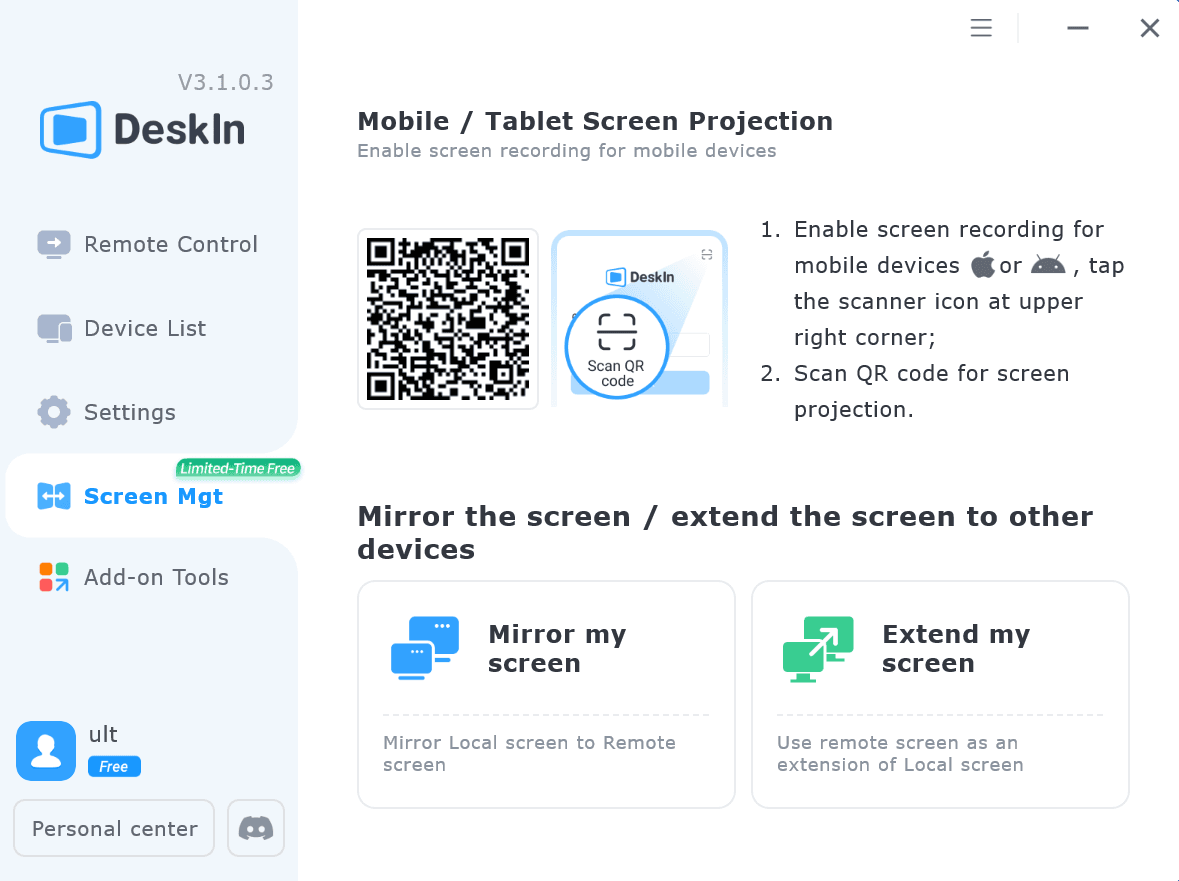
  2. Connect & Mirror: Open DeskIn on your Mac, click “Mirror / Extend Screen,” then scan the QR code using your iPhone.

    use deskin to screen mirroring
  3. Start Mirroring: Tap “Start Projection” to instantly display your iPhone screen on your computer.

    start mirroring iphone via deskin

You can also check out these related guides:

Common Questions About Apple Screen Mirroring

1. Why can’t my iPhone mirror its screen?

Common reasons include unstable Wi-Fi, unsupported devices, or blocked connections by firewalls. If your iPhone can’t find any mirroring output, restart both devices and ensure they’re on the same network. If that fails, use DeskIn, which supports wireless mirroring to Mac, PC, iPad, and Android.

2. Where is the iPhone screen mirroring option?

Open Control Center and tap Screen Mirroring (or “Screen Cast” on some iOS versions). If it’s missing, go to Settings > Control Center and add it manually. This function works with Apple TV or AirPlay-enabled smart TVs.

3. Why can’t AirPlay connect to my TV?

If AirPlay shows “No Device Found,” ensure your TV and iPhone share the same Wi-Fi and that your software is up to date.

4. How can I mirror my iPhone to a TV?

You can use AirPlay, an HDMI adapter, or third-party apps. If your iPhone-to-HDMI connection doesn’t respond, try using an official Lightning adapter. For wireless projection to computers or tablets, DeskIn lets you mirror iPhone → PC → iPad easily — without cables.

Conclusion: Fix iPhone Screen Mirroring Output Issues for a Smoother Casting Experience

When you encounter issues like “iPhone Screen Mirroring Output Not Found,” “AirPlay Connection Failed,” or “Unable to Connect,” most can be solved by restarting devices, checking the Wi-Fi network, and updating iOS.

If none of these work, your device may be incompatible or limited by AirPlay restrictions. In that case, try DeskIn, which makes iPhone-to-computer projection effortless. DeskIn not only supports cross-platform connections with low latency but also works stably even without an internet connection — making it a more flexible and seamless alternative to AirPlay.

Download DeskIn now and experience smoother, more reliable iPhone screen mirroring!

free download DeskIn
iPhone Screen Mirroring Output Not Found?

iPhone Screen Mirroring Output Not Found? Causes and Complete Fixes

When you try to cast your iPhone screen to a TV or computer but see the message “Screen Mirroring Output Not Found,” it can be frustrating. Many users report that the screen mirroring button doesn’t appear in Control Center or that their iPhone says “No Device Found.” This is a common iPhone screen mirroring output issue — usually related to network connection, device compatibility, or iOS version changes.

Before troubleshooting, let’s clarify what AirPlay is: it’s Apple’s wireless display technology that allows you to mirror your iPhone screen to a TV or Mac to share videos, photos, or presentations. However, if you’re using an iPhone 16 or older model, system setting changes might cause your iPhone to fail in finding available devices for mirroring.

This article will walk you through all the possible causes and fixes — whether you’re trying to connect wirelessly via Wi-Fi or mirror your iPad to a computer — and introduce DeskIn, the ultimate alternative tool that helps you complete screen mirroring smoothly.

Common Reasons Why iPhone Screen Mirroring Output Can’t Be Found

When mirroring your iPhone screen to a TV or Mac, if you see messages like “Unable to connect” or “No device found,” it usually means AirPlay or the network environment has encountered a problem. Common reasons include a missing mirroring button in Control Center, unsupported devices, or AirPlay connection issues with your TV.

Some users also notice lagging or the “spinning” issue when mirroring to a Mac, or even messages like “Mac screen mirroring output not found.” These often relate to firewall settings, Wi-Fi interference, or outdated iOS versions. If AirPlay can’t find your device or the connection keeps failing, keep reading — we’ll cover each cause and its solution in detail.

1. No Screen Mirroring Button in Control Center

If the screen mirroring button doesn’t appear in Control Center, the feature may not be enabled. Go to Settings > Control Center > Customize Controls and manually add “Screen Mirroring.” This solves the issue of iPhone screen mirroring settings not showing up.

For more details on controlling your Mac, see our guide:
How to Control a Mac Remotely with an iPhone – Full Step-by-Step Tutorial!

2. No Available Devices Found

If AirPlay can’t detect your TV or other devices, it’s often because they aren’t on the same Wi-Fi network or AirPlay isn’t enabled on the target device. Ensure your TV supports AirPlay and that your iPhone, TV, Mac, or Apple TV are all connected to the same Wi-Fi network to complete mirroring successfully.

Device Does Not Support AirPlay

If your iPhone can’t find a screen mirroring output, it could be due to device incompatibility. Below are common cases and recommendations:

  • iPhone 15 / 14 / 13 Series: Supports AirPlay 2, compatible with most smart TVs (Samsung, LG, Sony, etc.).

  • iPhone 12 / 11 / XS / XR Series: Requires iOS 16 or above and must be connected to the same Wi-Fi network; otherwise, devices may not appear.

  • iPhone 8 / 7 / 6 Series: Some newer TVs use protocols unsupported by older iPhones. Use a Lightning-to-HDMI cable or a third-party app like DeskIn.

  • Recommended Smart TV Brands: Samsung, LG, Sony, Panasonic, and Philips support AirPlay 2. Some lower-end models require manually enabling “AirPlay” or “Screen Mirroring.”

If you’re using an older iPhone or a non-AirPlay TV, switch to DeskIn — it allows cross-platform screen casting without being on the same network and with lower latency.

4. Outdated iOS or Device Malfunction

If your iPhone 16 can’t find a mirroring output, the issue might be an outdated iOS or a device error. Go to Settings > General > Software Update to check for updates. If the issue persists after updating, restart your iPhone or reset network settings to rule out system malfunctions.

5. Network Interference or Firewall Blocking

If AirPlay fails to connect, your router, firewall, or antivirus software might be blocking the connection. Ensure both devices are on the same Wi-Fi network, then temporarily disable firewall or security software and try again.

If problems persist, switch to DeskIn, a remote collaboration tool that bypasses network restrictions and mirrors your iPhone screen to a Mac or TV — stably and smoothly, without lag or disconnection.

How to Fix the “iPhone Screen Mirroring Output Not Found” Issue

If your iPhone can’t find a mirroring output or keeps failing to connect, don’t panic — this usually isn’t a hardware issue. Follow these troubleshooting steps: restart both devices, verify they’re on the same Wi-Fi, re-add “Screen Mirroring” in Control Center, enable AirPlay, update iOS, and check firewall permissions.

If your iPhone or iPad shows no signal even when connected via HDMI, use DeskIn — a wireless projection tool that easily mirrors your iPhone to a computer or iPad.

1. Restart Devices

When you encounter the “Screen Mirroring Output Not Found” message, the simplest and most effective first step is to restart your iPhone and your TV, Mac, or projector. Rebooting clears temporary system errors, refreshes Wi-Fi and AirPlay connections, and solves most display issues. Then test screen mirroring again.

2. Ensure Devices Are on the Same Wi-Fi

If AirPlay can’t detect your TV or compatible display, ensure your iPhone and receiving device are connected to the same Wi-Fi network. AirPlay only works over a shared local network. Even if one device is on 5GHz and the other on 2.4GHz, they might fail to connect. Try reconnecting or resetting your router.

3. Re-add Screen Mirroring Option in Control Center

After certain iOS updates, users may notice the screen mirroring button disappears. Go to Settings > Control Center > Customize Controls, then re-add “Screen Mirroring.” This restores the quick-cast shortcut, allowing you to mirror your iPhone screen to a Mac, iPad, or TV instantly.

4. Enable AirPlay on the Receiving Device

Knowing what AirPlay is helps: it’s Apple’s wireless display protocol that sends your iPhone screen to a TV or Apple TV. If AirPlay isn’t enabled on the receiving end, your iPhone won’t detect it. Open your TV or Apple TV settings to enable AirPlay and ensure both devices share the same network.

5. Update iOS

If you’re using an older iOS version, check for updates. Outdated systems may cause “iPhone 16 Screen Mirroring Output Not Found” or unstable connections. Go to Settings > General > Software Update, then install the latest version to fix compatibility and improve AirPlay performance.

6. Check Firewall Settings

If AirPlay still can’t connect, a firewall or security program might be blocking communication. Temporarily disable your computer or router’s firewall for testing, or add AirPlay as an allowed app. Make sure ports TCP 7000–7100 are open so your iPhone can detect the receiving device.

Still Can’t Fix It? Try the Ultimate Solution: DeskIn

deskin iPhone screen share

If none of the above methods work and you still can’t mirror your iPhone screen to your TV or computer, it’s time for a more stable solution — DeskIn.

Often called the best iPhone remote access tool, DeskIn easily mirrors your iPhone screen to MacBook, Windows PC, or other devices — without depending on AirPlay or specific network conditions. It delivers Apple TV–level image quality with ultra-low latency, perfect for meetings, gaming, or multi-screen workflows.

DeskIn Key Features:

  • Ultra HD Quality: Supports up to 4K 60FPS and 2K 144FPS for crisp, fluid visuals.

  • Ultra-Low Latency: Less than 40ms, enabling real-time interaction without lag.

  • Cross-Platform Support: Works on Windows, macOS, iOS, Android, and even the web.

  • Full Mobile Control: Lets you both mirror your phone to your computer and remotely control your PC from your phone.

  • Feature-Rich Free Plan: Includes screen projection, voice chat, and file transfer at no cost.

  • Fast and Stable Connection: 200+ global acceleration nodes automatically select the best route for uninterrupted performance.

Whether you’re remotely operating a Mac or sharing screens across devices, DeskIn provides smooth, wireless transmission — the most flexible and efficient AirPlay alternative available today.

How to Use DeskIn for iPhone Screen Mirroring

To mirror your iPhone to a Windows PC, MacBook, iPad, or Android device, there’s no need to rely on AirPlay. DeskIn lets you complete the connection quickly across platforms.

Steps:

  1. Download & Log In: Install DeskIn on both your iPhone and computer (e.g., MacBook). Sign up and log in.

    free download DeskIn
  2. Connect & Mirror: Open DeskIn on your Mac, click “Mirror / Extend Screen,” then scan the QR code using your iPhone.

    use deskin to screen mirroring
  3. Start Mirroring: Tap “Start Projection” to instantly display your iPhone screen on your computer.

    start mirroring iphone via deskin

You can also check out these related guides:

Common Questions About Apple Screen Mirroring

1. Why can’t my iPhone mirror its screen?

Common reasons include unstable Wi-Fi, unsupported devices, or blocked connections by firewalls. If your iPhone can’t find any mirroring output, restart both devices and ensure they’re on the same network. If that fails, use DeskIn, which supports wireless mirroring to Mac, PC, iPad, and Android.

2. Where is the iPhone screen mirroring option?

Open Control Center and tap Screen Mirroring (or “Screen Cast” on some iOS versions). If it’s missing, go to Settings > Control Center and add it manually. This function works with Apple TV or AirPlay-enabled smart TVs.

3. Why can’t AirPlay connect to my TV?

If AirPlay shows “No Device Found,” ensure your TV and iPhone share the same Wi-Fi and that your software is up to date.

4. How can I mirror my iPhone to a TV?

You can use AirPlay, an HDMI adapter, or third-party apps. If your iPhone-to-HDMI connection doesn’t respond, try using an official Lightning adapter. For wireless projection to computers or tablets, DeskIn lets you mirror iPhone → PC → iPad easily — without cables.

Conclusion: Fix iPhone Screen Mirroring Output Issues for a Smoother Casting Experience

When you encounter issues like “iPhone Screen Mirroring Output Not Found,” “AirPlay Connection Failed,” or “Unable to Connect,” most can be solved by restarting devices, checking the Wi-Fi network, and updating iOS.

If none of these work, your device may be incompatible or limited by AirPlay restrictions. In that case, try DeskIn, which makes iPhone-to-computer projection effortless. DeskIn not only supports cross-platform connections with low latency but also works stably even without an internet connection — making it a more flexible and seamless alternative to AirPlay.

Download DeskIn now and experience smoother, more reliable iPhone screen mirroring!

free download DeskIn
what is vnc

What Is VNC? A Complete Guide to Remote Desktop Control Technology

VNC (Virtual Network Computing) is a widely used remote desktop technology that allows users to operate another computer over the internet as if physically present. It is commonly applied in remote work, IT maintenance, and cross-platform collaboration. This article explains VNC’s working principles, pros and cons, comparisons with other protocols, and introduces a powerful and secure alternative — DeskIn — to help you find the best remote desktop solution.

What Is VNC?

 What Is VNC

VNC is a graphical remote desktop technology that enables users to connect to and control another computer from anywhere via the internet. Its core concept relies on screen transmission and input feedback — your keyboard and mouse operations are sent to the remote computer in real time, while its screen updates are returned to your device.

VNC is built on two components:

  • VNC Server – Installed on the controlled machine. It captures the screen and sends image data to the client.

  • VNC Viewer – Installed on the user’s device. It displays the remote screen and sends back keyboard/mouse actions.

Communication between these two components is handled through the RFB (Remote Frame Buffer) protocol, which enables cross-platform control across Windows, macOS, Linux, and more. Users only need the remote device’s IP address or access code to establish a connection.

Because VNC is open-source, multiple variants exist — RealVNC, TightVNC, UltraVNC, and others — used widely for enterprise support, server maintenance, and training. However, classic VNC has limitations in speed and security, so later sections cover how it compares to other protocols and why modern alternatives like DeskIn perform better.

free download DeskIn

What Is a VNC Client (VNC Viewer)?

VNC Viewer is the client-side application used to connect to and operate a computer running VNC Server. With it, users can view the remote desktop in real time and control it with their mouse and keyboard as if sitting in front of it.

It is available on Windows, macOS, Linux, iOS, and Android, making it suitable for remote IT support, server management, and online instruction. In most VNC tutorials, the user only needs to enter the remote host’s IP address or access code to establish a secure connection — making VNC a lightweight, cross-device remote desktop solution.

What Is a VNC Server?

VNC Server runs on the machine being controlled. It handles incoming viewer requests, transmits screen data, and processes input commands — essentially the core of the remote desktop system.

In Linux environments, commonly used VNC server programs include TigerVNC, RealVNC, and TightVNC, which can be started and configured via terminal commands. On Windows, users can enable and manage access rights through a graphical interface. Once properly installed and configured, remote users can securely log in and control the device over the network.

How VNC Works & the RFB Protocol

VNC operates through the RFB (Remote Frame Buffer) protocol, which works by compressing pixel data from the server’s screen and transmitting it to the client, while returning mouse and keyboard input back to the server.

Because only screen images and input are transmitted — not full system data — VNC can work across different operating systems and is widely used in remote management and technical support scenarios.

VNC vs. RDP: Similarities and Differences

VNC vs RDP

When choosing a remote desktop solution, VNC and RDP (Remote Desktop Protocol) are the most frequently compared technologies. Both allow remote operation, screen sharing, and maintenance tasks, but their architectures differ significantly.

Similarities

  • Remote control: both allow remote login and operation

  • Screen sharing: display the desktop in real time for support and collaboration

  • Secure connection: both can use encryption and authentication

Differences

  • Protocol: VNC uses RFB to transmit pixel data; RDP reconstructs the desktop using Microsoft's protocol, providing higher performance

  • Cross-platform: VNC supports Windows, macOS, Linux, iOS, and Android; RDP is mainly designed for Windows

  • Performance: RDP performs better on low-bandwidth networks; VNC may experience delays

  • Openness: VNC is open-source and customizable; RDP is closed but stable

If you value cross-platform flexibility, choose VNC. If you need high performance and Windows integration, choose RDP.

Why Linux Remote Desktops Commonly Use VNC

VNC’s open-source nature, lightweight footprint, and cross-platform compatibility make it a go-to solution for Linux remote desktops. It works across nearly all Linux distributions and connects smoothly with Windows, macOS, and mobile systems. Through RFB, users can remotely view and operate Linux desktops for system maintenance, server management, or development work — making VNC a widely adopted choice among Linux users.

VNC Limitations & Security Issues

Though VNC offers flexibility, it has clear limitations regarding security and network performance. Some versions lack built-in encryption, leading to increased risks during cross-network access. Understanding these issues — and deploying protective measures — is essential for safe use.

Common Security Issues & Best Practices

Common security risks:

  • Weak or reused passwords susceptible to brute-force attacks

  • Unencrypted transmissions vulnerable to interception

  • Open ports exposed to network scanning attacks

Recommended protections:

  • Use strong passwords, rotate them regularly, and enable 2FA

  • Tunnel VNC through SSH or a VPN to encrypt traffic

  • Restrict allowed IP addresses and close unused ports

  • Enable TLS/SSL encryption when available

These steps significantly reduce security threats and ensure safer remote desktop usage.

Cross-Network Challenges & Solutions

When accessing VNC across different networks, users may experience:

Common challenges:

  • Slow speeds causing lag or frozen screens

  • Packet loss affecting stability

  • Firewall or router rules blocking the connection

Solutions:

  • Use port forwarding to open a direct communication path

  • Use VPN or SSH tunnels for encrypted and reliable connection

  • Choose a cloud-relay solution like DeskIn for stable cross-network performance

    free download DeskIn

These methods can noticeably improve VNC’s usability across varied network environments.

Best VNC Alternative — DeskIn

 Best VNC Alternative — DeskIn

If you need a more powerful and smoother remote desktop solution, DeskIn is the top alternative to VNC. It delivers high performance, cross-platform support, and ease of use for individuals and businesses alike.

DeskIn supports 4K 60FPS / 2K 144FPS with adjustable resolution and under 40ms latency, providing smooth performance even for gaming or video editing. Its stable server connection and multi-monitor support ensure a seamless experience. DeskIn works on Windows, macOS, Android, iOS, and even offers a Web client for browser-based access.

Additional features such as voice chat, high-speed file transfer (12MB/s), screen mirroring & extension, remote power control, and more are all free. Gamers can use game mode, 3D perspective, controller support, and custom mobile key mappings for PC games.

Overall, DeskIn surpasses classic VNC in image quality, stability, and usability, making it ideal for work, teaching, or entertainment.

DeskIn Key Features & Advantages

As an efficient VNC alternative, DeskIn delivers a smoother and more secure remote desktop experience. Its key advantages include:

  • High quality & low latency: Up to 4K60FPS / 2K144FPS with <40ms latency

  • Cross-platform & multi-monitor: Works across Windows/macOS/iOS/Android, plus Web access

  • Fast connection & file transfer: Stable server relay and 12MB/s transfer speed

  • Full control features: Remote power control, voice chat, whiteboard, remote printing, screen extension

  • Easy to use & centrally managed: Intuitive UI and multi-device management for teams

  • Gaming & privacy modes: Game mode, 3D view, and privacy protections

  • Advanced security: End-to-end encryption, dynamic authentication, and permission controls

Compared with traditional VNC, DeskIn is easier, smoother, and more secure — ideal for business collaboration, IT maintenance, and entertainment.

DeskIn Remote Access Tutorial: 4 Easy Steps

Step 1: Download and install DeskIn

Install DeskIn on both the host and controller devices. Setup takes 1–2 minutes with no advanced configuration.

free download DeskIn

Step 2: Register or log in

Launch DeskIn and sign up using email, Google, or Apple. If you already have an account, simply log in.

Register or log in to DeskIn

Step 3: Get the device code & password

On the target computer, copy the “device code” and “temporary password,” then paste them into the controller device.

Step 4: Start remote control

Click “Connect,” and within seconds, your remote session begins.

Obtain device code and password

FAQs

Is VNC free?

Both open-source and commercial versions exist. Open-source versions (RealVNC, TightVNC) are free but limited, while commercial versions include encryption and support. For a more stable and complete experience, consider a high-performance alternative like DeskIn.

free download DeskIn

Is VNC secure?

Security depends on how it’s configured. Use strong passwords, VPN or SSH tunnels, and proper firewall rules. If you need higher-grade security, DeskIn offers end-to-end encryption, allow/deny lists, connection verification, and granular permission control.

How do I use VNC?

Install VNC Server on the host, use VNC Viewer on the client, then enter the IP address and authentication details to connect.

Can VNC transfer files?

Some VNC variants support file transfer, but speeds are slow and unstable. DeskIn offers 12MB/s high-speed transfer — better for collaboration and device management.

Conclusion

VNC is a reliable remote desktop solution known for being open-source, flexible, and cross-platform. However, it has clear limits in encryption and cross-network performance. For users who need higher image quality, lower latency, and stronger features, DeskIn is an ideal alternative — offering 4K quality, stable connections, and comprehensive multi-device support.

Download DeskIn now and experience a stable, low-latency remote desktop connection that boosts your productivity!

free download DeskIn

How to Play Xbox Games on Your Phone Easily (Full Guide)

The old-school debate of PC vs console will never truly die, but modern gaming has transformed the way we play. Today, players want freedom: play anything, anywhere, using any device. PC? Powerful. Console? Iconic. Smart rigs? Trust us—we’ve seen setups much wilder than that.

Thanks to Xbox Remote Play, you don’t even need to sit in front of your TV anymore. You can stream your Xbox One, Series X, or Series S directly to your mobile device—whether it’s a phone, tablet, or even a laptop.

If you’ve ever wondered how to play Xbox games on your phone, this guide walks you through everything you need. No fluff, no jargon—just clear, actionable steps.

What Is Xbox Remote Play? (Quick Overview)

Xbox Remote Play is a feature that lets you stream your Xbox console to another device over the internet or local network.
This allows you to:

  • Play Xbox games on your phone

  • Access your Xbox anywhere within your home

  • Continue gaming even when someone else is using the TV

  • Stream gameplay from your console to a tablet or laptop

It’s important to note: Remote Play is not cloud gaming. You’re streaming from your actual console, so your Xbox must be powered on (or in Sleep mode).

Step 1: Check the Requirements for Xbox Remote Play

Before you start, make sure your device and network meet Xbox’s recommended setup for smooth gameplay.

Supported Devices

To play Xbox on your phone, you’ll need:

  • Android 6.0+

  • iOS 10+

  • Windows 10 or 11

For tablets:

  • iPadOS 10+

  • Android Tablets 6.0+

Internet Requirements

Remote Play relies heavily on network stability. Xbox recommends:

  • Minimum upload speed: 4.75 Mbps

  • Recommended upload speed: 9 Mbps

  • Network: 5 GHz Wi-Fi

  • Best performance: Xbox connected via Ethernet

Even if your phone supports the app, an unstable network can still result in lag or low-quality streaming.

Other Compatibility Notes

  • Works with Xbox Series X|S and Xbox One

  • Instant-On / Sleep Mode must be active

  • Some backward-compatible games cannot be streamed to mobile devices

Once you’ve confirmed your setup meets these requirements, it’s time to configure your console.

Step 2: Set Up Xbox Remote Play on Your Console

xbox remote play

To start using Xbox Remote Play, follow these steps on your Xbox:

1. Open Settings

Go to Settings > Devices & connections > Remote features

2. Enable Remote Features

Check the box labeled Enable remote features

3. Test Your Setup

Select Test remote play to ensure your console is ready

4. Manage Access Permissions

If multiple people use the console, choose who can connect:

  • Any device

  • Only the logged-in profile

  • No remote access

5. Set Power Mode to Sleep

how to play xbox games on mobile

Go to:
Settings > General > Power options > Sleep

This ensures your console is always ready to stream—even when it looks “off.”

Step 3: How to Play Xbox Games on Phone Using the Xbox App

play xbox on your phone

Now for the exciting part—playing your Xbox directly on your phone.

1. Install the Xbox App

Download from:

2. Sign in with Your Xbox Account

Use the same Microsoft account connected to your console.

3. Connect Your Console

Inside the app:

  • Go to My Library

  • Select Consoles

  • Tap your Xbox

4. Start Remote Play

Choose Remote Play on this device
Tap Continue

5. Pair a Controller (Optional but Recommended)

Most games require a controller. You can connect via:

  • Bluetooth

  • USB-C

  • Xbox Wireless Controller (Bluetooth-supported)

If you’re just testing, you may tap Continue without controller, but expect limited functionality.

Your Xbox UI should now appear on your phone screen—fully playable.

Step 4: What to Do If Xbox Remote Play Doesn’t Work Smoothly

Even though Xbox Remote Play is great, it has real-world limitations:

Common Remote Play Issues

  • macOS isn’t supported natively

  • Some Android versions can’t install the app

  • Lower-end phones may lag or downscale video quality

  • Wi-Fi fluctuation causes stutters

  • Latency spikes in crowded networks

If you’re running into any of these problems, don’t worry—there’s a solution.

Step 5: Improve Your Setup Using DeskIn (Recommended)

DeskIn is an additional remote-access tool that enhances your Xbox Remote Play experience. It doesn’t replace Remote Play—it strengthens it.

Here’s why DeskIn + Xbox Remote Play is a powerful combination.

Why DeskIn Makes Xbox Remote Play Better

1. Enables Xbox Streaming on Unsupported Devices

Since Xbox Remote Play doesn’t support macOS, you can:

  1. Run Xbox App on Windows

  2. Stream your PC screen to your mac using DeskIn


    free download DeskIn

Result: You can play Xbox on macOS, smoothly.

2. Perfect for Phones With Weak Hardware

If your phone struggles to handle Remote Play:

This shifts all the heavy processing to your computer.

3. More Stable Video Streaming

DeskIn provides:

  • Faster video encoding

  • Adaptive bitrate

  • Lower latency

  • More stable sessions on weak Wi-Fi

Great for homes with multiple users sharing bandwidth.

4. Universal Compatibility

DeskIn works across:

  • Android

  • iOS

  • Windows

  • macOS

No more worrying about device restrictions.

5. Multi-Use Functionality

DeskIn isn’t just for gaming:

  • Access your PC remotely

  • Manage files

  • Work + play on the go

One tool, multiple benefits.

Final Thoughts

Learning how to play Xbox games on your phone is easier than ever thanks to Xbox Remote Play. With just a few setup steps, your phone becomes a compact Xbox screen.

And if you want even more stability or flexibility, adding DeskIn unlocks support for more devices, better streaming, and lower latency.

free download DeskIn

連絡先

メール: support@deskin.io

オフィスの住所:

991D Alexandra Road #02-17

シンガポール 119972

著作権 © 2025 Zuler Technology PTE. LTD. 無断複写・転載を禁じます。

著作権 © 2025 Zuler Technology PTE. LTD. 無断複写・転載を禁じます。

お問い合わせ

Eメール: support@deskin.io

本社: 991D Alexandra Road #02-17, シンガポール 119972

著作権 © 2025 Zuler Technology PTE. LTD. 無断複写・転載を禁じます。