Teknolohiya
Teknolohiya
/
5 Minuto
/
5 Minuto
GA
Na-update
Na-update
Na-update
Sa isang panahon na natutukoy ng hybrid na trabaho at mga nakakalat na koponan, ang simpleng akto ng pag-print ng dokumento ay naging isang nakakagulat na kumplikadong hamon. Paano makakapag-print ng isang pisikal na prototype ang isang remote designer nang walang lokal na high-end na printer? Narito ang Remote Printing—ang teknolohiya na nagbabago ng anumang networked printer sa isang global na mapagkukunan.
Ang gabay na ito ay nagbabasag kung ano ang remote printing, paano nito walang putol na pinagdudugtong ang mga digital at pisikal na puwang, at bakit ito hindi na isang luho kundi isang kritikal na kasangkapan sa produktibidad para sa anumang modernong koponan.
Ang remote printing ay nagbibigay-daan sa mga gumagamit na mag-send ng mga dokumento sa anumang printer sa buong mundo—sa loob ng opisina o sa mga kontinente—nang walang pisikal na koneksyon. Sa pamamagitan ng paggamit ng mga secure na internet-based na tool tulad ng mga cloud services, VPNs, o remote access software, pinapalaya nito ang tradisyonal na ugnayan sa pagitan ng isang device at ng printer nito.
Sa panahon ng hybrid na trabaho ngayon, binabago nito ang pag-print mula sa isang lokasyon-limited na gawain patungo sa isang on-demand na mapagkukunan—kasing-simple ng pagpapadala ng email. Hindi na kailangang malapit ang mga empleyado sa printer o umasa sa mga courier upang makuha ang mga pisikal na dokumento kung saan sila kinakailangan.
Ang mga remote workflows ay hindi na lamang teorya. Kailangan talaga ng mga tao na mag-print sa iba't ibang kwarto, gusali, at hangganan araw-araw. Narito ang mga pinaka-karaniwang paggamit:
Office-to-Home (o Balanse)
Sa remote printing, madali mong masosolusyunan ang dilema ng pagpapadala ng mga dokumentong kinakailangan ng mga kasamahan sa office printer habang nagtatrabaho mula sa bahay, o paghahanap ng mga materyales sa pagpupulong sa iyong home computer habang nasa opisina ka. Sa isang click lamang, maaaring mai-print ang mga dokumento kung saan mo gusto.
Mobile-to-Printer
Kapag ikaw ay nasa biyahe at kailangan ng isang kontrata o invoice na mai-print nang mabilis, ang isang malakas na remote printing solution ay ginagawang isang pocket-sized print controller ang iyong telepono, agad na pinapasa ang mga dokumento sa anumang nakalink na printer.
Kung madalas kang mag-print mula sa iyong telepono, makikinabang ka rin sa pag-alam kung paano ma-access ang iyong desktop files nang direkta mula sa Android. Tingnan ang aming walang putol na gabay para sa mga remote na manggagawa at digital nomads.
Cross-Platform Workflows (Mac → Windows, iPhone → PC, Chromebook → Mac)
Ang mga koponang gumagamit ng nakahalo na mga device ay maaari pa ring mag-print nang walang kaproblema. Ang remote desktop printing ay tinatanggal ang mga isyu sa driver at mga limitasyon ng compatibility, na nagbibigay-daan sa smooth na "print from anywhere" sa bawat platform.
Sa mga desentralisadong lugar ng trabaho ngayon, ang mga pangangailangan sa pag-print ay hindi nawala—lumipat lamang sila. Umaasa ang mga koponan sa remote printing upang pagdugtungin ang puwang sa pagitan ng digital na trabaho at pisikal na dokumento sa iba’t ibang lokasyon, device, at time zone.
Ang mga empleyado na nagtatrabaho mula sa bahay o mula sa iba’t ibang lungsod ay maaaring mag-send ng mga nilagdaang kontrata, presentasyon, o mga materyales sa pagpapanatili nang direkta sa mga approved office printer—pinapanatiling wala pang kapantay at standardized ang kolaborasyon sa mga rehiyon.
Maaaring mag-print ang mga sales rep, consultants, at executives ng mga proposal, report, o mga dokumento sa paglalakbay sa kanilang home-office printer mula sa mga paliparan, hotel, o site ng kliyente, tinitiyak na ang mga pangunahing papeles ay handa sa oras ng kanilang pagdating.
Ang mga legal, HR, healthcare, at finance teams ay maaaring mag-route ng sensitibong mga file lamang sa mga authorized, monitored printer.
Ang mga designer, engineer, at architect ay maaaring ma-access nang malayo ang mga color-calibrated na device, large-format plotters, at iba pang specialized printers—na nagbibigay sa kanila ng tumpak, propesyonal na output kahit saan sila nagtatrabaho.
Sa halip na bigyan ang bawat remote worker ng dedikadong printer, maaaring i-centralize ng mga organisasyon ang mga resources sa pag-print at bawasan ang mga gastos sa pagpapadala o courier sa pamamagitan ng pagpapahintulot ng lokal na pag-print sa mga regional office.
Ang mga remote staff ay maaaring mag-print ng mga shipping label, invoice, o warehouse documents eksakto kung saan sila kinakailangan, habang ang mga IT team ay nagte-troubleshoot at sumusubok ng mga printer nang malayo—nagrereduce ng downtime at onsite visits.
Ang mga estudyanteng unibersidad ay nagsusumite ng mga printed na asignatura o tesis sa mga printer ng campus habang nag-aaral mula sa bahay. Ang mga guro ay nagpi-print ng mga classroom materials o exam papers nang malayo bago bumalik sa paaralan.
Ang isang user ay nag-print ng isang recipe o coupon sa bahay habang namimili ng grocery, gamit ang isang mobile app na nakakonekta sa kanilang home printer. Ang isang miyembro ng pamilya ay tumutulong sa mga matatandang kamag-anak na mag-print ng mga reseta o form sa pamamagitan ng remote na pag-access sa kanilang home printer.
Ang remote printing ay naghuhugas ng puwang sa pagitan ng mga digital workflows at mga pisikal na pangangailangan ng dokumento—na nagpapagana ng produktibidad, seguridad, at flexibility sa isang lalong desentralisadong mundo.
Ang remote printing ay nagdadala ng higit pa sa kaginhawahan; hindi nito binabago ang kung paano nagtatrabaho ang mga modernong koponan. Binibigyan nito ang mga empleyado ng unibersal na access, mas mataas na seguridad, at mas maayos na workflows sa bawat device at lokasyon.
Trabaho Mula Saanman, Nang Walang Hangganan
Mag-print nang direkta sa office o shared printers mula sa bahay, sa site ng kliyente, o kahit habang naglalakbay. Walang pangangailangan na maging pisikal na malapit sa device: sumasabay sa iyo ang iyong mga file.
Mas Malakas na Seguridad at Pagsunod
Ang naka-encrypt na transmisyon at mga kontrol sa awtorisasyon ay tinitiyak na ang mga kumpidensyal na dokumento ay napupunta lamang sa mga approved printers, na sumusuporta sa mga pamantayan tulad ng ISO 20071, AES 256-bit encryption, at mga internal na patakaran sa seguridad ng data.
Mga Gastos at Pagtitipid ng Yaman
Maaaring mag-share ang mga remote teams ng centralized, mataas na kalidad na printers sa halip na bumili ng sobrang hardware o maglipat-lipat ng mga dokumento.
Mas Mabilis, Malinis na Operasyon
I-skip ang mga email attachments at USB transfers. Ang mga kontrata, label, proofs, at reports ay agad na umaabot sa tamang printer, pinapanatiling patuloy ang trabaho.
Itinayo para sa Hybrid at Distributed Teams
Ang bawat empleyado, nakabase sa opisina o remote, ay nakakatanggap ng consistent, maaasahang access sa mga resources sa pag-print, na nagbibigay ng pantay na pagkakataon sa iba’t ibang lokasyon.
Access sa Espesyal na Printers Anumang Oras
Gamitin ang mga large-format, color-calibrated, o department-specific printers na parang andiyan ka lang sa tabi nila—isang malaking panalo para sa mga design, engineering, at logistics teams.
Mas Kaunting Touchpoints, Mas Maliit na Paa ng Makina
Bawasan ang pagpapa-ship ng dokumento, lokal na reprints, at manual na paghawak. Ito ay mas eco-friendly, mas malinis, at mas kaunting pagkakamali.
Flexible para sa Modernong Digital Workflows
Mag-print nang walang putol mula sa mga mobile devices, cloud storage, o remote desktop printing sessions, na lahat ay integrated sa iyong existing digital tools.
Centralized IT Management
Maaaring i-deploy, i-monitor, at i-troubleshoot ng mga IT team ang mga printer sa iba’t ibang lokasyon mula sa isang lugar, na nagbabawas ng onsite support at nag-standardize sa buong ecosystem ng pag-print.
Sa esensya, ang remote printing ay nag-aupgrade ng isang pangunahing aksyon sa isang makapangyarihang kakayahan, pinapagana ang produktibidad, pinalalakas ang seguridad, at sumusuporta sa mga flexible na istilo sa trabaho ngayon.
Bigyan ang iyong koponan ng flexibility na nararapat sa kanila. Subukan ang tool ng DeskIn na mag-print mula sa kahit saan ngayon.

Sa likod ng mga eksena, ang remote printing ay pangunahing isang smart relay system; ang iyong device ay nagpapadala ng command, ang remote computer ay tumatanggap nito, at ang printer ang gumagawa ng trabaho, saan ka man naroroon. Narito kung paano talaga ito nangyayari.
Karamihan sa remote desktop printing ay nagsisimula sa isang secure tunnel. Ang mga RDP session, VPN, o mga cloud workspace ay nag-uugnay sa iyong device sa isang malayong computer, na nagpapahintulot sa iyo na kontrolin ang mga file at mga printer nito na para bang andiyan ka lang sa tabi.
Kung nagtatrabaho ka sa loob ng isang virtual machine, ang pag-redirect ng print ay pumapasok. Kumukuha ito ng iyong print request, inii-mapa ito sa tamang printer, at ipinapasa ang trabaho sa pamamagitan ng VM. Walang kalat na driver, walang manual na setup: malinis, mahusay na output lamang.
Narito kung saan nagiging masaya ang mga bagay. Ang DeskIn ay umiwas sa lahat ng komplikadong tradisyon. Ito ay awtomatikong nag-detect ng mga printer na ipinasok, sinisimulan ang mga ito sa iyong session, at ginagawang one-click na karanasan ang mga remote printing solution. Walang laban sa VPN, walang mga emergency sa IT, tanging ang makinis na pag-print mula sa kahit saan.
Kahit nasa laptop, telepono, o tablet ka, ang iyong print command ay ligtas na naglalakbay sa host machine at agad na nagpapagana. Iyon ang tunay na kapangyarihan ng print-from-anywhere; real-time, encrypted, at nakakagulat na walang kahirap-hirap.
Noong unang panahon, ang pag-email ng PDF ay tila isang maayos na workaround. Ngayon, mabagal ito, magulo, at walang kinalaman sa kahusayan ng remote printing.
Mga Pagkaantala at Kalituhan
Ang mga chain ng email ay nalilibing, ang mga mensahe ay nalalampasan, at bigla, ang "mabilis na pag-print" ay nagiging mini scavenger hunt. Sa mga tool ng print-from-anywhere, ang dokumento ay dumadaan nang diretso sa printer, walang kailangan sa gitna.
Mga Isyu sa Pag-format sa Iba't Ibang Device
Ang isang file na mukhang perpekto sa iyong laptop ay maaaring masira sa screen ng ibang tao. Ang mga font ay umaabot, ang mga margin ay kumikilos, at ang mga layout ay nawawasak. Pinapanatili ng remote desktop printing ang iyong pag-format na buo dahil nagpi-print ka nang direkta mula sa source machine.
Walang Kontrol sa Kung Kailan o Paano Ito Nagpi-print
Ang pag-email ng PDF ay nangangahulugang pagsuko ng kontrol: hindi mo maipipili ang tray, hanay ng pahina, o mga setting ng printer. Sa tamang remote printing solutions, ikaw ang nagdedesisyon kung paano eksakto ang hitsura ng huling output.
Kakulangan ng Seguridad at Paghahawakan sa Access
Ang email ay hindi idinisenyo para sa sensitibong mga dokumento. Sinumang tao ay maaaring mag-forward, kopyahin, o mishandle ang file. Ang secure remote printing ay pinapanatili ang lahat na naka-encrypt at tinitiyak na tanging mga awtorisadong device lamang ang maaring mag-trigger ng print job.
Ang pag-set up ng remote printing ay hindi dapat feels na parang pinapasok ang isang karayom sa dilim. Pinapanatili ng DeskIn ang lahat na malinis at hindi kumplikado: walang mga puzzle sa VPN, walang mga lipas na driver, walang "Bakit hindi lumalabas ang printer na ito?" na takot. Sa DeskIn, ang mga printer ay auto-detect, ang mga device ay instantly na nag-sync, at ang iyong workflow ay sa wakas nakakatanggap ng makinis na print-from-anywhere na karanasan na nararapat dito.
Ang DeskIn ay sinusuportahan din ang parehong Windows 7 at mas bago at macOS, kaya't ang mga mixed-device na koponan ay hindi nahuhuli sa mga isyu ng compatibility. At dahil ang DeskIn ay naglilipat ng mga file sa pamamagitan ng isang naka-encrypt na channel, ang bawat print job ay nananatiling protektado mula simula hanggang dulo, na nagbibigay sa iyo ng tunay na secure na remote printing solution.
Upang i-unlock ang buong karanasan, gumagamit ang DeskIn ng magaan na remote printing driver. Madali itong i-install, ngunit ito rin ang nagbibigay sa iyo ng instant, seamless na kontrol sa mga printer sa anumang remote computer.
Narito kung paano mo maitutakbo ang lahat sa loob lamang ng ilang minuto:
1. I-install ang DeskIn sa Parehong Device at Mag-log In gamit ang Parehong Account
I-download ang DeskIn sa iyong lokal na device at ang remote computer na nakakonekta sa printer. Mag-log in gamit ang parehong DeskIn account upang agad na mag-sync ang parehong device.
2. I-install ang DeskIn Remote Printing Driver sa Parehong Device
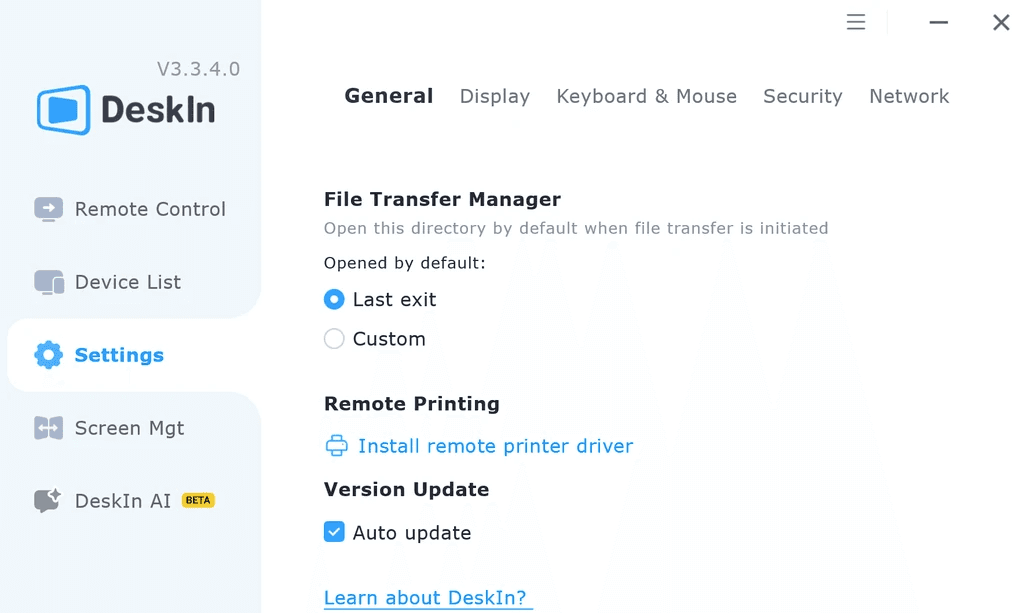
Upang ma-unlock ang buong remote desktop printing, kinakailangan ang DeskIn ng maliit na driver. Makikita mo ito sa ilalim ng:
Settings → General → Remote Printing → Install Remote Printer Driver
Kailangang mai-install ito sa parehong lokal na device at sa remote computer na iyong kinokontrol. Kakailanganin mo rin ang administrator access habang nag-i-install.
3. Pumili ng "DeskIn PDF Printer" Kapag Nagpi-print
Kapag na-install na ang driver, nagiging diretso ang pag-print nang malayo.
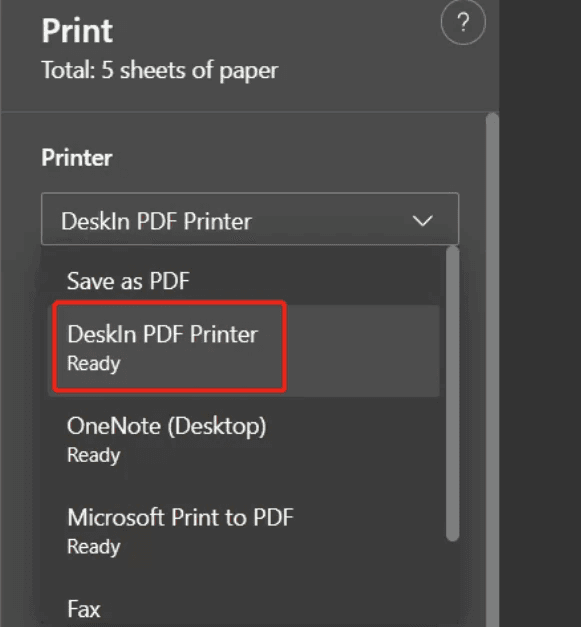
Kapag ipinindot mo ang Print sa remote computer, piliin lamang ang DeskIn PDF Printer bilang iyong printer. Ito ay nagsasabi sa DeskIn na idirekta nang secure ang file pabalik sa iyong lokal na device.
4. Pumili ng Iyong Output Option
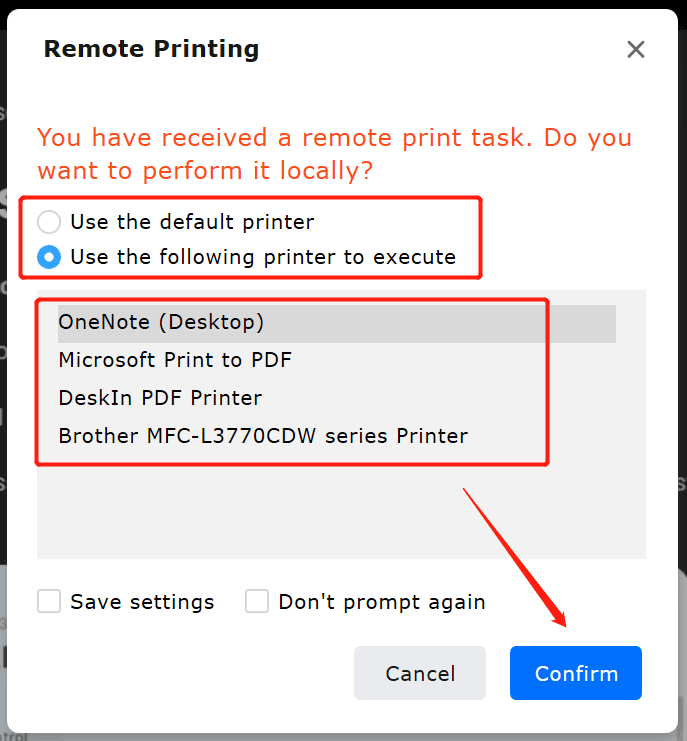
Matapos piliin ang printer, ipapakita ng DeskIn ang isang pop-up window na nagtatanong kung paano mo nais na maihatid ang dokumento.
Pumili ng opsyon na umuugma sa iyong workflow, pagkatapos ay i-click ang Confirm. Ang DeskIn ang bahala sa lahat sa likod ng mga eksena.
Mga Tip sa Pag-troubleshoot (Kung Wala nang Naka-print)
Kung ang print button ay tila hindi tumutugon o walang lumalabas sa iyong lokal na bahagi, narito ang mga mabilis na solusyon:
Tiyaking naka-install ang DeskIn printer driver
Sa controlled device, pumunta sa: DeskIn Client → Advanced Settings → Basic Settings → Install Remote Printing Driver
Subukan muli pagkatapos ng installation
I-click ang Print at suriin kung ang iyong main device ay humihiling sa iyo na pumili ng printer.
I-reinstall ang driver kung walang mga prompt na lumalabas. Alisin ang DeskIn PDF Printer mula sa remote computer, pagkatapos ay muling i-install ang driver sa pamamagitan ng DeskIn.
Kung naghahanap ka ng remote printing solution na mabilis, secure, at talagang madaling gamitin, ang DeskIn ay namumukod-tangi para sa lahat ng tamang dahilan. Ito ay itinayo para sa mga tunay na hybrid na koponan, hindi lamang para sa mga propesyonal sa IT, kaya ang pag-print mula sa kahit saan ay tila kasing simple ng pag-print mula sa iyong desk.
Secure Remote Printing, End-to-End: Ginagamit ng DeskIn ang AES 256-bit encryption upang pangalagaan ang bawat print job habang nasa biyahe, na pinoprotektahan ang mga kontrata, legal na file, at sensitibong data ng kliyente habang tumutugon sa mga modernong pamantayan sa seguridad ng enterprise.
Cross-Platform Compatibility: Kung ikaw ay tumatalon sa pagitan ng Windows at macOS o nagpi-print mula sa mobile, pinapanatili ng DeskIn ang lahat na naka-sync at maayos sa iba’t ibang sistema.
200+ Global Nodes para sa Stable Connectivity: Tinitiyak ng pandaigdigang network ng node ng DeskIn ang mabilis, maaasahang koneksyon kahit saan naroroon ang iyong koponan. Ibig sabihin ito ay nananatiling tumutugon at matatag ang remote printing sa mga bansa at kontinente.
Real-Time Performance: Sa session latency na mas mababa sa 40 ms at suporta para sa 2K/240FPS at 4K/60FPS streaming, tumutugon ang DeskIn agad sa mga remote printing commands: walang lag, walang pagkaantala, tanging makinis na pagpapatupad.
Magaan, Mabilis, at Madaling Setup: Iniiwasan ng DeskIn ang magulo at kumplikadong network configurations. I-install, mag-log in, idagdag ang remote printing driver, at handa ka na; perpekto para sa hybrid workers, remote offices, at naglalakbay na mga koponan.
Secure ba ang remote printing kapag ginagamit ang DeskIn?
Oo. Gumagamit ang DeskIn ng naka-encrypt na mga koneksyon upang pangalagaan ang iyong mga file mula simula hanggang dulo. Ang bawat print job na ipinapadala sa pamamagitan ng kanyang remote printing solution ay nananatiling pribado at secure.
Kailangan ko bang mag-install ng kahit ano bago mag-print nang malayo?
Upang ma-enable ang remote desktop printing, kailangan ng parehong lokal at remote device na naka-install ang DeskIn Remote Printing Driver. Tumagal lamang ito ng isang minuto at nangangailangan ng admin access.
Makakapag-print ba ako mula sa aking telepono gamit ang DeskIn?
Tiyak. Sinusuportahan ng DeskIn ang mobile-to-PC connections, kaya puwede kang mag-print mula sa kahit saan gamit ang iyong iOS o Android na device.
Paano kung hindi lumalabas ang DeskIn printer?
Karaniwan, nangangahulugan ito na hindi na-install ng maayos ang remote printing driver. I-reinstall ang driver sa controlled device, at ang DeskIn PDF Printer ay dapat agad na lumabas.
Gumagana ba ang DeskIn sa mga mixed operating systems?
Oo. Sinusuportahan ng DeskIn ang Windows at macOS, na ginagawang madali ang remote printing sa cross-platform setups—Mac sa Windows, Windows sa Mac, at iba pa.
Sa panahon ng hybrid na mundo ngayon, ang remote printing ay hindi na isang luho o IT-only na trick: ito ay isang praktikal, pang-araw-araw na tool na nagpapanatili ng galaw ng mga koponan. Mula sa pag-save ng mahahalagang oras hanggang sa pagbukas ng tunay na work-from-anywhere flexibility, ginagawang madali ng remote printing na manatiling produktibo kahit nasa bahay, sa opisina, o kalahating daang milya ang layo.
Habang ang mga workflow ay nagiging higit na nakakalat, ang kakayahang mag-print ng secure at maaasahan sa kabila ng mga device ay nagiging mahalaga, hindi opsyonal. At dito talaga kumikinang ang DeskIn. Isinasalin nito ang kumplikadong remote desktop printing sa isang malinis, one-click na karanasan, na nagbibigay ng bilis, katatagan, at seguridad na kailangan ng mga modernong koponan.
Ginagawa ng DeskIn na parang walang kahirap-hirap ang pag-print mula sa kahit saan. Walang mga sakit ng ulo mula sa VPN, walang laban sa compatibility, walang nakakalitong setup, tanging mga instant na resulta.
Handa na bang i-upgrade ang iyong workflow? I-download ang DeskIn ngayon at maranasan ang secure, seamless remote printing na tunay na gumagana.
Sa isang panahon na natutukoy ng hybrid na trabaho at mga nakakalat na koponan, ang simpleng akto ng pag-print ng dokumento ay naging isang nakakagulat na kumplikadong hamon. Paano makakapag-print ng isang pisikal na prototype ang isang remote designer nang walang lokal na high-end na printer? Narito ang Remote Printing—ang teknolohiya na nagbabago ng anumang networked printer sa isang global na mapagkukunan.
Ang gabay na ito ay nagbabasag kung ano ang remote printing, paano nito walang putol na pinagdudugtong ang mga digital at pisikal na puwang, at bakit ito hindi na isang luho kundi isang kritikal na kasangkapan sa produktibidad para sa anumang modernong koponan.
Ang remote printing ay nagbibigay-daan sa mga gumagamit na mag-send ng mga dokumento sa anumang printer sa buong mundo—sa loob ng opisina o sa mga kontinente—nang walang pisikal na koneksyon. Sa pamamagitan ng paggamit ng mga secure na internet-based na tool tulad ng mga cloud services, VPNs, o remote access software, pinapalaya nito ang tradisyonal na ugnayan sa pagitan ng isang device at ng printer nito.
Sa panahon ng hybrid na trabaho ngayon, binabago nito ang pag-print mula sa isang lokasyon-limited na gawain patungo sa isang on-demand na mapagkukunan—kasing-simple ng pagpapadala ng email. Hindi na kailangang malapit ang mga empleyado sa printer o umasa sa mga courier upang makuha ang mga pisikal na dokumento kung saan sila kinakailangan.
Ang mga remote workflows ay hindi na lamang teorya. Kailangan talaga ng mga tao na mag-print sa iba't ibang kwarto, gusali, at hangganan araw-araw. Narito ang mga pinaka-karaniwang paggamit:
Office-to-Home (o Balanse)
Sa remote printing, madali mong masosolusyunan ang dilema ng pagpapadala ng mga dokumentong kinakailangan ng mga kasamahan sa office printer habang nagtatrabaho mula sa bahay, o paghahanap ng mga materyales sa pagpupulong sa iyong home computer habang nasa opisina ka. Sa isang click lamang, maaaring mai-print ang mga dokumento kung saan mo gusto.
Mobile-to-Printer
Kapag ikaw ay nasa biyahe at kailangan ng isang kontrata o invoice na mai-print nang mabilis, ang isang malakas na remote printing solution ay ginagawang isang pocket-sized print controller ang iyong telepono, agad na pinapasa ang mga dokumento sa anumang nakalink na printer.
Kung madalas kang mag-print mula sa iyong telepono, makikinabang ka rin sa pag-alam kung paano ma-access ang iyong desktop files nang direkta mula sa Android. Tingnan ang aming walang putol na gabay para sa mga remote na manggagawa at digital nomads.
Cross-Platform Workflows (Mac → Windows, iPhone → PC, Chromebook → Mac)
Ang mga koponang gumagamit ng nakahalo na mga device ay maaari pa ring mag-print nang walang kaproblema. Ang remote desktop printing ay tinatanggal ang mga isyu sa driver at mga limitasyon ng compatibility, na nagbibigay-daan sa smooth na "print from anywhere" sa bawat platform.
Sa mga desentralisadong lugar ng trabaho ngayon, ang mga pangangailangan sa pag-print ay hindi nawala—lumipat lamang sila. Umaasa ang mga koponan sa remote printing upang pagdugtungin ang puwang sa pagitan ng digital na trabaho at pisikal na dokumento sa iba’t ibang lokasyon, device, at time zone.
Ang mga empleyado na nagtatrabaho mula sa bahay o mula sa iba’t ibang lungsod ay maaaring mag-send ng mga nilagdaang kontrata, presentasyon, o mga materyales sa pagpapanatili nang direkta sa mga approved office printer—pinapanatiling wala pang kapantay at standardized ang kolaborasyon sa mga rehiyon.
Maaaring mag-print ang mga sales rep, consultants, at executives ng mga proposal, report, o mga dokumento sa paglalakbay sa kanilang home-office printer mula sa mga paliparan, hotel, o site ng kliyente, tinitiyak na ang mga pangunahing papeles ay handa sa oras ng kanilang pagdating.
Ang mga legal, HR, healthcare, at finance teams ay maaaring mag-route ng sensitibong mga file lamang sa mga authorized, monitored printer.
Ang mga designer, engineer, at architect ay maaaring ma-access nang malayo ang mga color-calibrated na device, large-format plotters, at iba pang specialized printers—na nagbibigay sa kanila ng tumpak, propesyonal na output kahit saan sila nagtatrabaho.
Sa halip na bigyan ang bawat remote worker ng dedikadong printer, maaaring i-centralize ng mga organisasyon ang mga resources sa pag-print at bawasan ang mga gastos sa pagpapadala o courier sa pamamagitan ng pagpapahintulot ng lokal na pag-print sa mga regional office.
Ang mga remote staff ay maaaring mag-print ng mga shipping label, invoice, o warehouse documents eksakto kung saan sila kinakailangan, habang ang mga IT team ay nagte-troubleshoot at sumusubok ng mga printer nang malayo—nagrereduce ng downtime at onsite visits.
Ang mga estudyanteng unibersidad ay nagsusumite ng mga printed na asignatura o tesis sa mga printer ng campus habang nag-aaral mula sa bahay. Ang mga guro ay nagpi-print ng mga classroom materials o exam papers nang malayo bago bumalik sa paaralan.
Ang isang user ay nag-print ng isang recipe o coupon sa bahay habang namimili ng grocery, gamit ang isang mobile app na nakakonekta sa kanilang home printer. Ang isang miyembro ng pamilya ay tumutulong sa mga matatandang kamag-anak na mag-print ng mga reseta o form sa pamamagitan ng remote na pag-access sa kanilang home printer.
Ang remote printing ay naghuhugas ng puwang sa pagitan ng mga digital workflows at mga pisikal na pangangailangan ng dokumento—na nagpapagana ng produktibidad, seguridad, at flexibility sa isang lalong desentralisadong mundo.
Ang remote printing ay nagdadala ng higit pa sa kaginhawahan; hindi nito binabago ang kung paano nagtatrabaho ang mga modernong koponan. Binibigyan nito ang mga empleyado ng unibersal na access, mas mataas na seguridad, at mas maayos na workflows sa bawat device at lokasyon.
Trabaho Mula Saanman, Nang Walang Hangganan
Mag-print nang direkta sa office o shared printers mula sa bahay, sa site ng kliyente, o kahit habang naglalakbay. Walang pangangailangan na maging pisikal na malapit sa device: sumasabay sa iyo ang iyong mga file.
Mas Malakas na Seguridad at Pagsunod
Ang naka-encrypt na transmisyon at mga kontrol sa awtorisasyon ay tinitiyak na ang mga kumpidensyal na dokumento ay napupunta lamang sa mga approved printers, na sumusuporta sa mga pamantayan tulad ng ISO 20071, AES 256-bit encryption, at mga internal na patakaran sa seguridad ng data.
Mga Gastos at Pagtitipid ng Yaman
Maaaring mag-share ang mga remote teams ng centralized, mataas na kalidad na printers sa halip na bumili ng sobrang hardware o maglipat-lipat ng mga dokumento.
Mas Mabilis, Malinis na Operasyon
I-skip ang mga email attachments at USB transfers. Ang mga kontrata, label, proofs, at reports ay agad na umaabot sa tamang printer, pinapanatiling patuloy ang trabaho.
Itinayo para sa Hybrid at Distributed Teams
Ang bawat empleyado, nakabase sa opisina o remote, ay nakakatanggap ng consistent, maaasahang access sa mga resources sa pag-print, na nagbibigay ng pantay na pagkakataon sa iba’t ibang lokasyon.
Access sa Espesyal na Printers Anumang Oras
Gamitin ang mga large-format, color-calibrated, o department-specific printers na parang andiyan ka lang sa tabi nila—isang malaking panalo para sa mga design, engineering, at logistics teams.
Mas Kaunting Touchpoints, Mas Maliit na Paa ng Makina
Bawasan ang pagpapa-ship ng dokumento, lokal na reprints, at manual na paghawak. Ito ay mas eco-friendly, mas malinis, at mas kaunting pagkakamali.
Flexible para sa Modernong Digital Workflows
Mag-print nang walang putol mula sa mga mobile devices, cloud storage, o remote desktop printing sessions, na lahat ay integrated sa iyong existing digital tools.
Centralized IT Management
Maaaring i-deploy, i-monitor, at i-troubleshoot ng mga IT team ang mga printer sa iba’t ibang lokasyon mula sa isang lugar, na nagbabawas ng onsite support at nag-standardize sa buong ecosystem ng pag-print.
Sa esensya, ang remote printing ay nag-aupgrade ng isang pangunahing aksyon sa isang makapangyarihang kakayahan, pinapagana ang produktibidad, pinalalakas ang seguridad, at sumusuporta sa mga flexible na istilo sa trabaho ngayon.
Bigyan ang iyong koponan ng flexibility na nararapat sa kanila. Subukan ang tool ng DeskIn na mag-print mula sa kahit saan ngayon.
Sa likod ng mga eksena, ang remote printing ay pangunahing isang smart relay system; ang iyong device ay nagpapadala ng command, ang remote computer ay tumatanggap nito, at ang printer ang gumagawa ng trabaho, saan ka man naroroon. Narito kung paano talaga ito nangyayari.
Karamihan sa remote desktop printing ay nagsisimula sa isang secure tunnel. Ang mga RDP session, VPN, o mga cloud workspace ay nag-uugnay sa iyong device sa isang malayong computer, na nagpapahintulot sa iyo na kontrolin ang mga file at mga printer nito na para bang andiyan ka lang sa tabi.
Kung nagtatrabaho ka sa loob ng isang virtual machine, ang pag-redirect ng print ay pumapasok. Kumukuha ito ng iyong print request, inii-mapa ito sa tamang printer, at ipinapasa ang trabaho sa pamamagitan ng VM. Walang kalat na driver, walang manual na setup: malinis, mahusay na output lamang.
Narito kung saan nagiging masaya ang mga bagay. Ang DeskIn ay umiwas sa lahat ng komplikadong tradisyon. Ito ay awtomatikong nag-detect ng mga printer na ipinasok, sinisimulan ang mga ito sa iyong session, at ginagawang one-click na karanasan ang mga remote printing solution. Walang laban sa VPN, walang mga emergency sa IT, tanging ang makinis na pag-print mula sa kahit saan.
Kahit nasa laptop, telepono, o tablet ka, ang iyong print command ay ligtas na naglalakbay sa host machine at agad na nagpapagana. Iyon ang tunay na kapangyarihan ng print-from-anywhere; real-time, encrypted, at nakakagulat na walang kahirap-hirap.
Noong unang panahon, ang pag-email ng PDF ay tila isang maayos na workaround. Ngayon, mabagal ito, magulo, at walang kinalaman sa kahusayan ng remote printing.
Mga Pagkaantala at Kalituhan
Ang mga chain ng email ay nalilibing, ang mga mensahe ay nalalampasan, at bigla, ang "mabilis na pag-print" ay nagiging mini scavenger hunt. Sa mga tool ng print-from-anywhere, ang dokumento ay dumadaan nang diretso sa printer, walang kailangan sa gitna.
Mga Isyu sa Pag-format sa Iba't Ibang Device
Ang isang file na mukhang perpekto sa iyong laptop ay maaaring masira sa screen ng ibang tao. Ang mga font ay umaabot, ang mga margin ay kumikilos, at ang mga layout ay nawawasak. Pinapanatili ng remote desktop printing ang iyong pag-format na buo dahil nagpi-print ka nang direkta mula sa source machine.
Walang Kontrol sa Kung Kailan o Paano Ito Nagpi-print
Ang pag-email ng PDF ay nangangahulugang pagsuko ng kontrol: hindi mo maipipili ang tray, hanay ng pahina, o mga setting ng printer. Sa tamang remote printing solutions, ikaw ang nagdedesisyon kung paano eksakto ang hitsura ng huling output.
Kakulangan ng Seguridad at Paghahawakan sa Access
Ang email ay hindi idinisenyo para sa sensitibong mga dokumento. Sinumang tao ay maaaring mag-forward, kopyahin, o mishandle ang file. Ang secure remote printing ay pinapanatili ang lahat na naka-encrypt at tinitiyak na tanging mga awtorisadong device lamang ang maaring mag-trigger ng print job.
Ang pag-set up ng remote printing ay hindi dapat feels na parang pinapasok ang isang karayom sa dilim. Pinapanatili ng DeskIn ang lahat na malinis at hindi kumplikado: walang mga puzzle sa VPN, walang mga lipas na driver, walang "Bakit hindi lumalabas ang printer na ito?" na takot. Sa DeskIn, ang mga printer ay auto-detect, ang mga device ay instantly na nag-sync, at ang iyong workflow ay sa wakas nakakatanggap ng makinis na print-from-anywhere na karanasan na nararapat dito.
Ang DeskIn ay sinusuportahan din ang parehong Windows 7 at mas bago at macOS, kaya't ang mga mixed-device na koponan ay hindi nahuhuli sa mga isyu ng compatibility. At dahil ang DeskIn ay naglilipat ng mga file sa pamamagitan ng isang naka-encrypt na channel, ang bawat print job ay nananatiling protektado mula simula hanggang dulo, na nagbibigay sa iyo ng tunay na secure na remote printing solution.
Upang i-unlock ang buong karanasan, gumagamit ang DeskIn ng magaan na remote printing driver. Madali itong i-install, ngunit ito rin ang nagbibigay sa iyo ng instant, seamless na kontrol sa mga printer sa anumang remote computer.
Narito kung paano mo maitutakbo ang lahat sa loob lamang ng ilang minuto:
1. I-install ang DeskIn sa Parehong Device at Mag-log In gamit ang Parehong Account
I-download ang DeskIn sa iyong lokal na device at ang remote computer na nakakonekta sa printer. Mag-log in gamit ang parehong DeskIn account upang agad na mag-sync ang parehong device.
2. I-install ang DeskIn Remote Printing Driver sa Parehong Device
Upang ma-unlock ang buong remote desktop printing, kinakailangan ang DeskIn ng maliit na driver. Makikita mo ito sa ilalim ng:
Settings → General → Remote Printing → Install Remote Printer Driver
Kailangang mai-install ito sa parehong lokal na device at sa remote computer na iyong kinokontrol. Kakailanganin mo rin ang administrator access habang nag-i-install.
3. Pumili ng "DeskIn PDF Printer" Kapag Nagpi-print
Kapag na-install na ang driver, nagiging diretso ang pag-print nang malayo.
Kapag ipinindot mo ang Print sa remote computer, piliin lamang ang DeskIn PDF Printer bilang iyong printer. Ito ay nagsasabi sa DeskIn na idirekta nang secure ang file pabalik sa iyong lokal na device.
4. Pumili ng Iyong Output Option
Matapos piliin ang printer, ipapakita ng DeskIn ang isang pop-up window na nagtatanong kung paano mo nais na maihatid ang dokumento.
Pumili ng opsyon na umuugma sa iyong workflow, pagkatapos ay i-click ang Confirm. Ang DeskIn ang bahala sa lahat sa likod ng mga eksena.
Mga Tip sa Pag-troubleshoot (Kung Wala nang Naka-print)
Kung ang print button ay tila hindi tumutugon o walang lumalabas sa iyong lokal na bahagi, narito ang mga mabilis na solusyon:
Tiyaking naka-install ang DeskIn printer driver
Sa controlled device, pumunta sa: DeskIn Client → Advanced Settings → Basic Settings → Install Remote Printing Driver
Subukan muli pagkatapos ng installation
I-click ang Print at suriin kung ang iyong main device ay humihiling sa iyo na pumili ng printer.
I-reinstall ang driver kung walang mga prompt na lumalabas. Alisin ang DeskIn PDF Printer mula sa remote computer, pagkatapos ay muling i-install ang driver sa pamamagitan ng DeskIn.
Kung naghahanap ka ng remote printing solution na mabilis, secure, at talagang madaling gamitin, ang DeskIn ay namumukod-tangi para sa lahat ng tamang dahilan. Ito ay itinayo para sa mga tunay na hybrid na koponan, hindi lamang para sa mga propesyonal sa IT, kaya ang pag-print mula sa kahit saan ay tila kasing simple ng pag-print mula sa iyong desk.
Secure Remote Printing, End-to-End: Ginagamit ng DeskIn ang AES 256-bit encryption upang pangalagaan ang bawat print job habang nasa biyahe, na pinoprotektahan ang mga kontrata, legal na file, at sensitibong data ng kliyente habang tumutugon sa mga modernong pamantayan sa seguridad ng enterprise.
Cross-Platform Compatibility: Kung ikaw ay tumatalon sa pagitan ng Windows at macOS o nagpi-print mula sa mobile, pinapanatili ng DeskIn ang lahat na naka-sync at maayos sa iba’t ibang sistema.
200+ Global Nodes para sa Stable Connectivity: Tinitiyak ng pandaigdigang network ng node ng DeskIn ang mabilis, maaasahang koneksyon kahit saan naroroon ang iyong koponan. Ibig sabihin ito ay nananatiling tumutugon at matatag ang remote printing sa mga bansa at kontinente.
Real-Time Performance: Sa session latency na mas mababa sa 40 ms at suporta para sa 2K/240FPS at 4K/60FPS streaming, tumutugon ang DeskIn agad sa mga remote printing commands: walang lag, walang pagkaantala, tanging makinis na pagpapatupad.
Magaan, Mabilis, at Madaling Setup: Iniiwasan ng DeskIn ang magulo at kumplikadong network configurations. I-install, mag-log in, idagdag ang remote printing driver, at handa ka na; perpekto para sa hybrid workers, remote offices, at naglalakbay na mga koponan.
Secure ba ang remote printing kapag ginagamit ang DeskIn?
Oo. Gumagamit ang DeskIn ng naka-encrypt na mga koneksyon upang pangalagaan ang iyong mga file mula simula hanggang dulo. Ang bawat print job na ipinapadala sa pamamagitan ng kanyang remote printing solution ay nananatiling pribado at secure.
Kailangan ko bang mag-install ng kahit ano bago mag-print nang malayo?
Upang ma-enable ang remote desktop printing, kailangan ng parehong lokal at remote device na naka-install ang DeskIn Remote Printing Driver. Tumagal lamang ito ng isang minuto at nangangailangan ng admin access.
Makakapag-print ba ako mula sa aking telepono gamit ang DeskIn?
Tiyak. Sinusuportahan ng DeskIn ang mobile-to-PC connections, kaya puwede kang mag-print mula sa kahit saan gamit ang iyong iOS o Android na device.
Paano kung hindi lumalabas ang DeskIn printer?
Karaniwan, nangangahulugan ito na hindi na-install ng maayos ang remote printing driver. I-reinstall ang driver sa controlled device, at ang DeskIn PDF Printer ay dapat agad na lumabas.
Gumagana ba ang DeskIn sa mga mixed operating systems?
Oo. Sinusuportahan ng DeskIn ang Windows at macOS, na ginagawang madali ang remote printing sa cross-platform setups—Mac sa Windows, Windows sa Mac, at iba pa.
Sa panahon ng hybrid na mundo ngayon, ang remote printing ay hindi na isang luho o IT-only na trick: ito ay isang praktikal, pang-araw-araw na tool na nagpapanatili ng galaw ng mga koponan. Mula sa pag-save ng mahahalagang oras hanggang sa pagbukas ng tunay na work-from-anywhere flexibility, ginagawang madali ng remote printing na manatiling produktibo kahit nasa bahay, sa opisina, o kalahating daang milya ang layo.
Habang ang mga workflow ay nagiging higit na nakakalat, ang kakayahang mag-print ng secure at maaasahan sa kabila ng mga device ay nagiging mahalaga, hindi opsyonal. At dito talaga kumikinang ang DeskIn. Isinasalin nito ang kumplikadong remote desktop printing sa isang malinis, one-click na karanasan, na nagbibigay ng bilis, katatagan, at seguridad na kailangan ng mga modernong koponan.
Ginagawa ng DeskIn na parang walang kahirap-hirap ang pag-print mula sa kahit saan. Walang mga sakit ng ulo mula sa VPN, walang laban sa compatibility, walang nakakalitong setup, tanging mga instant na resulta.
Handa na bang i-upgrade ang iyong workflow? I-download ang DeskIn ngayon at maranasan ang secure, seamless remote printing na tunay na gumagana.


How to Play MapleStory Classic World on Mac
A lot of the players who are most excited about MapleStory Classic World grew up on 2005-era MapleStory — and a large share of that generation now does its computing on a MacBook. Nexon clearly knows this: a native macOS client was on the feature list for the second Closed Online Test, which ran August 4–12, 2026, alongside Ossyria and third job advancement. But as of this writing, that Mac client is still in development, not publicly available, and there's still no confirmed public launch date for the game itself.
So if you want to play MapleStory Classic World on a Mac right now — or want a reliable plan for when the game does launch — you've got two real options: run Windows in a virtual machine, or use DeskIn remote desktop to control an actual Windows PC from your Mac. This guide covers both, including a login-conflict issue that catches a lot of virtual machine users off guard.
Not yet, publicly. Nexon's May 2026 roadmap update confirmed macOS support is in development, and it appeared as a testable feature in the second Closed Online Test. Windows PC remains the confirmed launch platform, and Nexon hasn't said whether the Mac client will be ready at launch or arrive afterward. The game hasn't had a full public release on any platform — Nexon has said one more test is planned before launch.
Given that, Mac players currently have two ways in: a Windows virtual machine, or remote desktop software that connects to a real Windows PC.
Classic World is exclusive to GMS (Global MapleStory), covering North America, Europe, and most other regions without a local Nexon partner. Markets with their own official MapleStory service — Korea, China, Japan, Taiwan/Hong Kong, and Southeast Asia — aren't GMS-eligible, so Mac players in those regions would need a VPN to reach Classic World, which isn't recommended. Whether NA and EU will run as separate worlds hasn't been confirmed.
Tools like Parallels Desktop or VMware Fusion let you run a full Windows install inside macOS, and then install MapleStory Classic World the way a Windows user would. It works, but it asks a lot of your Mac's hardware.
RAM: 16GB minimum recommended; 8GB is genuinely tight, since macOS and Windows are both running at once and macOS alone can eat most of that before Windows gets a share. For a comfortable setup with guides or Discord open on the side, aim for 32GB.
CPU/GPU: Virtual machines can't pass hardware through at 100%; graphics get software-emulated, which typically costs 20–30% of the performance you'd get on native Windows hardware.
Thermals: Running two full operating systems under load generates real heat, and laptop-class Macs with limited cooling can throttle during longer grinding sessions.
Apple Silicon translation overhead: M-series Macs can only run Windows on ARM in a VM. If Classic World ships as an x86/x64 build, it needs an extra translation layer to run at all, stacking on top of the virtualization overhead already mentioned.
Anti-cheat compatibility is a real unknown: the original MapleStory has historically been hostile to virtualized environments because of its anti-cheat system, and Nexon hasn't said how Classic World's anti-cheat will treat VMs. Treat virtualization as a maybe, not a guaranteed plan.
There's also the practical overhead: setting up a VM means downloading a Windows image, allocating dozens of gigabytes of disk space, installing display drivers, and — on Apple Silicon — dealing with ARM compatibility quirks that don't show up on a real x86 PC. Keyboard shortcuts can also conflict, since macOS system shortcuts (Control, Option, Command) don't always play nicely with a Windows game's default keybinds.
Instead of building a Windows environment inside your Mac, DeskIn lets you connect directly to a Windows PC you already have — your desktop at home, a work machine, or a spare laptop — and control it from your Mac in real time. The game runs on genuine Windows hardware the whole time, so there's no emulation tax, no ARM translation layer, and no anti-cheat guessing game.
A virtual machine makes sense if:
You don't have access to any Windows PC at all, so a Mac VM is your only option.
Your Mac has strong specs — 16GB+ RAM, ideally 32GB, and a higher-end M-series chip that can absorb the performance loss.
You're comfortable with a fairly technical setup process.
You rarely need to switch between devices, so the single-login limitation isn't a practical issue for you.
DeskIn makes more sense if:
You already have a Windows PC (or another Mac) that can run MapleStory Classic World, and you just want to reach it from your MacBook.
You're traveling or away from your desk often and want to pick up where you left off without re-downloading anything.
You don't want to deal with logging out of one device every time you switch to another.
Your Mac has more modest specs, and you'd rather not risk stutters, crashes, or a game that won't launch at all.
If you already own a Windows machine, DeskIn is generally the lower-effort, lower-risk choice. A VM is really a fallback for players with no Windows access and a Mac powerful enough to absorb the overhead.
Step 1: Set up the Windows PC. Install MapleStory Classic World on a Windows PC and create your character, then install DeskIn on that same PC, sign in, and enable unattended access with a connection password so you can reach it later without anyone at the keyboard.
Step 2: Install DeskIn on your Mac. Download the macOS version of DeskIn, sign in with the same account, and your Windows PC will appear in your device list.
Step 3: Connect. Select the PC, enter the connection password, and you'll get a live view of the Windows desktop that you control with your Mac's mouse and trackpad — the same session, the same login, no conflicts.
Step 4: Tune quality for your connection. On a stable connection, push quality up to enjoy Classic World's remastered pixel art in full detail; on the road, prioritize smoothness to cut down on input lag.
Step 5: Log in and play. Open the game inside the remote session and log in as usual — grinding, party quests, and shopping all work exactly as they would sitting at the PC directly.
Resolution and quality: Free-tier users should start around 720p/30fps for a stable baseline; paid-tier users can push up to 4K 60FPS or 2K 240FPS on a strong connection to get the most out of Classic World's art.
Screen scaling: If your Mac and Windows PC have very different display sizes, use DeskIn's automatic scaling option in the toolbar, or adjust the remote PC's resolution to match your Mac's screen more closely.
Keyboard and mouse mapping: DeskIn maps your Mac's keyboard directly to the remote PC. Turning on Game Mouse mode prevents the keyboard from getting locked mid-session.
Controller support: If Mac keyboard controls feel awkward, pair a controller to your Mac and enable controller mapping from the toolbar — DeskIn will pass those inputs straight through to the remote PC.
Simple Setup:No Windows installation required — connect and start playing within minutes.
Doesn't tax your Mac's hardware. All the actual computation happens on the remote Windows PC; your Mac just displays the stream and sends inputs.
Performance and compatibility match native Windows, because that's exactly what's running — no ARM translation layer to worry about.
No account login conflicts, since DeskIn connects to the same existing session instead of creating a new device.
Cross-device flexibility. The same account lets you connect from Mac, iPhone, iPad, or Android, and it's always the same underlying session — no juggling logins between devices.
Not publicly yet. Nexon has confirmed a macOS client is in development and tested it in the second Closed Online Test, but Windows remains the confirmed launch platform and no public Mac release has shipped.
Yes. DeskIn uses end-to-end encryption and two-factor login, and since you're remotely operating a PC you already control, your credentials never pass through a third party.
Technically you can install one, but the experience will be rough. With 8GB split between macOS and Windows, there's very little left over for Windows, and stutters or crashes become likely during longer sessions. DeskIn is the more stable option here, since the remote PC handles all the processing — your Mac's RAM isn't a bottleneck.
Real-world performance depends on both ends' network quality, but since DeskIn connects to native Windows hardware with no virtualization overhead, and its low-latency streaming keeps end-to-end delay under 40ms on a good connection, it typically feels smoother than a resource-constrained VM.
No. DeskIn controls the same PC and the same already-active session rather than logging in as a new device, so it doesn't trigger MapleStory's single-session login limit — this is exactly the conflict that trips up VM users switching between two separate Windows installs.
DeskIn needs a Windows (or other supported platform) machine to connect to. If you don't have one, consider borrowing access to a friend's or family member's PC, or renting a cloud Windows machine as your connection target.
DeskIn supports Windows, macOS, iOS, and Android. A Mac can connect to a Windows PC, and a Windows PC can just as easily connect to and control a Mac.
MapleStory Classic World doesn't have a public Mac client yet, but that doesn't mean Mac players have to gamble on a resource-hungry virtual machine and hope the anti-cheat cooperates. If you already have access to a Windows PC that can run the game — or even another Mac — connecting to it through DeskIn gets you native Windows performance, none of the virtualization overhead, and none of the account-login headaches that come with running a second "device." Set it up once, and you'll be ready to log in the moment Classic World opens its doors.

How to Play MapleStory Classic World on Mobile Before the Official App Arrives
MapleStory Classic World has turned into one of the most-searched topics in the MapleStory community this year. Nexon's pre-Big Bang server pulled in roughly 5,000 players for its first Closed Online Test back in April 2026, and thousands more signed up for the second test that ran August 4–12, 2026. With Ossyria, third job advancement, and controller support now confirmed, interest has never been higher — and a lot of that interest is coming from players who want to know one thing: can you play MapleStory Classic World on your phone?
Short answer: not with an official app, not yet. This guide breaks down exactly what Nexon has confirmed about platforms so far, then walks through how DeskIn remote desktop lets you play MapleStory Classic World on mobile right now, without waiting on an app that hasn't been announced.
As of this writing, Nexon has not announced a mobile or console version of MapleStory Classic World. The confirmed platforms are Windows PC and macOS — macOS support was specifically added as a testable feature during the second Closed Online Test in August 2026, alongside Ossyria and third job advancement, but it's still listed as "in development" rather than publicly available.
There's also no full public launch date yet. Nexon has run two Closed Online Tests so far and has said one more test is planned before release, so most community trackers currently estimate a launch window in late 2026 or early 2027 — but that's community speculation, not an official date.
Put simply: if you want to play MapleStory Classic World on a phone or tablet today, a native app isn't an option. The only practical route is streaming the PC version from a Windows machine you already have access to.
Classic World is exclusive to GMS (Global MapleStory), Nexon's English-language service for North America, Europe, and most other regions without a local Nexon partner. Players in markets with their own official MapleStory service — Korea, China, Japan, Taiwan/Hong Kong, and Southeast Asia — aren't eligible for GMS accounts, so Classic World isn't accessible there without a VPN, which isn't recommended. It's not yet confirmed whether NA and EU will run as separate worlds within Classic World.
DeskIn is a cross-platform remote desktop app built specifically with PC gaming in mind, and it maps well onto exactly the problem MapleStory Classic World mobile players are trying to solve.
Stable, low-latency connections. DeskIn's ZeroSync® engine keeps end-to-end latency under 40ms on a good connection and automatically reroutes around congested paths, so grinding, dodging, and skill combos in Classic World's classic-era combat don't feel delayed.
Up to 4K 60FPS / 2K 240FPS streaming. Classic World's remastered pixel art holds up well when it isn't compressed into mush — DeskIn's streaming keeps text and sprites sharp even on a phone screen.
You're connecting to your own PC, not emulating one. DeskIn doesn't run Windows inside your phone; it streams the display of a Windows computer you control and sends your inputs back in real time. That means full compatibility and full performance — no emulation layer to fight with.
End-to-end encryption and two-factor login. Sessions are encrypted end-to-end, and you can set an allowlist of authorized devices, so only you can connect to your own PC.
Flexible, per-character keybinds. Classic World's Warrior, Magician, Bowman, and Thief classes each use very different skill layouts. DeskIn's on-screen game keyboard lets you build a custom key layout and save it as its own profile, so you can switch between characters without re-mapping keys every time.
Built-in virtual mouse. In pointer mode, DeskIn adds virtual left/right mouse buttons over the stream, which makes precise UI clicks — inventory, cash shop, trade windows — far easier than tapping blindly on a touchscreen.
Once you're connected, mobile play through DeskIn covers pretty much everything you'd do sitting at your PC:
Daily quests and login rewards — knock these out on your commute instead of waiting until you're home.
Cash shop browsing — scroll and preview cosmetics with touch gestures just like any shopping app.
Grinding and leveling — use the virtual directional pad and skill-key layout to keep training in familiar maps.
Party quests — latency low enough to keep up with a party's pacing on runs like Kerning City PQ.
Trading and the marketplace — check prices and list items using the virtual mouse for precise clicks.
Guild chat and messaging — reply to your guild or party the moment something comes up.
Step 1: Set up DeskIn on the Windows PC running Classic World. Install DeskIn on the PC where you've registered for testing (or where the game is installed once it launches), sign in, and turn on unattended access so the PC can be reached without anyone sitting in front of it.
Step 2: Install the DeskIn app on your phone. Download DeskIn from the App Store or Google Play, sign in with the same account, and your PC will show up in the device list.
Step 3: Connect and switch to pointer mode. Tap your PC to connect, then switch the control mode from touch to pointer — this unlocks the customizable virtual keyboard and virtual mouse.
Step 4: Browsing the cash shop. Drag to move the cursor and tap the virtual mouse buttons to click through menus and item previews, exactly like using a mouse on a desktop.
Step 5: Grinding. Open the game keyboard menu, build a layout with your movement keys and skill keys, and save it as a profile. Pull it up any time you start a grinding session.
Step 6: Pick the right streaming quality for your connection. On mobile data, prioritize smoothness over resolution to cut down on input delay; on Wi-Fi, bump the quality up to enjoy Classic World's remastered art at full clarity.
A tablet's bigger screen is a natural fit for content that needs either more reading room or more precision — daily quest text and boss encounters both qualify.
Step 1: Same setup as mobile. Install DeskIn on your iPad or Android tablet and sign in — connection steps are identical to the phone app.
Step 2: Daily quests. The larger display makes quest text, item descriptions, and map markers easier to read at a glance, so you're less likely to misread an objective mid-run.
Step 3: Boss fights. Bosses demand precise dodges and timing that touch controls alone can struggle with — pair your tablet with a Bluetooth keyboard and mouse, or a controller (see below), instead of relying on the virtual keyboard.
Step 4: Bump the frame rate for boss content. Choose a higher refresh setting in DeskIn's connection options so skill telegraphs and boss patterns read clearly in real time.
Step 5: Use split-screen for guide lookups. Run DeskIn alongside a browser or notes app in split view to check attack patterns without leaving the fight.
If virtual buttons don't feel precise enough, DeskIn supports Bluetooth controllers, including Xbox, PlayStation, and several third-party pads.
Step 1: Pair the controller with your phone. Use your phone's Bluetooth settings to pair the controller first.
Step 2: Connect through DeskIn. Once connected to your PC, DeskIn automatically detects the paired controller — no extra driver install needed.
Step 3: Test your inputs. Head into a training map first and confirm movement, attacks, and skills map to the buttons you expect before jumping into content that matters.
Step 4: Favor smoothness for fast-paced play. When you're actively grinding or fighting with a controller, prioritize DeskIn's smoothness setting over max resolution for the most responsive feel.
Running a Warrior and a Bowman means running two very different skill bars. Here's how to keep them separate in DeskIn instead of re-mapping keys every login:
Step 1: Switch to pointer mode and open the game keyboard menu. After connecting, switch to pointer mode and open DeskIn's game keyboard settings.
Step 2: Create a new keyboard layout. Tap "New Keyboard" and add your movement pad, skill keys, and item keys to match your current character's build.
Step 3: Name it by character or class. Label the layout something identifiable — "Bowman" or "Main Warrior" — and save it.
Step 4: Load the right profile when you switch characters. Before logging into a different character, select its saved layout from the game keyboard menu instead of rebuilding it from scratch.
Step 5: Update layouts as skills change. When a class gets rebalanced or you unlock new skills after a job advancement, go back into that profile and add the new keys.
No. Nexon has not announced a mobile or console version. Confirmed platforms are Windows, with a macOS client currently in development.
Nexon hasn't announced a public release date. Two Closed Online Tests have run so far (April 16–24 and August 4–12, 2026), with one more test planned before launch. Community estimates point to late 2026 or early 2027, but that isn't official.
No. DeskIn remotely operates your own PC and sends the same mouse and keyboard input you'd normally use — it isn't a macro, bot, or memory-editing tool, so it doesn't behave like the automation that anti-cheat systems are built to catch.
DeskIn's low-latency streaming keeps things playable on a stable connection, generally noticeably smoother than trying to force a browser workaround. Real-world latency still depends on both ends' network quality, so Wi-Fi is recommended over cellular when possible.
For checking dailies or browsing the shop occasionally, the free plan typically covers it. If you plan to grind for long sessions, use a controller regularly, or manage several devices, a paid plan unlocks higher streaming quality and additional features.
Setup and connection steps are identical. The difference is screen size — phones are handy for quick, single-hand tasks like dailies and the shop, while tablets are better suited to boss fights and content where you want a controller or external keyboard.
Until Nexon ships a mobile client — if one ever gets announced — DeskIn is the most practical way to keep playing MapleStory Classic World away from your desk. Install it on both your gaming PC and your phone or tablet, set up a keybind profile per character, and you can knock out dailies, grind, and even tackle boss fights without being tied to a monitor.

Gawing Pangalawang Monitor ang iPad Para sa Windows at Mac Computers
Para sa mga multitasking na manggagawa, ang pagkakaroon ng pangalawang monitor ay maaaring greatly increase ng productivity. Kung ikaw ay isang tao sa home office o isang estudyante na walang dual screen. Narito kung paano mo madaling gawing pangalawang monitor ang iyong idle iPad para sa iyong computer.
1. Taasan ang espasyo ng screen upang ipakita ang higit pa sa parehong oras. Para sa mga multi-task users, maiiwasan nilang magpalipat-lipat ng mga bintana, na nakakatipid ng oras.
2. Ang bawat screen ay gumagana nang hiwalay, ginagawang mas organisado ang workspace.
Kapag nag-e-edit ng mga video, isang screen ang ginagamit para sa pag-e-edit at ang isa para sa paglalagay ng mga materyales. Kapag sumusulat ng papel, isang screen para sa pagsusulat, ang isa para sa paghahanap ng impormasyon atbp.
3. Ang laki ng screen ng iPad ay sapat na malaki, at ang kalidad ng display ay medyo maganda. Para sa mga gumagamit na may mga pangangailangan sa disenyo o gumagamit ng MacBook, mas nagiging cost-effective ito kaysa sa pagbili ng karagdagang screen, at wala nang problema sa pagkakaiba ng kulay.
4. Maraming tao ang may mga iPad sa bahay. Sa pamamagitan ng paggamit ng device na mayroon ka bilang isang dual screen, nakakatipid ka sa gastos ng pagbili ng isa pang screen at ng espasyong ilalagay ito.
Ang sariling tampok ng Apple na Apple Sidecar ay nagbibigay-daan sa iyo na gamitin ang iPad bilang isang external display para sa MacBook at iMac. Gumawa lamang ng ilang simpleng setting at maaari mong makamit ang seamless connection sa pagitan ng iyong iPad at computer.
Paalala: Upang magamit ang Apple Sidecar, ang dalawang device ay dapat nakalog sa parehong Apple ID o nasa parehong network. Dapat i-on ang Bluetooth at Wi-Fi sa parehong device, at hindi dapat lumagpas ang distansya ng 10 meters (tungkol sa 10 meters).
Buksan ang Mac System Settings >> I-click ang "Display" sa sidebar >> I-click ang "+" pop up menu sa kanan at piliin ang iyong iPad.
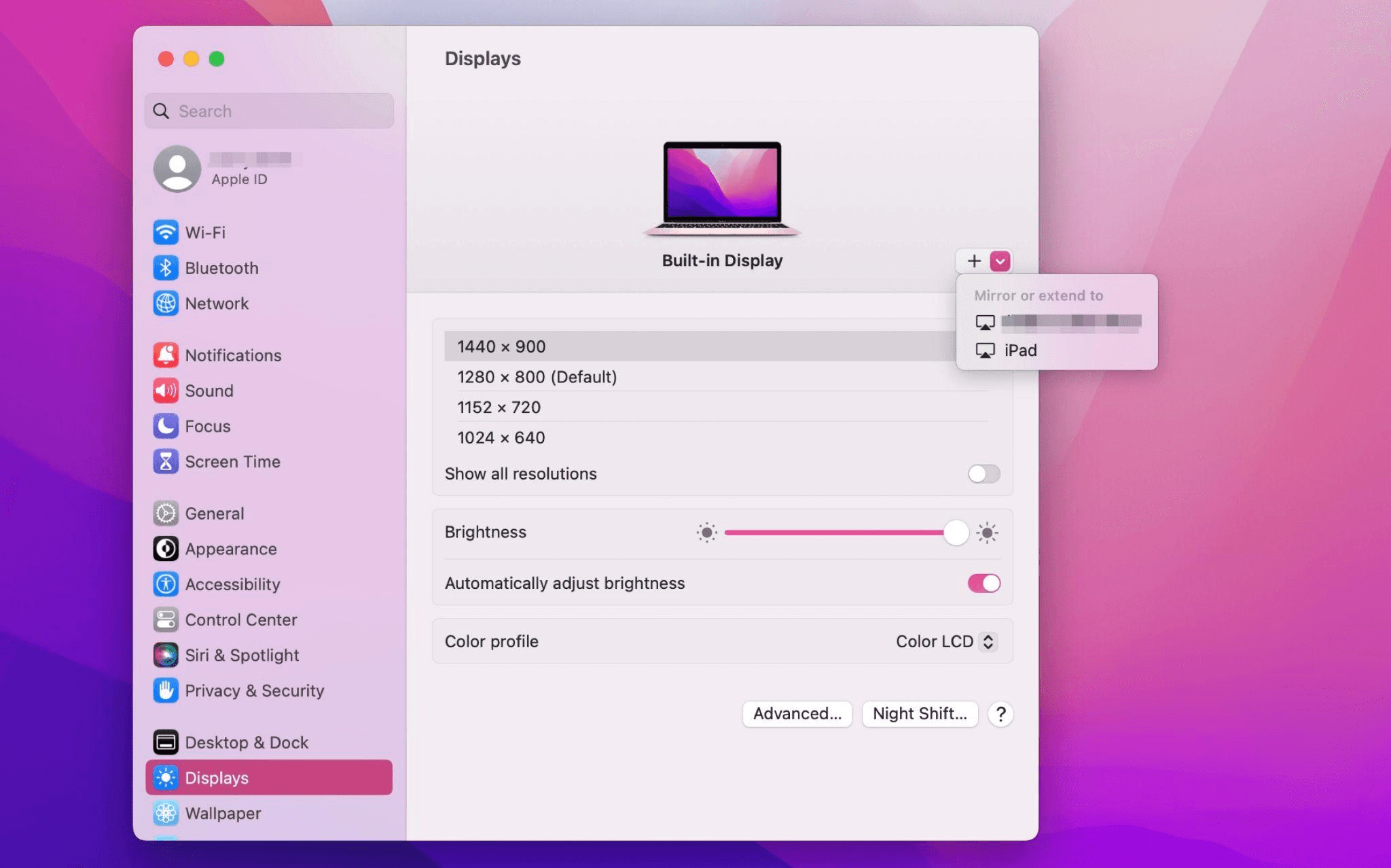
Piliin ang iPad, baguhin ang Use as settings sa "Extended Display". Suriin ang Airplay settings sa itaas na toolbar ng Mac at itakda ang iPad bilang "Use As Separate Display".
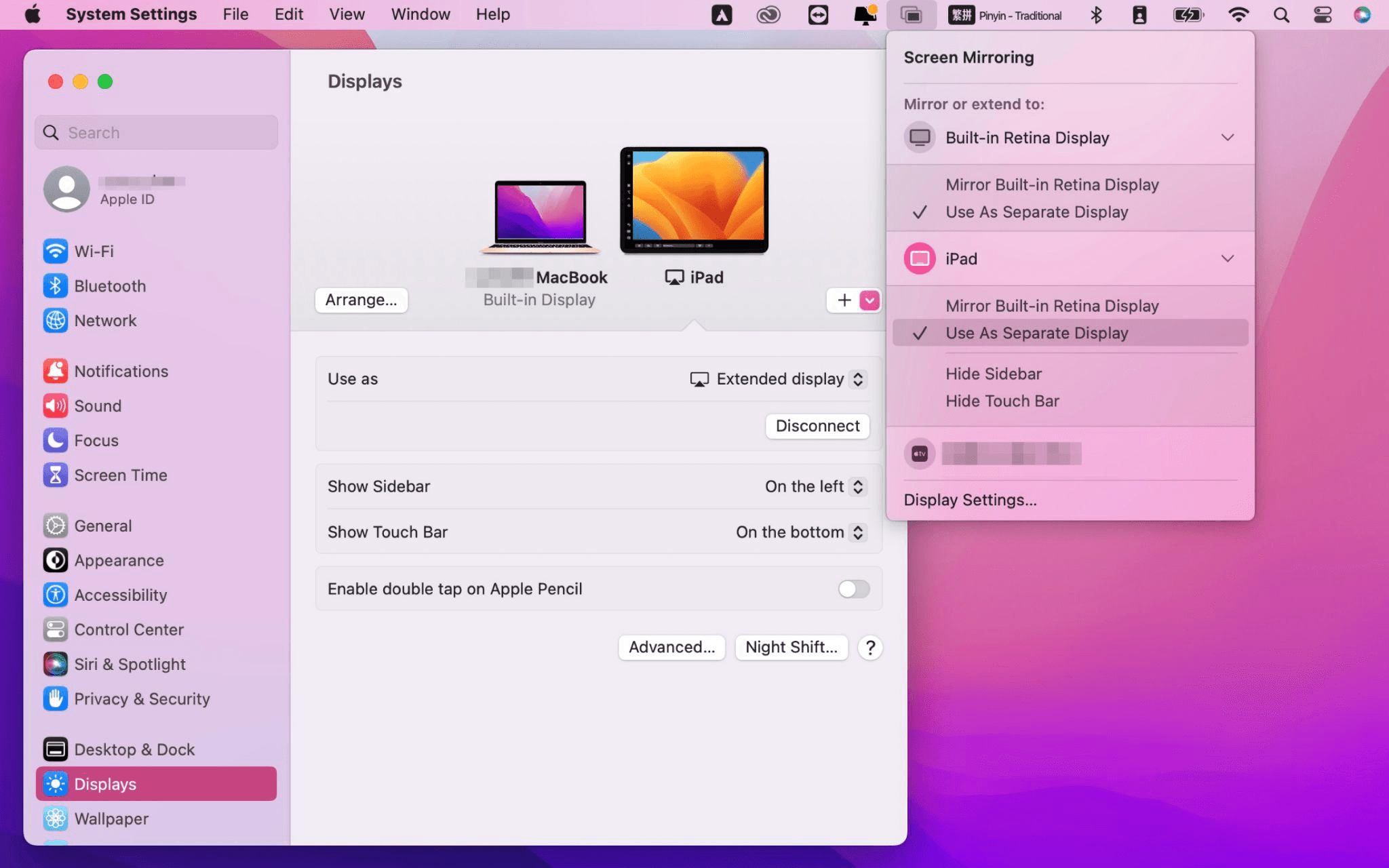
Matapos makumpleto ang mga setting, ang iyong iPad ay magiging pangalawang display para sa iyong Mac. Maaari mong ilipat ang mga bintana mula sa iyong Mac papunta sa iyong iPad nang maayos. Maaari mo ring gamitin ang sidebar sa iPad o baguhin ang posisyon ng sidebar sa system display settings.
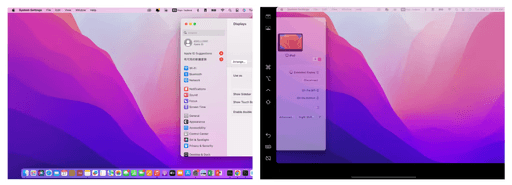
MacBook Screen (Kaliwa) at iPad Screen (Kanan)
Ang Apple Sidecar ay sumusuporta lamang sa mga Mac na inilabas pagkatapos ng 2016 at iPadOS13 o bago. Kung gumagamit ka ng lumang Apple device o Windows device, maaari mo pa ring gamitin ang DeskIn remote software upang gawin ang screen extension. Sinusuportahan nito ang paggamit ng iPad bilang pangalawang display para sa Mac at Windows, at ang smoothness ay hindi mas mababa sa sidecar.
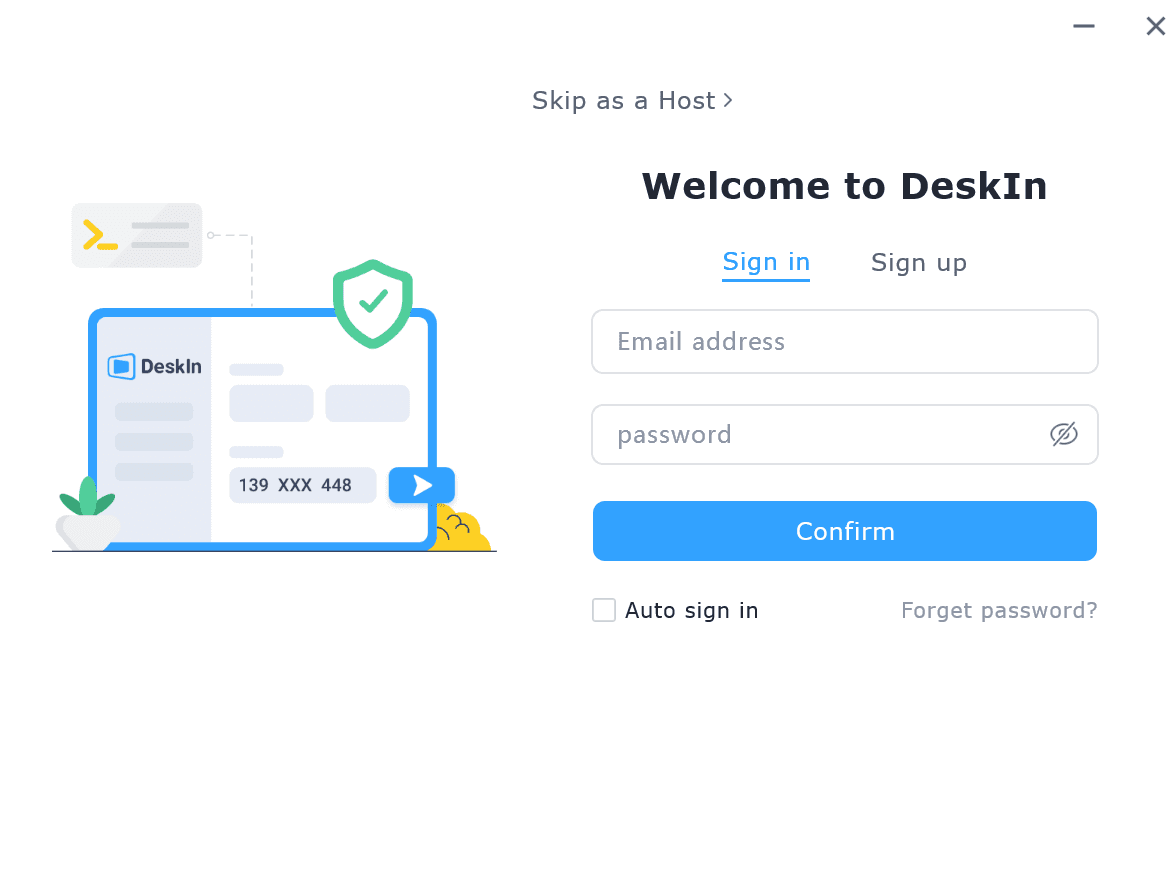
I-download ang DeskIn sa iyong computer at iPad, magrehistro para sa isang libreng account at mag-log in nang hiwalay.

Paalala: Sa iyong unang pag-log in sa isang bagong device, kailangan mong kumpletuhin ang email verification, na naglalayong protektahan ang seguridad ng iyong account.
Buksan ang DeskIn app sa iyong Windows/Mac computer >> Pumunta sa "Screen Mgt" Tab >> I-click ang "Extend my screen"
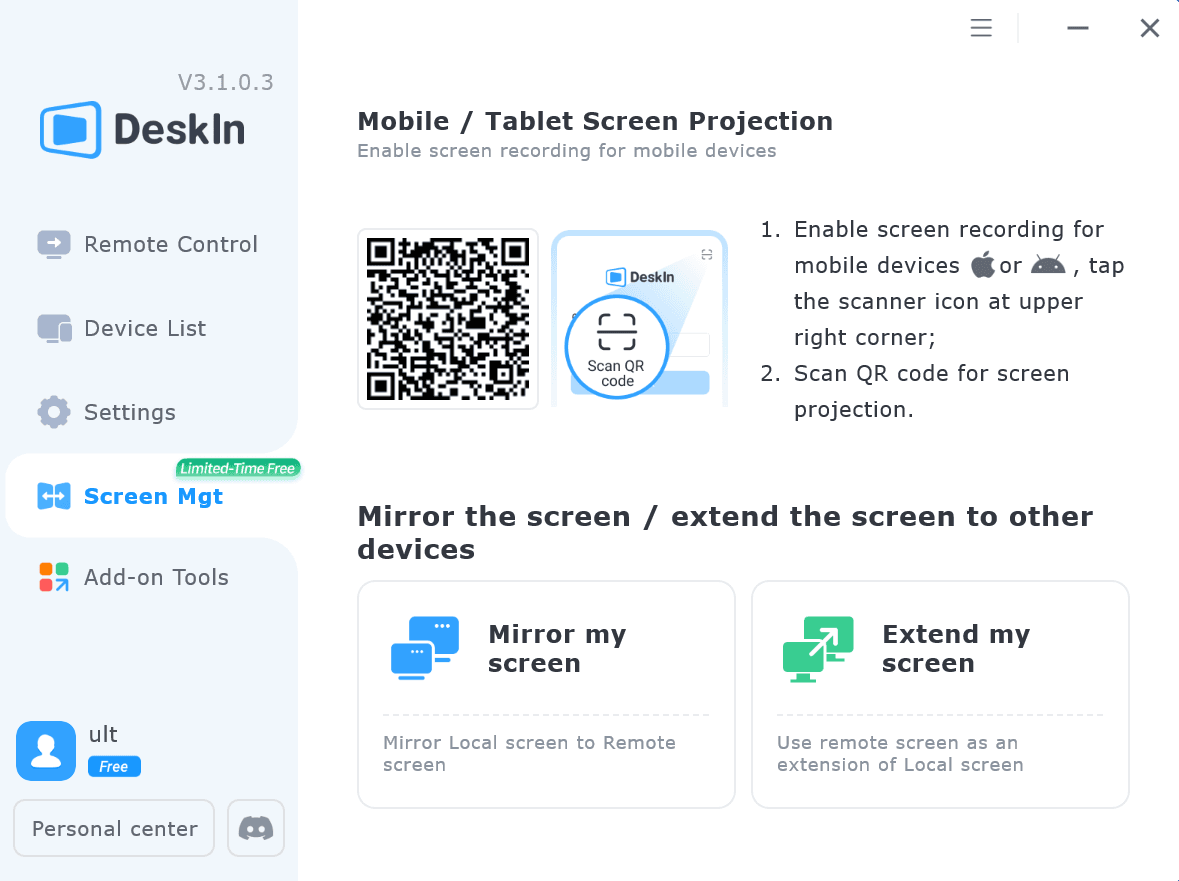
Piliin ang iyong iPad, at i-click ang "Start Extending". Kapag nakakonekta, ang iyong iPad ay magiging pangalawang display ng iyong Windows/Mac computer, maaari mong ilipat ang mga bintana sa pagitan ng dalawang screen na para bang nasa isa lamang ito.
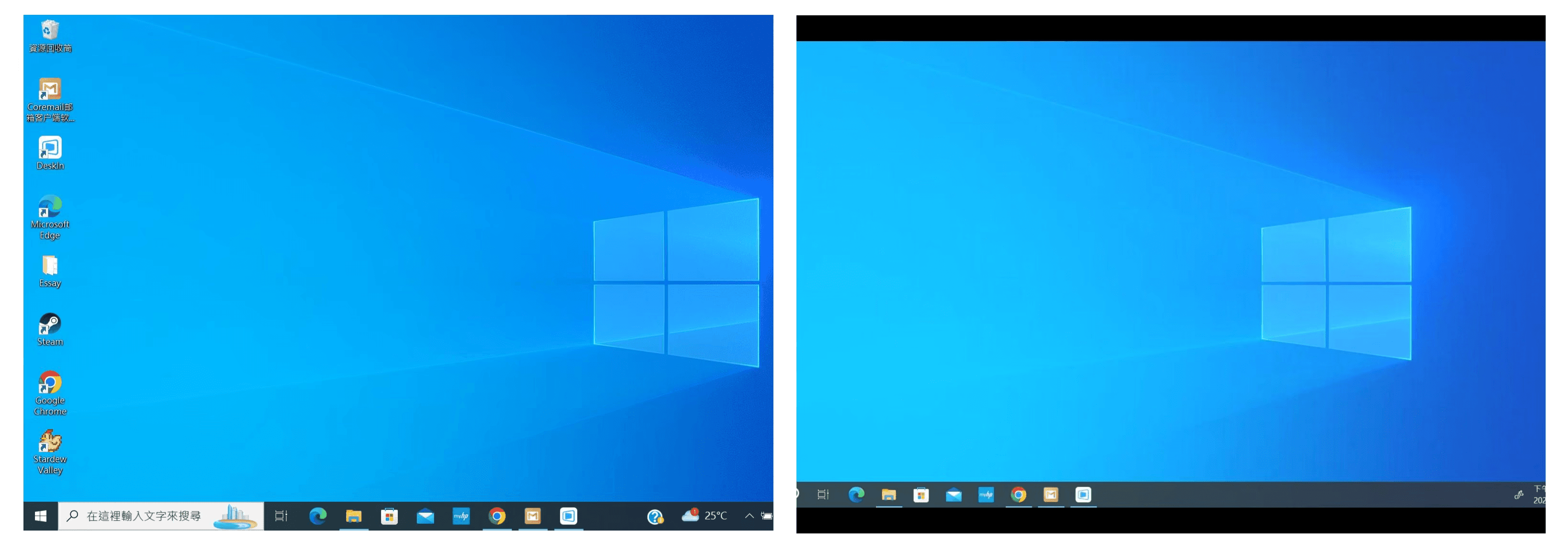
Computer Screen (Kaliwa) at iPad Screen (Kanan)
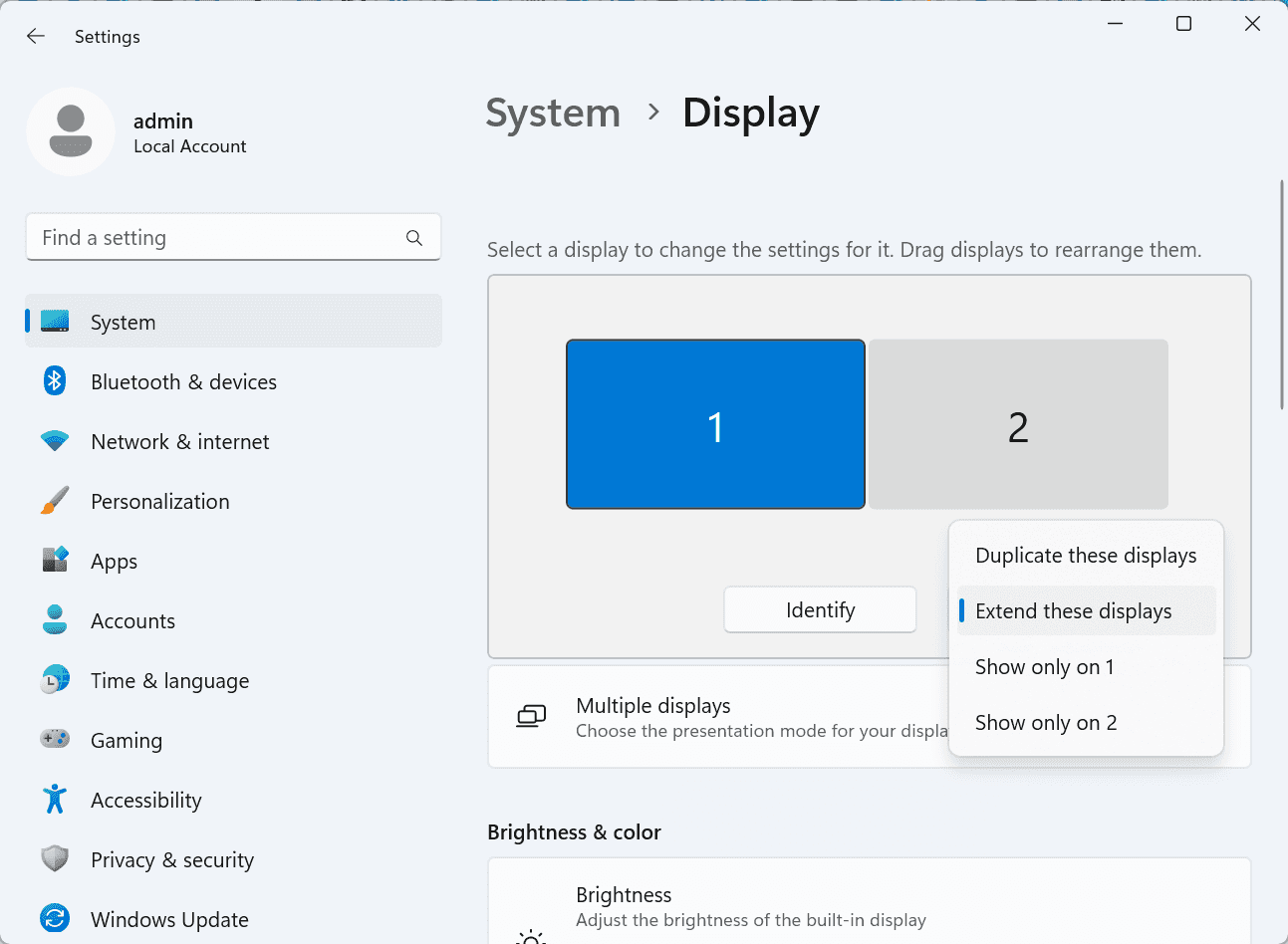
Matapos ang extension, kung napansin mong ang iyong iPad ay nagmi-mirror lamang ng nilalaman sa iyong computer screen, mangyaring pumunta sa Windows System Settings >> Display Settings at baguhin ang screen option sa "Extend these displays". Maaari mo ring baguhin ang posisyon ng screen sa pamamagitan ng pag-drag ng 2 screens.
Ang artikulong ito ay nagpapakita kung paano gamitin ang DeskIn remote desktop software upang gawing "pangalawang screen" ang isang iPad para sa Mac at Windows computers. Ito ay lalong kapaki-pakinabang para sa mga tao na kailangang hawakan ang maraming gawain nang sabay-sabay at nais na mapabuti ang productivity. Kung naghahanap ka ng screen extension tool na gumagana sa iyong MacBook, iPad, Android Tablet at Windows PC, ang DeskIn remote desktop ay ang pinakamainam na solusyon para sa iyo. I-download ang DeskIn at subukan ito ngayon!
How to Play MapleStory Classic World on Mac
A lot of the players who are most excited about MapleStory Classic World grew up on 2005-era MapleStory — and a large share of that generation now does its computing on a MacBook. Nexon clearly knows this: a native macOS client was on the feature list for the second Closed Online Test, which ran August 4–12, 2026, alongside Ossyria and third job advancement. But as of this writing, that Mac client is still in development, not publicly available, and there's still no confirmed public launch date for the game itself.
So if you want to play MapleStory Classic World on a Mac right now — or want a reliable plan for when the game does launch — you've got two real options: run Windows in a virtual machine, or use DeskIn remote desktop to control an actual Windows PC from your Mac. This guide covers both, including a login-conflict issue that catches a lot of virtual machine users off guard.
Not yet, publicly. Nexon's May 2026 roadmap update confirmed macOS support is in development, and it appeared as a testable feature in the second Closed Online Test. Windows PC remains the confirmed launch platform, and Nexon hasn't said whether the Mac client will be ready at launch or arrive afterward. The game hasn't had a full public release on any platform — Nexon has said one more test is planned before launch.
Given that, Mac players currently have two ways in: a Windows virtual machine, or remote desktop software that connects to a real Windows PC.
Classic World is exclusive to GMS (Global MapleStory), covering North America, Europe, and most other regions without a local Nexon partner. Markets with their own official MapleStory service — Korea, China, Japan, Taiwan/Hong Kong, and Southeast Asia — aren't GMS-eligible, so Mac players in those regions would need a VPN to reach Classic World, which isn't recommended. Whether NA and EU will run as separate worlds hasn't been confirmed.
Tools like Parallels Desktop or VMware Fusion let you run a full Windows install inside macOS, and then install MapleStory Classic World the way a Windows user would. It works, but it asks a lot of your Mac's hardware.
RAM: 16GB minimum recommended; 8GB is genuinely tight, since macOS and Windows are both running at once and macOS alone can eat most of that before Windows gets a share. For a comfortable setup with guides or Discord open on the side, aim for 32GB.
CPU/GPU: Virtual machines can't pass hardware through at 100%; graphics get software-emulated, which typically costs 20–30% of the performance you'd get on native Windows hardware.
Thermals: Running two full operating systems under load generates real heat, and laptop-class Macs with limited cooling can throttle during longer grinding sessions.
Apple Silicon translation overhead: M-series Macs can only run Windows on ARM in a VM. If Classic World ships as an x86/x64 build, it needs an extra translation layer to run at all, stacking on top of the virtualization overhead already mentioned.
Anti-cheat compatibility is a real unknown: the original MapleStory has historically been hostile to virtualized environments because of its anti-cheat system, and Nexon hasn't said how Classic World's anti-cheat will treat VMs. Treat virtualization as a maybe, not a guaranteed plan.
There's also the practical overhead: setting up a VM means downloading a Windows image, allocating dozens of gigabytes of disk space, installing display drivers, and — on Apple Silicon — dealing with ARM compatibility quirks that don't show up on a real x86 PC. Keyboard shortcuts can also conflict, since macOS system shortcuts (Control, Option, Command) don't always play nicely with a Windows game's default keybinds.
Instead of building a Windows environment inside your Mac, DeskIn lets you connect directly to a Windows PC you already have — your desktop at home, a work machine, or a spare laptop — and control it from your Mac in real time. The game runs on genuine Windows hardware the whole time, so there's no emulation tax, no ARM translation layer, and no anti-cheat guessing game.
A virtual machine makes sense if:
You don't have access to any Windows PC at all, so a Mac VM is your only option.
Your Mac has strong specs — 16GB+ RAM, ideally 32GB, and a higher-end M-series chip that can absorb the performance loss.
You're comfortable with a fairly technical setup process.
You rarely need to switch between devices, so the single-login limitation isn't a practical issue for you.
DeskIn makes more sense if:
You already have a Windows PC (or another Mac) that can run MapleStory Classic World, and you just want to reach it from your MacBook.
You're traveling or away from your desk often and want to pick up where you left off without re-downloading anything.
You don't want to deal with logging out of one device every time you switch to another.
Your Mac has more modest specs, and you'd rather not risk stutters, crashes, or a game that won't launch at all.
If you already own a Windows machine, DeskIn is generally the lower-effort, lower-risk choice. A VM is really a fallback for players with no Windows access and a Mac powerful enough to absorb the overhead.
Step 1: Set up the Windows PC. Install MapleStory Classic World on a Windows PC and create your character, then install DeskIn on that same PC, sign in, and enable unattended access with a connection password so you can reach it later without anyone at the keyboard.
Step 2: Install DeskIn on your Mac. Download the macOS version of DeskIn, sign in with the same account, and your Windows PC will appear in your device list.
Step 3: Connect. Select the PC, enter the connection password, and you'll get a live view of the Windows desktop that you control with your Mac's mouse and trackpad — the same session, the same login, no conflicts.
Step 4: Tune quality for your connection. On a stable connection, push quality up to enjoy Classic World's remastered pixel art in full detail; on the road, prioritize smoothness to cut down on input lag.
Step 5: Log in and play. Open the game inside the remote session and log in as usual — grinding, party quests, and shopping all work exactly as they would sitting at the PC directly.
Resolution and quality: Free-tier users should start around 720p/30fps for a stable baseline; paid-tier users can push up to 4K 60FPS or 2K 240FPS on a strong connection to get the most out of Classic World's art.
Screen scaling: If your Mac and Windows PC have very different display sizes, use DeskIn's automatic scaling option in the toolbar, or adjust the remote PC's resolution to match your Mac's screen more closely.
Keyboard and mouse mapping: DeskIn maps your Mac's keyboard directly to the remote PC. Turning on Game Mouse mode prevents the keyboard from getting locked mid-session.
Controller support: If Mac keyboard controls feel awkward, pair a controller to your Mac and enable controller mapping from the toolbar — DeskIn will pass those inputs straight through to the remote PC.
Simple Setup:No Windows installation required — connect and start playing within minutes.
Doesn't tax your Mac's hardware. All the actual computation happens on the remote Windows PC; your Mac just displays the stream and sends inputs.
Performance and compatibility match native Windows, because that's exactly what's running — no ARM translation layer to worry about.
No account login conflicts, since DeskIn connects to the same existing session instead of creating a new device.
Cross-device flexibility. The same account lets you connect from Mac, iPhone, iPad, or Android, and it's always the same underlying session — no juggling logins between devices.
Not publicly yet. Nexon has confirmed a macOS client is in development and tested it in the second Closed Online Test, but Windows remains the confirmed launch platform and no public Mac release has shipped.
Yes. DeskIn uses end-to-end encryption and two-factor login, and since you're remotely operating a PC you already control, your credentials never pass through a third party.
Technically you can install one, but the experience will be rough. With 8GB split between macOS and Windows, there's very little left over for Windows, and stutters or crashes become likely during longer sessions. DeskIn is the more stable option here, since the remote PC handles all the processing — your Mac's RAM isn't a bottleneck.
Real-world performance depends on both ends' network quality, but since DeskIn connects to native Windows hardware with no virtualization overhead, and its low-latency streaming keeps end-to-end delay under 40ms on a good connection, it typically feels smoother than a resource-constrained VM.
No. DeskIn controls the same PC and the same already-active session rather than logging in as a new device, so it doesn't trigger MapleStory's single-session login limit — this is exactly the conflict that trips up VM users switching between two separate Windows installs.
DeskIn needs a Windows (or other supported platform) machine to connect to. If you don't have one, consider borrowing access to a friend's or family member's PC, or renting a cloud Windows machine as your connection target.
DeskIn supports Windows, macOS, iOS, and Android. A Mac can connect to a Windows PC, and a Windows PC can just as easily connect to and control a Mac.
MapleStory Classic World doesn't have a public Mac client yet, but that doesn't mean Mac players have to gamble on a resource-hungry virtual machine and hope the anti-cheat cooperates. If you already have access to a Windows PC that can run the game — or even another Mac — connecting to it through DeskIn gets you native Windows performance, none of the virtualization overhead, and none of the account-login headaches that come with running a second "device." Set it up once, and you'll be ready to log in the moment Classic World opens its doors.
How to Play MapleStory Classic World on Mobile Before the Official App Arrives
MapleStory Classic World has turned into one of the most-searched topics in the MapleStory community this year. Nexon's pre-Big Bang server pulled in roughly 5,000 players for its first Closed Online Test back in April 2026, and thousands more signed up for the second test that ran August 4–12, 2026. With Ossyria, third job advancement, and controller support now confirmed, interest has never been higher — and a lot of that interest is coming from players who want to know one thing: can you play MapleStory Classic World on your phone?
Short answer: not with an official app, not yet. This guide breaks down exactly what Nexon has confirmed about platforms so far, then walks through how DeskIn remote desktop lets you play MapleStory Classic World on mobile right now, without waiting on an app that hasn't been announced.
As of this writing, Nexon has not announced a mobile or console version of MapleStory Classic World. The confirmed platforms are Windows PC and macOS — macOS support was specifically added as a testable feature during the second Closed Online Test in August 2026, alongside Ossyria and third job advancement, but it's still listed as "in development" rather than publicly available.
There's also no full public launch date yet. Nexon has run two Closed Online Tests so far and has said one more test is planned before release, so most community trackers currently estimate a launch window in late 2026 or early 2027 — but that's community speculation, not an official date.
Put simply: if you want to play MapleStory Classic World on a phone or tablet today, a native app isn't an option. The only practical route is streaming the PC version from a Windows machine you already have access to.
Classic World is exclusive to GMS (Global MapleStory), Nexon's English-language service for North America, Europe, and most other regions without a local Nexon partner. Players in markets with their own official MapleStory service — Korea, China, Japan, Taiwan/Hong Kong, and Southeast Asia — aren't eligible for GMS accounts, so Classic World isn't accessible there without a VPN, which isn't recommended. It's not yet confirmed whether NA and EU will run as separate worlds within Classic World.
DeskIn is a cross-platform remote desktop app built specifically with PC gaming in mind, and it maps well onto exactly the problem MapleStory Classic World mobile players are trying to solve.
Stable, low-latency connections. DeskIn's ZeroSync® engine keeps end-to-end latency under 40ms on a good connection and automatically reroutes around congested paths, so grinding, dodging, and skill combos in Classic World's classic-era combat don't feel delayed.
Up to 4K 60FPS / 2K 240FPS streaming. Classic World's remastered pixel art holds up well when it isn't compressed into mush — DeskIn's streaming keeps text and sprites sharp even on a phone screen.
You're connecting to your own PC, not emulating one. DeskIn doesn't run Windows inside your phone; it streams the display of a Windows computer you control and sends your inputs back in real time. That means full compatibility and full performance — no emulation layer to fight with.
End-to-end encryption and two-factor login. Sessions are encrypted end-to-end, and you can set an allowlist of authorized devices, so only you can connect to your own PC.
Flexible, per-character keybinds. Classic World's Warrior, Magician, Bowman, and Thief classes each use very different skill layouts. DeskIn's on-screen game keyboard lets you build a custom key layout and save it as its own profile, so you can switch between characters without re-mapping keys every time.
Built-in virtual mouse. In pointer mode, DeskIn adds virtual left/right mouse buttons over the stream, which makes precise UI clicks — inventory, cash shop, trade windows — far easier than tapping blindly on a touchscreen.
Once you're connected, mobile play through DeskIn covers pretty much everything you'd do sitting at your PC:
Daily quests and login rewards — knock these out on your commute instead of waiting until you're home.
Cash shop browsing — scroll and preview cosmetics with touch gestures just like any shopping app.
Grinding and leveling — use the virtual directional pad and skill-key layout to keep training in familiar maps.
Party quests — latency low enough to keep up with a party's pacing on runs like Kerning City PQ.
Trading and the marketplace — check prices and list items using the virtual mouse for precise clicks.
Guild chat and messaging — reply to your guild or party the moment something comes up.
Step 1: Set up DeskIn on the Windows PC running Classic World. Install DeskIn on the PC where you've registered for testing (or where the game is installed once it launches), sign in, and turn on unattended access so the PC can be reached without anyone sitting in front of it.
Step 2: Install the DeskIn app on your phone. Download DeskIn from the App Store or Google Play, sign in with the same account, and your PC will show up in the device list.
Step 3: Connect and switch to pointer mode. Tap your PC to connect, then switch the control mode from touch to pointer — this unlocks the customizable virtual keyboard and virtual mouse.
Step 4: Browsing the cash shop. Drag to move the cursor and tap the virtual mouse buttons to click through menus and item previews, exactly like using a mouse on a desktop.
Step 5: Grinding. Open the game keyboard menu, build a layout with your movement keys and skill keys, and save it as a profile. Pull it up any time you start a grinding session.
Step 6: Pick the right streaming quality for your connection. On mobile data, prioritize smoothness over resolution to cut down on input delay; on Wi-Fi, bump the quality up to enjoy Classic World's remastered art at full clarity.
A tablet's bigger screen is a natural fit for content that needs either more reading room or more precision — daily quest text and boss encounters both qualify.
Step 1: Same setup as mobile. Install DeskIn on your iPad or Android tablet and sign in — connection steps are identical to the phone app.
Step 2: Daily quests. The larger display makes quest text, item descriptions, and map markers easier to read at a glance, so you're less likely to misread an objective mid-run.
Step 3: Boss fights. Bosses demand precise dodges and timing that touch controls alone can struggle with — pair your tablet with a Bluetooth keyboard and mouse, or a controller (see below), instead of relying on the virtual keyboard.
Step 4: Bump the frame rate for boss content. Choose a higher refresh setting in DeskIn's connection options so skill telegraphs and boss patterns read clearly in real time.
Step 5: Use split-screen for guide lookups. Run DeskIn alongside a browser or notes app in split view to check attack patterns without leaving the fight.
If virtual buttons don't feel precise enough, DeskIn supports Bluetooth controllers, including Xbox, PlayStation, and several third-party pads.
Step 1: Pair the controller with your phone. Use your phone's Bluetooth settings to pair the controller first.
Step 2: Connect through DeskIn. Once connected to your PC, DeskIn automatically detects the paired controller — no extra driver install needed.
Step 3: Test your inputs. Head into a training map first and confirm movement, attacks, and skills map to the buttons you expect before jumping into content that matters.
Step 4: Favor smoothness for fast-paced play. When you're actively grinding or fighting with a controller, prioritize DeskIn's smoothness setting over max resolution for the most responsive feel.
Running a Warrior and a Bowman means running two very different skill bars. Here's how to keep them separate in DeskIn instead of re-mapping keys every login:
Step 1: Switch to pointer mode and open the game keyboard menu. After connecting, switch to pointer mode and open DeskIn's game keyboard settings.
Step 2: Create a new keyboard layout. Tap "New Keyboard" and add your movement pad, skill keys, and item keys to match your current character's build.
Step 3: Name it by character or class. Label the layout something identifiable — "Bowman" or "Main Warrior" — and save it.
Step 4: Load the right profile when you switch characters. Before logging into a different character, select its saved layout from the game keyboard menu instead of rebuilding it from scratch.
Step 5: Update layouts as skills change. When a class gets rebalanced or you unlock new skills after a job advancement, go back into that profile and add the new keys.
No. Nexon has not announced a mobile or console version. Confirmed platforms are Windows, with a macOS client currently in development.
Nexon hasn't announced a public release date. Two Closed Online Tests have run so far (April 16–24 and August 4–12, 2026), with one more test planned before launch. Community estimates point to late 2026 or early 2027, but that isn't official.
No. DeskIn remotely operates your own PC and sends the same mouse and keyboard input you'd normally use — it isn't a macro, bot, or memory-editing tool, so it doesn't behave like the automation that anti-cheat systems are built to catch.
DeskIn's low-latency streaming keeps things playable on a stable connection, generally noticeably smoother than trying to force a browser workaround. Real-world latency still depends on both ends' network quality, so Wi-Fi is recommended over cellular when possible.
For checking dailies or browsing the shop occasionally, the free plan typically covers it. If you plan to grind for long sessions, use a controller regularly, or manage several devices, a paid plan unlocks higher streaming quality and additional features.
Setup and connection steps are identical. The difference is screen size — phones are handy for quick, single-hand tasks like dailies and the shop, while tablets are better suited to boss fights and content where you want a controller or external keyboard.
Until Nexon ships a mobile client — if one ever gets announced — DeskIn is the most practical way to keep playing MapleStory Classic World away from your desk. Install it on both your gaming PC and your phone or tablet, set up a keybind profile per character, and you can knock out dailies, grind, and even tackle boss fights without being tied to a monitor.
Products
Download
Resources
Contact Us
Email: support@deskin.io
Office: 991D Alexandra Road #02-17, Singapore 119972
Copyright © 2026 Zuler Technology PTE. LTD. All rights reserved.
Contact Us
Email: support@deskin.io
Office: 991D Alexandra Road #02-17, Singapore 119972
Products
Download
Resources
Copyright © 2026 Zuler Technology PTE. LTD. All rights reserved.
Products
Download
Resources
Contact Us
support@deskin.io
991D Alexandra Road #02-17
Singapore 119972
Copyright © 2026 Zuler Technology PTE. LTD. All rights reserved.
【New User Special Offer】
Save
Extra 20%
on your first order|4K60FPS
Extra
20% Off
|For
New Users
【New User Special Offer】
Save
Extra 20%
on first order


